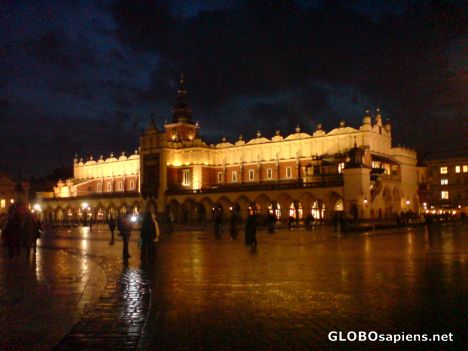
Thursday, July 7, 2011

Bieganski at the Galicia Jewish Museum


On Sunday, July 3rd, 2011, I spoke about my book "Bieganski: The Brute Polak Stereotype, Its Role in Polish-Jewish Relations and American Popular Culture" at Krakow's Galicia Jewish Museum. I spoke as part of Krakow's world famous Festival of Jewish Culture.

I was hosted by a member of the faculty of Krakow’s Jagiellonian University, the second oldest university in Central Europe, after the Charles University of Prague. My host and his family showed me hospitality such as I have rarely encountered. I’ve been lucky enough to travel the world and to experience unforgettable hospitality on several continents, but this family was truly special. I will long cherish the memory of the time I spent in their home. Their open-hearted graciousness and obvious gentility honored the best of Polish traditions of “a guest in the house is God in the house” and belied the pernicious Brute Polak stereotype.

I am more grateful than I can detail here to this professor and his family, and I am also very grateful to the Galicia Jewish Museum. I am proud to have had the chance to participate, in however small a way, in its vital and honorable work of commemorating the life of a vibrant community that was victimized by an unspeakable crime.

It's frequently said that fear of public speaking is the number one fear. I do not suffer from it. It's like poison ivy; I walk through woods as often as I can and remain immune to the poison ivy that so threatens my hiking companions. I am at a loss to explain to my students how to overcome fear of public speaking.

The morning of the talk I gave myself extra time to go for a walk. I reminded myself that I would now be speaking in Poland, across a language and culture barrier, to a Polish audience, about the country's most controversial topic, that, in the past, I'd been denounced by both Polish chauvinists and Jewish chauvinists, and that that might happen again today, that the Krakow Festival of Jewish Culture is itself controversial, and that anything could happen. I found that I was feeling my usual pre-talk calm.

I reflected on how every piece of hate email I've ever received -- "You are involved in anti-Polish conspiracies!" "You are a pogromist!" -- helped me to prepare for this moment. I had a potential response for any potential extreme comment.

Krakow, for the past several days, had been experiencing exceptionally cold, wet weather. Something told me that, though it was July, I ought to pack a wool sweater, and I do not regret having listened to this little voice. The day of the talk was soggy and chill and I hoped that that might boost attendance. Someone debating whether to attend the talk or toss a frisbee on a lawn would have more incentive to attend.

I'd written my talk for the museum while still in America, second guessing what aspect of "Bieganski" would work best for a Polish audience. One of my favorite experiences talking about "Bieganski" was a talk I gave for the Unitarian Universalist Church of the Palisades in Englewood, NJ. There I emphasized the American side of the question of Polish and Jewish stereotypes. This talk in Poland would be very different.

I deeply believe in, and am completely committed to, civil and courteous discourse. For that reason, I often don't use visual aids during talks, or I use them minimally. Eye contact is a key feature of human communication. Eye contact would be all the more important when I was addressing an audience for whom English is a foreign language, on the country's most controversial topic.

As I spoke, I maintained eye contact with my audience. I could see that my listeners were troubled by what I was saying. I don’t think anything they’ve heard so far about Polish-Jewish relations prepared them for this material.

After my talk was over, questions from the audience confirmed what I guessed to be true from eye contact. Audience members expressed shock and outrage. One audience member emphasized how highly America is thought of in Poland. How could American newspapers, films, scholarly books, jokes, say such things about Poles? Don’t Americans really know what happened in Poland?

Audience members from Hungary expressed appreciation for a scholarly dissection of stereotyping, and wanted to know if scholarship on stereotyping could help them combat rising anti-Semitism in Hungary. I am not in touch with anyone actively resisting anti-Semitism in Hungary, and have no resources to offer these good people. If anyone reading this knows of any such resources, please mention them in the comments section. I thank you in advance.

Audience members surmised that maybe the problem had been caused by the peasant immigration of one hundred years ago. Maybe now that highly educated and self confident “children of Solidarity” were representational of Poles on the international scene, the stereotype would die off. I politely disagreed, and recommended chapters in the book that talk about the necessity of Bieganski, and why, in my estimation, the peasant immigration cannot be blamed and is not guilty, and why all the highly professional Polish immigrants in the world will not eliminate the Brute Polak stereotype. In fact, one of the informants for “Bieganski” plainly stated that all the Polish-Americans she knew in real life were urban dwelling, highly educated professionals, and yet she still thought of Poles as rather brutish peasants.

In short, audience reaction shows that “Bieganski” is as poet John Guzlowski titled his Amazon review, “A Necessary Book.”

Now the not so good news. Attendance for the talk was small. I am grateful for every audience member, and for the obvious intellect, integrity and compassion shown by each audience member in his or her comments. But audience members themselves said, some rather heatedly, “This should have been better attended. This should have been more widely publicized. This needs to be discussed by more people.”

One Pole said to me, “When Jan Tomasz Gross was here, he received as much advertising as a McDonald’s hamburger.”

I am sure that many factors are at work. I want to say this, though, and there is an important reason for saying it.

I mentioned to an internet group devoted to discussion of Polish matters that I’d be traveling to Poland soon, and would be available to talk about “Bieganski.” An official of at least one prominent, national Polish-American fraternal organization, local Polish clubs, and the Polish embassy were members of that group. None of them offered any contacts to arrange a speaking venue. None offered any help to publicize my talks.

The talks I will deliver in Poland have been made possible by a friend of mine, a university professor of Polish-Jewish descent.

This is why I mention this: I have seen a minority of Polish Americans mention on internet discussion groups something like the following: “No one tells the Polish story. Everyone tells the Jews’ story. Poles are being mistreated. Jews have much power. Poles have no power.” Again, those who voice such statements are a minority, but a consistent minority in online Polish-interest discussion groups.

My point is this: “Bieganski” has been supported by Jews. The most significant support I received for speaking engagements during this trip to Poland came from a scholar of Polish-Jewish ancestry and a Jewish museum. The Jagiellonian University professor hosting me is Polish Catholic, and my first hostess was Polish Catholic. Poles in Poland did their part.

My experience has consistently belied the stereotype of Jews as having too much power, or the stereotype of Jews as blocking scholarship pertinent to Poles. I cannot accept comments that further the stereotype of Jews acting as a monolithic group to consistently block Polish scholarship. Rather, I recommend that concerned Polish Americans unite, behave in a civil manner with each other, support each other, and act strategically. To the extent that that is already happening, bravo. May it increase.

Saturday, July 2, 2011

Rescue "General Nil" ! A Movie More People Should See!

Olgierd Lukaszewicz as Emil August Fieldorf in "General Nil."

Emil August Fieldorf is one of the most inspirational combat heroes of World War II. He fought against both the Nazis and the Soviets and planned the 1944 execution of SS Police Leader Franz Kutschera. Fieldorf's life and his death defy comfortable narratives, though, and his story is largely forgotten.

"General Nil" is a 2009 film based on Fieldorf. "General Nil" is graced with unimpeachable production values, an unforgetable, heartbreaking and bracing central performance by Olgierd Lukaszewicz, and a story that needs to be told. Right now, though, it is almost unknown, and available in limited DVD versions.
 
I sat down to watch this movie knowing what hardcore film fans don't want to know: the entire plot, and ending, of the movie. And I knew it would be an uhappy ending. What's amazing about "General Nil" is that director Ryszard Bugajski managed to make a movie-movie, a genuinely – I have to say this -- entertaining and aesthetically pleasing film about the worst crimes humanity has committed, and the victims of the worst monsters.
 
I finished this film feeling not at all depressed or crushed as I expected, but with the feeling of satisfaction that a masterful film can create in its viewers. In this, "General Nil" is comparable to "A Man for All Seasons." Paul Scofield plays St. Thomas More, a main character every viewer knows is going to die, crushed to death by historical conflicts beyond his control. Even so, it's a great film, and one you love having watched after you've finished.
 
"General Nil" offers the eye candy film fans demand: aesthetically composed, interesting images: a train chugging off to the snowy wastes of Siberia, vintage 1940s and 1950s clothing, hairstyles and automobiles, on-location architecture and interiors. It also offers intrigue and insights into real historical events of world historical importance: young and gorgeous Polish Home Army, or Armia Krajowa soldiers carry out the assassination of a Nazi villain; Poles debate their fate as they await aid from their allies, the United States and Great Britain.
 
In spite of its epic sweep, the film offers the intimate moments we go to movies to see. Fieldorf, back from Siberia, finds a 78 rpm record that somehow survived the war. He puts it on an old victrola, and reminds his wife of an easier, luckier night from their past, when they were able to dance and flirt and not worry about tomorrow. Then, these two wrinkled, wounded people – wounded inside and out – force their bodies through romantic dance movies. In this attempt at romance, and even love, in spite of all they have been through, Fieldorf and his wife are as brave as any two characters could be.
 
Fieldorf is seen in a vile Soviet dungeon alongside other Home Army veterans – and a notorious Nazi. It was the Soviet's perverse plan to equate Polish Home Army veterans with Nazis: of course: up is down, wrong is right, and the Party decides all. Even in that setting, pregnant with historical significance, the director does not forget to create a small, human moment. Fieldorf's response to the Nazi, once on his hit list, now his fellow prisoner, results in one of the film's most touching and challenging scenes.
 
„General Nil's” Soviets are appropriately reptilian, including Helen Wolinska Brus, the Stalinist judge who condemned Fieldorf to death, and Jozef Rozanski, a torturer who manages to appear ready for a cocktail party set to Cole Porter tunes after a workday of blowing out the brains of heroic Home Army veterans. Rozanski was a real person, and a real torturer, having tortured some of the finest human beings who ever lived, including Witold Pilecki.
 
Fieldorf is not depicted as perfect. He doesn't know how to do the right thing for his wife and children, and it's not clear, in any case, what the right thing might be. When approached by a hot blooded young Home Army veteran who wants to continue the war they'd fought against the Nazis, only now against the Soviets, Fieldorf raises his hand to slap the younger man's face, but, when he makes contact, all he can do is caress the younger man, and then walk away, silent, shoulders slumped, his posture an acknowledgement of Poland's doomed fate after being betrayed by her American allies, the United States and Great Britan, at Yalta.


I thought I'd be biting the bullet throughout this film, thought it would be like a visit to the dentist – painful but good for you, something you're glad when it's over.
 
In fact the film was gripping and rewarding to watch, and … did I say that there is an unhappy ending? Maybe … and maybe not. Fieldorf was a man, a real man, and, in this, he was utterly victorious. Spending two hours with him was my good fortune.
 
PS: „Bieganski” mentions Helen Wolinska Brus, the Soviet judge who condemned Fieldorf to death. Poland asked England to extradite her in order that she might face justice for her crime. She never did. She said she refused to return to Poland, „the country of Auschwitz.” „Bieganski” provides the context necessary to understand her comment. 

And one more PS: I owe great thanks to my superb hostess here in Poland, Malgorzata, without whom I would have remained unaware of the existence of this not-to-be-missed film.  

Friday, July 1, 2011

Late Night Hello from Poland


It's late at night, for me, Poland time, and even later at night, for me, New Jersey time. I'm a morning lark, not a night owl, and this computer I have temporary access to appears not to have miscrosoft word installed, so I'm typing this on the blog screen. It's underlining every word in red because, as this computer sees things, these are misspelled Polish words, not properly spelled English words.

I am dyslexic and rely heavily on spellcheck. Will I expose my inability to spell to all five of my blog readers with this one post? 

I am tempted to avoid posting a hasty and inconclusive update from Poland -- would it not be more prudent to wait till I get back and have the entire trip under my belt, and can craft a prepackaged product, not initial, slam bang in the face ramblings of someone still experiencing jet lag?

What I've found, over the years, though, in my travels, is that I often record in my diary an impression that later fades into oblivion, or is purposely edited out of the received narrative, the official story, the predigested truth. 

A month from now, will I remember how excited I feel right now, tonight, how honored I feel to be alive, how ... thrilled, and how much I am feeling that old childish love for Poland -- a love that is not my entire story, one throbbing peach of love -- (see, if I had microsoft word and time at my disposal, I could just type that absurd figure of speech and go back later and massage it into something less passionate and weird) -- but, rather, I feel that little girl's love for the land of spiritual swashbucklers and street demonstrators and people "just like my parents!" is the core, and around that core are layers and layers of life and realizations and memories and hopes and plans and disappointments and yet it beats, that unmanageable figure of speech, that -- that throbbing peach of love!

I posted a while back about a book, "Lost Between Worlds," that addresses WW II from the point of view of a Polish Jew who kept a diary while everything was happening. He didn't know the final outcome. And so you get his fresh impressions. Very valuable.

So, even though it's risky to post well past my bedtime, and without spellcheck, I have to talk. 

Random stuff, no time to massage it into a coherent narrative:

My current host, an excellent human being, took me to a very soignee party put on by the American Consulate. Everyone was beautiful, handsome, talented, and well dressed. I just loved standing in a room full of Poles who were all beautiful, handsome, talented, and well dressed. If you are Polish American, if you have read my work, I don't have to say anything else. You completely understand. 

Rabbi Schudrich was there, and Barbara Kirshenblatt Gimblett, and a Rabbi in very traditional Hassidic dress. 

A Marine band played the Star Spangled Banner, and I stood at attention. It next played, without a stop in the music, Jeszcze Polska Nie Zignela, and it was all I could do to keep from crying. 

After an hour of just soaking up all the Polish beauty and talent, I saw a man I felt I absolutely had to speak with. I had not approached anyone on my own; rather, I followed my host's lead on whom we chatted with. But, this man  -- I just had to had to talk to him. I excused myself from my host, and crossed the room, and walked up to this man.

We chatted for a few minutes and suddenly I realized -- I had met him in 1988-89, when I was living in Poland. Back then, I and my friends thought he was a spy. I still think he was a spy. But it was very nice to run into him at the party. And rather amazing.

I just can't help comparing the Poland of today not only with the Poland of my first visit, but with the Slovakia my mother and I returned to in 1974. That was just a few years after the Soviet tanks rolled in to crush the Prague Spring of 1968. I remember buses taking rest stops and passengers relieving themselves in the trees, my Aunt and Uncle who were non-persons, because of his political stands -- she had been gang raped by Red Army soldiers and bore lifteime scars --  my other uncle stopping a conversation, in his own home, an isolated village cottage, and saying to us, "Don't you know anyone can be listening to what you are saying?" The priest in the village who had been horribly tortured and sent back as a warning. The Soviet posters everywhere, which my mother translated to me as, "Big Brother Is Watching."

That is so much not the Poland I am in now. That is a layer, but not the whole story. 

I want to engage in another embarassing, over-the-top figure of speech --  I feel as impressed with today's Poland as I felt by the Himalaya. The Indian subcontinent crashes into Asia and pushes up the earth and the tallest mountains are formed. Poles and other good peoples were crashed into by Nazism and Communism and they pushed and they pushed and they pushed and slowly, sometimes impercetibly, sometimes with cymbals, they made history. And then they went to parties like the one I attended tonight, and stood around looking suave and can't-touch-this gorgeous.

I first learned of my people's tragic fate through very thin, red, white and blue, "Par Avion" air mail. My mother kept in touch with her family. We can't send them this or that. They can't do this or that. We can't visit --  not yet. Why, why, why? The Germans did this. The Russians did that. And nothing can change any of it.

When you are a little American kid, it's something to have relatives like that. Americans could, in those expansive days, have or do anything. Our family? An alternate reality. 

And that alternate reality is now gone. I just keep repeating this over and over again when I look at young people -- they don't remember communism. And when I look at people my age -- they don't remember World War II.

This is a different world. And it's all wonderful. You see history. One of the great parts of getting old is that you realize that you don't have to answer all the questions, or, maybe, frankly, any of the questions. Kids today will not have to answer why Mommy can't go back to the country she was born in, or why we can't send Uncle Jan that American product he liked so much the one time he tried it. My burning childhood questions have evaporated. The story has not evaporated. It keeps getting told. 

I remember the painful disconnect between me and my American siblings, growing up in the world where "everything is possible and nothing matters," and my Bohunk parents, from the world where "Nothing is possible and everything matters." 

My parents worked so damn hard -- my mother often two full-time manual labor jobs in one day -- and were so poor, and so limited in their choices. We American kids looked at them and thought, at time, what dummies are parents were. My brothers sometimes worked with my father, caddying. They were troubled by how rich American men treated my father. It wasn't till I was older, and American academia did me the favor of slamming every door in my face, no matter how hard I worked, no matter how well I met their demands, that I realized my parents' heroism, and logic.

America is flooding Poland now: glass and steel, shopping malls, advertising, and the internet porn, of every species, that drowns us all. Will young Polish kids conclude, or be brainwashed into thinking that, everything is possible and nothing matters, and that their ancestors, who sacrificed so much for a steady food supply for their families, or the right to speak Polish or raise a Polish flag, were a bunch of clowns? Or heroes impossible to emulate? Or so distant as to be worthy to be forgotten? 

I hope these matters play some role in Polish kids' questions, and if they don't, that's great. I'm just glad I got the chance to ride some of this wave. 

Wouldn't it be great if, on some future date, the questions that lead to "Bieganski"similarly evaporate? If Polish kids and Jewish kids look back and say, "Wow, in the past there was so much hostility and misunderstanding. Hard to believe that."

So much of my earlier trips to EE were about dialing down consumerism. Consumerism is now here. I ask myself, while riding the escalator in a shopping mall, am I in Poland? Or America? A question of essences. Anyone who wants to answer this for me, please raise your hand.

Hospitality. I have been shown the finest hospitality on this trip. "A guest in the house is God in the house." I don't want to risk embarassing my hosts by naming them publicly in this post, but they honor Poland. I'm so touched. 

One last thought: a group of citizens should really get together and do something about the signage, especially in Krakow. Billboards and neon signs screwed into centuries-old buildings defeat their stated purpose. Beauty sells. 

Monday, June 20, 2011

Poland. Leipzig. Turkey. Travel. Food. Love. And ... New Jersey.


Leaving Poland, Summer, 1989. A Letter Written to Friends, Stored, and Re-Read in 2005

Right before leaving Poland, I got sick. The disease was sudden and ugly. I was covered with pus-filled sores. I had so much to do before leaving. I had to abort my list. The disease set the agenda for me: ten days on my back, sleeping or staring.

When Nancy came by to pick up her bird, for which I had been pet-sitting, she fixed me with a look. She came back a couple of hours later, her baby on her hip. "Let's go," she announced, "I'm taking you to a doctor." It was a national holiday. Everything was closed. She had "zalatwicz-ed" an appointment for me with the colleague of a friend.

As she was driving me home, I expressed a lack of confidence in the doctor I saw. In spite of her being busy with a move to a new apartment, and in spite of the potential danger I posed to her baby, she drove me to another doctor after nightfall.

Alicja, in spite of possible contagion, washed my sheets, brought me homemade soup, and sat with me every night. She also gave me difficult-to-acquire medicines. Anita visited often and made me laugh. Tenia whizzed in and out with cartons of yogurt. My next-door neighbors arranged meetings for me with two more doctors, one of whom visited a couple of times, never asking for payment. Witek fetched some powdered medicine for me from the pharmacy, mixing it up in water and encouraging me to drink it. During his visit, the sores in my mouth and throat that had been bothering me very much popped and never returned.

Poles and Polish-Americans in Poland treated me with a care and attention I had never received in the U.S. when sick. Does Poland's self-declared status as a crucified nation make its citizens mindful of the vulnerable pocket in our souls?

A completely unexpected wave of sentiment and respect for Poland possessed me. For the past year, I had been one of them, these people I watched from my tram window, my ticket in my pocket. I, too, had jostled in line, had, with the focus of a barracuda, stalked shops; I had been blindsided by purse-wielding buffalo in my desperate attempts to score a seat on the trams. I had drunk tap water that Scientific American had deemed unfit even for industrial use; I had mouthed cynicism but secretly hoarded hope that something like the seventeenth-century miracle at Bright Mountain might happen again, and all the bogeymen in Poland might be made to leave with the waving of the Madonna's smoke-darkened icon. I had marched and chanted lunatic, swashbuckling slogans like, "Wilno is ours!" and, "We want Afghanistan to happen here!" I had had no patience for Poles because I felt I was one of them, and it was my toes they were squashing, goddamnit.


Seventy-two hours before I left, I realized that I wasn't one of them, after at all. There was a very good reason why I could float past the security guard at the American consulate, my flat New Jersey accent key to an entry that the crowds fidgeting or fighting outside – the women all tricked up, the peasants in their Sunday clothes, their suits with potato-digging hands at the ends of the sleeves – might never possess. I was about to be lifted out of this punishing reality as if by divine helicopter, and they would stay, those I observed from my tram window, the "stare babki," old grandmothers, to take up their posts in the lines outside meat shops, the pale children, the proud, always well-groomed women to alcoholic husbands, the young men to making fists, painting placards and shouting; all of them to the vocation of heroism, which is a required course in Poland. They may pass or fail, but none can opt not to take the class.

I would appear by magic in America, a country which I envisioned increasingly as a brightly lit supermarket, where various cuts of meat lay in sterile plastic, which I could calmly approach, inspect, select, pay for, and take home, without standing in a chaotic, serpentine line, a line whose length reminded me that there are only so many cuts of meat on display, and that that number is always smaller than the number of people on line, and if the woman in front of me got hers, I won't get mine. There would be no thwack, thwack of cleaver into messy flesh and firm wood below, no smell, no flies, to remind me that sirloin is not born in Styrofoam. Or sometimes I envisioned America as a dizzying smorgasbord of freedoms and opportunities, and a drunken, giddy sense of not knowing which to exercise first.

Already I began to miss Poland, where I had seen teenage boys drop their backpacks and stand at teary-eyed attention after one of them had struck up the national anthem; where I knew I need never feel hungry because I was always within a few feet of someone, even a total stranger, who, given any prodding at all, would feed me; where, in the middle of a snowstorm, on a remote country road, I could be picked up by a jolly man who, when asked what he did for a living, would merely smile and say, "Listen. This is Poland. Anything is possible."

In America it would not be necessary to "zalatwicz" or "kombinowacz" anything. (The delicate barter of favors, connections, promises; the acquisition of what's necessary through clever daredevilry and complete flouting of how it's supposed to be.) If I got sick, I could call a doctor and make an appointment; my next-door neighbor's heart would be immaterial. If I got sores on my mouth, I could apply the appropriate balm, prescribed by an MD, dispensed from a tube, rather than wait for Witek to show up.


My train left Krakow at 10:22 p.m. Alicja, Tenia, Jim, Gosia, and Steve saw me off. Alicja gave me flowers. Steve handed me a bunch of cattails, an atypically sentimental – for him – parting gift. Tenia, who has lived in the Middle East – her father, an exile, had taken jobs around the world, and around the world, he would ask people if they knew where Poland was, and no matter how they responded, he would pull a map out of his breast pocket and show them – Tenia gave me a silk veil from Arabia. Then she said one of the most moving things I've ever heard in my life.

I've always wanted to feel as if I was combating the darkness. I've only ever taken jobs that really meant something to me. Poland was hard; I was parsimonious in applying any meaning to what I was doing there. Tenia knew this. As the train began to pull away, we were still holding each other. "If you ever wonder why you came to Poland," she began, and then choked up, and couldn't continue. The train was not patient.

"Tell me!" I demanded, my hands tearing away from her body.

"It was to meet me," she shouted, "because you've made a tremendous difference in my life."

I waved and waved, as the goofy neon "Krakow" sign grew smaller and smaller. Suddenly I knew what to do: the Nepali goodbye, and hello. Two hands pressed together. "Namaste," I said, to the figures no longer visible on the distant platform, to the sooty city of Krakow, to the whole heavy Polish karma, which I couldn't take on and would love to shake off. "Namaste," "I salute the divinity within you." Our Lady of Czestochowa would like it.

***

The Romanian border guard was plump, sweaty, prickle-faced; his teeth protruded from his mouth at a forty-degree angle. "Hey, Yankee," he said. "Do you know why Mexicans call you 'Gringos'? Because when the evil Yankee soldier came to beat up the Mexicans and kill their cattle, he was wearing green. So, they yelled at him, 'Green! Go!'" We laughed. My laughter was something of a charity operation, an airlift donation. Suddenly his face grew grim. "What are you reading? We'll have to take a look at that." It was the Arts and Leisure supplement to the New York Times. I offered it to him. "Hey, thanks," he said, suddenly humble. "I could use it to improve my English."

Romania looked beautiful and primitive; there were earthen houses daubed with white and ocher earth, as in Nepal; a woman leading a water buffalo, peasants who stopped work to wave at the passing train as if it were the first they'd seen, as if it were chugging through a Brueghel painting. Then a scarring vision of the Apocalypse: a valley devoid of trees or human forms, dozens of smokestacks vomiting opaque orange smoke into a sky dyed orange, sewers of orange sludge foaming under the train.

No sooner had the train stopped in a station than it was besieged by Romanians of all ages, in modern urban, rural peasant, and Gypsy attire, to beg, buy, and barter. I was reminded – in Poland, when lights suddenly flicked off, when there was nothing in the shops, someone would always manage to say, "At least we are not in Romania," and thus developed an image in the mind of the hearer of Romania as the worst of Poland, and then several circles of Soviet hell drearier. "Do you have anything, anything at all?" the Romanians pleaded in Polish, over and over. "To buy? To sell? To give? We have nothing." A Polish train is rich for them. Some of the throng, unable to say anything in Polish, merely mimed putting food to their lips. Polish hands and arms reached out of windows; hands extended from shrugging shoulders scattered candy to children. A beautiful Gypsy woman (I've maybe never seen any other kind) bought some coffee from a young Pole in a suit. He had that "I'm determined not to get cheated here" look on his face. He was a bit altar-boyish, in the sense that he was studiously missing something of life. The train began to move. The Pole counted his new wad of bills. Not enough. He hollered; handed the short bills back to the Gypsy, demanded his coffee. The Gypsy woman grabbed her bills. She now had both: the money
and the coffee. The Pole, trapped on a moving train, spluttered outrage. The Gypsy just smiled that slick, "I've got you" smile at which she might have had some practice. Then, as the train gained speed, she ran, stretched, and handed the Pole, captive in the train, but fleeing, freed from Romania, which she might never leave, his coffee. I think she would have come out of it more than the Pole if she had kept both, or if she had given both away. She'd still have that smile.

In Sofia, Bulgaria I wondered fecklessly for two hours, trying to decipher a way to get south to Turkey. I had only thirty hours on my transit visa. Finally, I heard, "
Prosze pani, czym moge sluzyc?" "Please, ma'am, how may I help you?" I turned around to see a shirtless, bronzed and blonde Polish boy and his slightly less Adonis-like companion. They chaperoned me around Sofia for a few hours, helping me to find other Poles with whom I could change money at an advantageous rate, buying my train ticket, and packing me off with seven buns, a can of meat, three bottles of peach juice, an actual peach, and some tomatoes. When I tried to pay them back with a can of Bulgarian halvah, they snuck it back into my pack when I wasn't looking.

Demonstrations in Leipzig, East Germany, 1989

That train only went as far as Burgas, where I would have to await a morning bus. Hotel rooms for Americans, even the rat-holes, rent at fifty bucks a night, minimum. In a park, I put my pack down on a bench, put my head on that, and fell asleep. Around one I was awoken by a mobile beer hall, a crew of Germans drinking cheap vodka straight from the bottle. I leaned in and asked, "Does anyone speak English?"

"Yes!" piped a bright-eyed girl.

They were East Germans, and had that sorrow about them that young East Germans have. They have none of the bravado and drama of young Poles, whose history has given them a recently handy mythology to plug into.

As Bright-Eyes and I chatted, chuckles arose from a distant bench. Finally, and one could feel that he was resisting it but had to give in to temptation, the source of the chuckles joined us. A face emerged, that of a young man. He was dark; well, no, the night was dark; was it that he was sad? But he announced himself through chuckles. Somehow, he was older than his years, or Brontesque; something about him was not what an American would expect in a nineteen-year-old guy. As we talked, I slowly awoke into the conversation. He was from Leipzig, where East Germans had been staging massive street protests that were being broadcast all over the world. He had participated in those protests. He had been making history. He had a German accent.

Though I struggle against it, I, or my gut, associates German accents with "
drag nach osten" and "kulturkampf," with churches in Poland with no stained glass – "All smashed by the Germans" – with older friends whose forearms bear their Auschwitz tattoos, with masks of childlike helplessness and horror on my older relatives' faces. But in this young man's mouth a German accent was not an expression of power. He seemed so earthy – in that his mood and his ambition seemed on a level with the earth.

We traded barbed one-liners; almost anything can be a double entendre when such two get going. Never mind the triple and quadruple entendres. Hadn't
his country invaded mine? Or was that not East Germany, but the Third Reich, an entity that was incinerated by firebombs on Dresden long before he, or even his parents, was born? And was it my country his invaded after all? Or Poland, while I was born in America of an immigrant father, unable to speak my father's code lingo, Polish, till this past year of study? And hadn't my president called his country part of an "Evil Empire"? Not my president; so alienated by Reagan, I spent his two terms outside of the US.

I and the boy from Leipzig, whose name I never got, made each other laugh in spite of ourselves. Around five I lay back down on "my" bench to "rest my eyes," thinking, "I'll have to get that Leipzig guy's address… but wait. I promised myself – after
that Polish man, no more men. Yeah, well, this guy from Leipzig, he'd just be a friend … " Before I knew it the bright-eyed girl was shoving a bus ticket into my hand, and a rising sun was shoving itself under my eyelids. "I got this for you. You slept too long to stand in line. We have to go this minute. Bye!"

"
Auf wiedersehen!" I said, regretting that I wouldn't have more chances to test out my German.

I took the Bulgarian bus as far south as buses go, then stuck out my thumb in dry, rolling, Biblical-looking hills, with low, spiny, deep green bushes scattered on them. Boys and girls drove sheep; old men rode donkeys. I stood for more than an hour when two very chic French tourists, looking like Robert Wagner and Natalie Wood, picked me up and drove me within a tantalizing nine kilometers of the border. It was a hot, uphill climb the rest of the way. The heat, sun, and incline drove me to larceny. I skipped off the road and picked four pears from a tree "protected" by homemade barbed wire made of carefully braided thorn branches. Finally, I did the truly unthinkable. I flagged down a taxi. Thank God no one I knew was there to witness my abandonment of divine commandments and proletarian ideals.

I couldn't believe my eyes at the border. We are so trained on movies, I thought, "This can't be real; there's no majestic, tear-inducing music swelling with each step I take towards this pitiful sight." Dozens of families, maybe a hundred or more, clotted at the border, choking it with all their possessions: mattresses, lamps, kids, stoves, pots, pans, piled so high atop ramshackle trucks I had to strain my bench-sleeping neck and squint against sun to take it all in. These were Turks, or maybe just non-Christian Bulgarians, depending on whom you asked. Bulgaria had decided to kick out its Turks, or, again, its "Turks," folks whose ancestors had lived in Bulgaria for five hundred years.

I sat on a table, told to wait by the border guards. After an hour of this I stuck out my thumb. "
Autostop" – "I'm hitchhiking," I informed passing cars. The third driver pointed to his back seat. I jumped in and pleaded with the border guard. Because of glasnost or perestroika or being overwhelmed by the massed refugees, he let me go. I slept as Peter the Hungarian, who spoke no English, drove the 275 kilometers to Istanbul.

Turkish driving is like nothing I've ever seen. It's a patchwork of all the worst of driving styles elsewhere: New-York-cabbie-cutthroat-drive-or-die-aggression, Northern-California-laid-back-go-ahead-and-cross-I've-only-got-a-million-cars-behind-me-and-this-is-a-six-lane-highway-stoner noblesse oblige, small-town-stop-in-the-middle-of-the-freeway-and-lean-out-your-window-and-converse-with-your-cousin-or-scrape-up-some-roadkill-for-dinner redneck unconsciousness, with a dash of Praise-God-This-Is-A-Car!!! But-last-week-we-had-only-donkey-carts!-Wait-till-the-village-sees-this! Third World creative experimentation with the new. Peter the Hungarian drove with the cool control of an Indy Five Hundred champ, even when a car full of Turks veered in front of him on rush-hour freeway, gesticulating wildly, shouting in Hungarian, "Pull over! Pull over! You've got to try our new hotel!"

Turkish Fruit Stand OMG!!!

When we passed our first Turkish fruit stand, I wanted to rip the wheel right out of Peter's hands. I was coming from Soviet-era Poland. The land where lard, flour, and potatoes, in various forms, make up a goodly percentage of the calories one is likely to encounter in any given day.

Peaches! Big as grapefruits! Pink and yellow, orange and glowing as sunset! Mountains of watermelons, the one on top cut open to reveal firm, magenta flesh! Grapes!
Several kinds! If you think I am using too many exclamation points, talk to me after you spend a year in Soviet-Era Poland and then pass a Turkish fruit stand in high summer! And here are five more - !!!!! Apples! Fresh figs! I didn't even know you could eat fresh figs! Honeydew! Oranges! Limes! What a cosmic tease! I couldn't understand how Peter, how anyone, could whiz right by them without stopping to rape, pillage, plunder, slurp and spray saliva and fruit juices as spectacularly as a fountain, feel the peaches, just feel them, bury one's face down to the last watermelon seed, or at least to fall down prostrate in spluttered prayers of gratitude and wonderment. With each fruit stand we passed, I was sure it was the last one, an impossible to reproduce miracle. Surely these were what inspired the Crusades. Indeed, my first foray alone in Istanbul was to a fruit stand, where I learned, to my shock, that the Turkish words for "watermelon" and "cherry" are almost identical to the Polish. Was this the best echo of 1683, when Poles changed history, halted jihad, and defeated the Turks at Vienna? They appropriated Turkish tents and fashions … did they take fruits, and their names, as well? Apparently, not enough.

Peter's plan was to camp outside the city, but he drove me into downtown Istanbul, and, with the help of maps, took me to the exact street address I wanted. Such are the good people in this world.

Istanbul.
I stayed with Haldun and Hale Bingol, two former students, and their parents. I could never say enough to honor the hospitality they showed me, or even the simple graciousness that pervaded their conduct of their lives. They were endlessly generous and warm, giving me more than I ever thought to ask for. Haldun chauffeured me around, showing me sights I would have never seen otherwise, like the view of the Bosphorus at night, its two magnificent bridges, tour boats looking like wedding cakes gliding up and down, dour, shadowy and huge Soviet navy vessels, wee fishing boats determinedly putt-putting along, the seven hills of Istanbul sprinkled with multicolored lights, the full moon rising in a vast, flat, black sky, and a very handsome Turk, maybe thirty or thirty-five, manning his portable coffee stand, his immaculate white shirt and tight jeans and deep dimples lit by a pressure lamp, as he makes and serves tiny cups of coffee to whomever comes by between midnight and six a.m., his shift.

I've loved many places, and tried to honor love: Nepal, most breathtaking; Burma: most polite people living under a horrific dictatorship; England, most polite people not living under a horrific dictatorship. My best praise for Turkey: I quickly wished something I'd never wished before, in my fast-forward, no looking back life; I wished I could be granted another youth, so I could throw it away here. Fall in love with the wrong, dark, hairy men; become addicted to fruit, and like some absinthe fiend, waste in a garret writing unhinged poetry muddled by too much fructose. Oh, for time just to get lost in Istanbul. Finally, after a year in Krakow, where, as often as not, the sound of a horse's hooves clip-clopping on cobblestones woke me from sleep, I was in a city, the kind where you feel the need to walk fast and think fast. It was hot; it was crowded; there were more races of people than I could make sense of, all in their own costumes: Persians, Africans, Saudis, Europeans, in chadors or Dutch wax or kaffiyehs or pink and lime halter tops and baggy shorts. There were ancient, rancid alleyways manned by deeply creased men on stools who made being an old man on a stool look the weighty vocation indeed; alleyways swept by the kind of eternal Madonnas who could, if asked in the right words, give you eyewitness accounts of the down-home in all of human history – how good Jesus was at hide and seek; how Suleiman liked his eggs. There were chrome and glass. There was the call of the muezzin.

The men carried themselves with a sexual energy in their shoulders and hips and a pride. Once, I had to cross a street. I stood behind a Turkish man, who, I was sure, had not seen me. I was waiting to cross, utterly befuddled by the traffic, and whatever three-dimensional system of hieroglyphs that directed its flow, sure crossing on my own initiative would require me to first draft my last will and testament, thinking all those things one thinks while standing, certainly invisible, behind a very handsome Turkish man. Suddenly, without turning around, he said, in English, and very gently, "Come on." We crossed. After a few words, we went our ways …

Wasn't I talking about a peach? No, no, the Blue Mosque. The space inside did something completely different to my spirit than the interior of a Christian church. It was not a superior sensation, nor inferior, just different. God there was not a pinprick of light at the end of a tunnel, but an omnipresent companion. At the mosque there were little children selling water, a plump, veiled woman repeating, "Mash Allah," as she gave out candied almonds. The cautious, slender French tourist took one or two; the veiled-in-black woman in the dark corner, deep in prayer, slid the entire tray's contents to somewhere deep in her veil, and handed it back empty. Oh, I loved Istanbul.


I was there! I was there!

Bodrum


I went south, to Bodrum, a blinding, white beach resort, took a boat to clear, turquoise waters, dove into a school of fish. I went north and took a walk through the countryside, where peasants plied me with food, offers of shelter, watermelons. I took a night bus, where I was ungracious to my seat companion, a nursing mother. She responded to my international signals of snotty impatience with her engagement with life in "my" space with silent humility and an all-night-long tenderness toward me, as if I were one of her own, though she was younger than I.


I'm back in the states now, looking for work. Applied for a dream job with Amnesty International. It's not what you know, but who. Can the night bus Madonna, the Turkish man who gets American women across the street, vouch for me? More realistically, I've sent in my application to do substitute teaching.

In Romania, someone had walked up to me and asked, "
Czy Pani jest Polka?" "Tak," I replied, without thinking. "Are you Polish?" "Yes." It wasn't until moments later that I realized what I had said.

Remember Katyn!

Right now I'm at my sister's house. As it happens, a Polish man has been working on her driveway. He did all the things I had come to loathe in Poland. He immediately brought up the past, the epic suffering. Was I aware, he had to ascertain, of the Katyn Massacre? Now, mind, I had just met this gentleman, and he was pouring crack-filler in a suburban New Jersey driveway. What had the 1940 Soviet massacre of Polish army officers to do with that, or any aspect of life in 1989 New Jersey? Who cares? He was obedient, regardless of temporary circumstances, to the command to recite the litany of betrayed heroism. He exercised the "We're at a formal ball" dramaturgy of phrases, gestures, that keep a Poland of knights and aristocrats alive, at least as an alternative universe to the one that involves paving driveways and applications to substitute teach. He commented that since my sister and I were preparing his lunch, it would be a fine one. "Two womens. Good meal!" The sexism! And yet I couldn't get enough of this. To his call of "Katyn Massacre," I provided the response, "The Battle of Grunwald!" till we had run through the whole history of heroically bleeding Poles. He made me feel cozy, at home, among all these Americans who could never understand.

In my loneliness and confusion, I stumbled upon the teacher I've been seeking. My niece Amanda was lying on the couch. I was wondering how a two-month-old fills her day. No pen or paper, no passport, no big questions, how does she avoid getting bored? And she just lay there, laughing and smiling, frowning and knitting her brow, reaching out her hands and feet, opening her hands, spreading her toes, over and over. She was so ready, so sure and eager. Over and over, reaching out, ready for what life had in store, no agenda, just reaching out, bravely.
Comments Added, 2005
"I see you had chicken pox while you were away," said my sister, a nurse, fingering a scar near my scalp line. It was chicken pox. Chicken Pox! Why didn't any of the Polish doctors know? What could have been more obvious? I wax so romantic here about Poland, but what is romantic about a country whose doctors can't diagnose chicken pox? Sheesh!

And Poland today? I've been back since '89. They've embraced materialism with a vengeance, and hard-core Republican attitudes, as well. Beggars are spat upon. Neon signs are screwed into Krakow's ancient stones. A Google search of the words "
stare babki" takes you to porn sites.

And yet…what I saw in '89 – the heroism of kids facing down water cannons and brutal police – the supportive social network that defied Soviet atomization – was all real. I insist. At the risk of sounding like Dorothy just back from Oz.

…Who was Steve and why did he give me cattails?

…If this letter is not proof that the Vatican erred when demoting St. Christopher, I don't know what is. How did I ever survive traveling like this, tempting fate with every item on my itinerary, hopping from one serendipitous encounter to another, without my constant prayers to Christopher, the allegedly mythical, Christ-carrying Patron Saint of Travelers?

The nice things I say about Turks here, if said today, after the terror attacks of September 11, 2001, would be heard by some, inevitably, only as examples of a strained political correctness. But, again, as with Poland, it
is all true. The Turks really were that nice to me.

Would I even contemplate going to Turkey today? What are the travelers' advisories? I just found them at http://travel.state.gov. "Security will be extremely tight … Americans should avoid demonstrations… " On a lighter note, the US State Department has issued a "Driver Safety Briefing." It says, "never let emotions affect what you do," and the "local driver" in Turkey is likely to take "some unexpected action." I back my State Department on this matter one hundred percent.

…Finally, Amanda. She's sixteen now. If she gave any sign that there was any chance that she'd even contemplate a trip like this – the excessively romantic, threadbare locales with inadequate medical facilities; the hitchhiking! – I'd do everything I could to help my sister have her daughter Amanda committed to a convent school with tightly secured dorms and a rigorous academic program that trains students in skills that guarantee long-term employment.
St. Christopher. Patron of Travelers. My Main Man. 

Friday, June 17, 2011

A Rant about a Scholarly Article about Polish Woodcarvers


I just finished reading "Repopulating Jewish Poland – In Wood" by Erica Lehrer, currently in the history department at Concordia University, where she is Assistant Professor and Canada Research Chair in Post-Conflict Memory, Ethnography & Museology.

Lehrer's article talks about contemporary Polish wood carvers who carve figurines of Jewish characters, and sell them for the tourist market.

There are no blatant lies, no "Polish concentration camps," no over the top hatreds: "Poles imbibe anti-Semitism with their mother's milk" in Lehrer's article. Her article is not "They Were Just People" (Poles saved Jews because the Poles were too stupid to realize the risk and too greedy to pass up Jewish Gold) or the Yad Vashem page smearing the Ulma family.

While I was reading the article, though, I underlined sentence after sentence that suggested to me that the author harbors a foundational contempt for Poles and that contempt comes out in her every word choice, every careful use of scare quotes, every detail she chooses to focus on. Example: a carver has a pack of Marlboro cigarettes handy while carving – this is highlighted in order to discredit the carver, to make him out to be, what – a Nazi? Or just Bieganski?

Another carver's workshop is "bunker like." No facts are adduced: no heights, colors, dimensions. Just Lehrer's feelings that the workshop is "bunker like." This is not scholarship. This is the diary of a young lady in a bad mood. Scholarship relies on replicable facts, not subjective feelings. But this article, published in a peer-reviewed journal, is more about Lehrer's feelings than facts. It offers her subjective response to what she is viewing, written in purple prose, rather than concrete descriptions that would generate, in the reader's mind, the image Lehrer sees. It's more diary than scholarship, and the diary of someone who has a chip on her shoulder that impedes her vision. Lehrer tries, and fails, to come to terms with that failing. She admits the chip on her shoulder, and then justifies it. She is sad about the Holocaust. So are all decent people. We don't all use that sadness as an excuse to belittle, and misrepresent, others.

The article paints the usual picture, but sotto voce, with no money shots. "Few Poles shoulder the weight" of Polish guilt over the Holocaust. Poles are consistently poor, simple and stupid people who "subsist" by "scavenging" the crumbs of Holocaust tourism. Poles do not do this out of any deep motivations. They do it for cash.

In addition to money, another possible motivation for Polish wood carvers carving Jewish figurines: Jewish triumphalism. Somehow, Jews are so powerful, that they have managed, through some supernatural means, to compel these simpleminded Poles, who could never conceive of commemorating Jews on their own, to carve Jews, as a sign of Jewish presence in Poland: "No matter how many times you try to put the Jews down, they pop up." Really. Lehrer quotes a Jewish woman who believes this. With no critical commentary.

Poles didn't care about Jewish suffering during the Holocaust because Poles did not include Jews in their "universe of obligation" (346). Poles didn't suffer themselves under the Nazis; they were just witnesses of others' suffering. Lehrer never says this last in so many words – she just mentions Poles as witnesses of Jews' suffering, while carefully never mentioning any Polish suffering. But Poles do imagine themselves to have suffered: "The Christ of nations."

Poland must come to terms with itself and "others." Jews face no such burden. Jews are apparently all born tolerant and multicultural. And they understand Poles really well, and explain them to the world in articles like this.

Poles who carve Jewish figurines are doing this as part of a guilty Polish attempt to "placate" dead Jews. Oh, yeah. Poles are real superstitious – they see visions of dead Jews. Poles carved "mean … Nazi" anti-Semitic figurines before large numbers of Western tourists arrived after communism. I was in Poland before the fall of communism and the arrival of large numbers of tourists and I saw Jewish figurines. I didn't see "mean … Nazi" carvings. It would be helpful if Lehrer could adduce facts to support her point. Photos, descriptions, interviews.

Depicting Jews in black coats and with large noses is anti-Semitic. I remember an American Jewish friend haranguing me about Hollywood actors in Biblical epics. She demanded not just bigger noses on the actors, but, specifically, bigger hooked noses. Is it always anti-Semitic to ask for relatively prominent noses in artistic depictions of Jews? My friend who wanted to see them in Biblical films would argue that it is not. It is, however, always anti-Polish to describe Polish art as "Nazi" art without any supporting evidence.

Polish wood carvings of Jews are analogous to "Tobacco Store Indians." Americans sometimes had such carvings. This was after Americans wiped out Native Americans. Did Poles wipe out Poland's Jews? Does Lehrer clarify? No.

Jozef Regula, a Polish carver of Jewish figurines, turns his house inside out to be hospitable to Lehrer, yet somehow she manages to depict him as a clueless, anti-Semitic buffoon. She dismisses his hospitality as an "abrupt establishment of sympathy." For crying out loud! Regula hands his house over to her, his memories, his spiritual experiences: all she can do is sneer.

Her main point: Poles who never knew any Jews carve their typically Polish, nasty stereotypes of Jews. Polish culture is to blame. Lehrer quotes Alina Cala on this. What Lehrer never shows any awareness of, any at all, is that she, Lehrer, is doing the exact same thing she accuses her Polish wood carvers of doing.

Lehrer doesn't know Poles. Her contempt is like a force field that prevents her from making any intimate, human contact with Poles – she never acknowledges any common humanity she shares with Poles. Rather, when Poles attempt to make intimate contact with her, she quarantines them as unworthy and outside the boundaries of what she is willing to touch, or be touched by – or eat. Their chicken is not kosher. She never says this openly to the Poles attempting contact with her – again, there is a quarantine around her thoughts. When conversing with the simpleminded Poles, they look at her "quizzically." She opens up only when she meets Max Rogers, a Hassidic Jew who travels to Poland regularly but "rejects any attachment to Poland." When with Rogers, Lehrer talks about her pent up negative responses to the Poles who were open and hospitable to her, eager to connect with her.

Lehrer indicts Poles as ignorant of Jewish culture. Rogers, Lehrer's Jewish secret sharer, though he travels regularly to Poland, can't recognize a Chrystus Frasobliwy, the most common Polish folk art theme. Rogers is also hostile. In a Midrash – his own, or canonical, I do not know – Rogers contrasts Jewish holiness – a Torah scroll – with a "bad man," to whom Jozef Regula, and, by extension, all Polish Catholics, are made analogous. As long as Rogers can see a Jewish man in one of Regula's carvings, he likes the statue. When he finally realizes that the statue is of Jesus, Rogers rejects it.

Lehrer tries to convince the reader to be scandalized that Regula gave her a Chrystus Frasobliwy carving. My friend, the late Rabbi Laurie Skopitz, used to send me Jewish amulets. I keep them near me at all times. I do not care that they are Jewish and I am not. I wonder if Erica Lehrer could ever understand that. If she ever came to, she would have become a different person than the one who wrote this article.

The animatronic, fantasy Poles Lehrer attempts to animate in her article are unrecognizable to me. I am 50% Polish-American. I've been to Poland several times. I've visited – in their homes – with Polish Communists, Catholics, dissidents, self-identified Neo-Pagans, coal miners, peasants, pierced punks, street fighters, fans of Western music – and I've never met anyone as stupid, as repulsive, as not human, as the Poles Lehrer writes about. Her hostility to Poles created these negative images on the page. And her lousy ethnography.

All I can think of is the pain that I would feel, were I Jozef Regula, and were I to read Erica Lehrer's article "about" "me." Scare quotes in honor of Lehrer.

I support excellent scholarship that treats anti-Semitism in Poland. See my Amazon reviews of Jan Tomasz Gross' "Fear," and Brian Porter's "When Nationalism Began to Hate," etc.

That's not what this article is.

I interviewed Jewish Americans and Canadians for "Bieganski." Much of those interviews never made it into the finished book. That's because my informants, all of whom I fell in love with – maybe with the exception of Danielle, although I'd love to see how the intervening years have changed her, if at all – my informants were utterly frank with me. When people are utterly frank with a scholar who is writing for publication that scholar owes the informants, the truth, scholarship, and her own humanity, the duty of treating those informants with respect.

One of my informants made a comment about African Americans that was so shocking to me I almost felt my hair rise above my head. Another told me a story about a very bad rabbi that could have been an HBO miniseries, it was so rife with corruption and titillation. That material never made it into the final book. I respected – I loved – my informants. And scholarship. And truth.

What I strove for, above all, was to get my informant's humanity on the page, as well as their words. I took flak for that. Too many words, some readers complained. No, I insisted. It takes that many words to establish this informant's personhood, which I will not violate. And you can't begin to understand Polish Jewish relations until you understand – not to mention develop a tolerance for and patience with – Polish and Jewish people.


When I was alienated by an informant, Danielle, say, I let the reader know, and know why. And I included enough of Danielle's data to see her point of view.

Erica Lehrer treated her informants as an opportunity to certify her worst prejudices against Poles. And now she's got a full time professorship. And, from the acknowledgements the article lists, it appears that her "work" was fully funded. "Repopulating Jewish Poland" won an honorable mention from the American Folklore Society. Thank you again, Academia.

I've lived intimately with peasants, in Africa, Asia, and Eastern Europe. I know that peasants can possess a dignity, wisdom, and strength that is often completely unknown to modern people. Rather, modern people are content to see peasants as Bieganski, as brutes, as near animals.

Please buy and read an excellent book that really gets to the heart of the kind of people I met in remote villages in Poland – in Africa – in Asia – who are otherwise unknown to the rest of the world. It's Hans Joachim Schauss's "Contemporary Polish Folk Artists." I talk about that book in the final portion of this blog post.

Here's the article. Tell me what I got wrong. Tell me what I missed.

Here's a photo of Jozef Regula with carvings.

Friday, June 10, 2011

The Polish Catholic Conscience

Zegota members. source
"We are required by God to protest. God who forbids us to kill. We are required by our Christian consciousness. Every human being has the right to be loved by his fellowmen. Blood of the defenseless cries to heaven for revenge. Those who oppose our protestare not Catholics." from "Protest" by Zofia Kossak.


This series of blog posts travels inside the mind of an anti-Polish bigot. Much of this is discussed in "Bieganski," a book that offers an x-ray into the anatomy and physiology of bigotry.

1.) The first post offers an introduction.

2.) The second post discusses the concept of universal human progress, its nineteenth century refiners, and its modern-day adherents.

3.) The third post points out echoes of ideas of universal human progress in discussions of Polish-Jewish relations, and points out that these echoes are fallacies.

4.) The fourth post mentions facts that prove the bigots wrong. Polish peasants are entirely capable of ethical behavior.

5.) The fifth post points out that Polish moral leaders responded appropriately to atrocity. Polonia has not adequately communicated their story, and their efforts have been all but forgotten.

***
The information, below, is from Wladyslaw Bartoszewski's 1989 article, "The Founding of the All-Polish Anti-Racist League in 1946." This article appeared in "Polin: Studies in Polish Jewry," published by the Littman Library of Jewish Civilization. All Poles and Polonians owe the Littman Library a debt of gratitude for Polin, a splendid and essential publication that has published many key articles about Poles, Jews, America, Israel, and Poland.

Wladyslaw Bartoszewski is a Polish hero. He was in the underground during the war, and, after the war, he, along with other Poles, struggled against post-war anti-Semitism.

When those who are invested in the Bieganski, Brute Polak stereotype insist that Poles require non-Poles to educate them, to help them evolve, to help them to develop a conscience, these bigots attempt to erase the existence of heroes like Wladyslaw Bartoszewski.

Bartoszewski describes the precarious status of Jews in post-war Poland. There was deadly violence. "Bieganski" quotes Temple University Professor Joan Mellen, who, in "Poland's Little Holocaust after the Holocaust," published in the Baltimore Sun, implied that because Poland was such an essentially anti-Semitic country, that all Poles were involved in post-war atrocities against Jews, and that no Pole condemned these attacks.

Bartoszewski was alive and active in post-war Poland. He reports otherwise. Unfortunately, far more people will see articles like Mellen's than will see Bartoszewski's eyewitness account. Bartoszewski acknowledges that the story he has to tell has not reached wide audiences. He begins his article mournfully, admitting that history books do not tell his story. Polonia owes it to the world to communicate this story on university campuses, in the mainstream press, and in popular culture.

***

"There are no accounts in histories of Poland after the Second World War of the All-Polish Anti-Racist League, founded in 1946 … it is a waste of time to search scholarly works for even a brief mention of the League, its origins and public activities, or the contents of the League's publication, Prawo Czlowieka (The Rights of Man.) The terrible experience of the war years and the dreadful crime committed against Polish Jews … have pushed actions and phenomena which were, in a sense, marginal to the whole picture, to one side…scholars have not been interested in its existence" (243).

After WW II, the Soviet Union invaded Poland. Poland experienced something like a civil war. "Acts of repression, violence, and terror, mass arrests, deportations, bloody confrontations claiming thousands of dead and injured, were an everyday occurrence, particularly in the first year. Through ruthless political and police methods, a new political order and system was introduced, which was rejected by a significant part of society … the tragedy of the genocide of the Jews was, after all, a great psychological shock for many Poles" (244).

"Both in the Polish press and on the radio at that time there was no lack of voices to oppose these tragic incidents, and the recent suffering and extermination of Jewish society in Poland were also mentioned. Articles, memoirs, and references to the subject can be found in the first post war dailies Robotnik, Dziennik Ludowy, Gazeta Ludowa, Kurier Codzienny, in the weeklies Nowa Epoka, Odrodzenie, and particularly in the Krakow Tygodnik Powszechny" (247).

"An initiative was taken during the first weeks of 1946 by former members of the occupation Council for Aid to the Jews. This was to establish a loosely structured, all-Polish society to discuss the problem for the moral and political danger for Poland and the Poles of actions dictated by anti-Semitic views and anti-Jewish prejudices, whatever their causes. [Former members of Zygota] Were unanimous in recognizing the importance of using their own authority and enlisting the public support of others of importance in the struggle against the degrading chauvinism in Poland, against manifestations of national, religious, and racial hatred, and, above all, against all unsympathetic or hostile attitudes towards Jews who had survived … a group met in Warsaw on 30 March, 1946."

In April 1946 a pamphlet was published and appeals appeared in many national and local dailies, calling for the establishment of an Organization committee for the All Polish Anti-Racist League.

[from pamphlet]

"On 30 March 1946 a group of social and political activists, representing all circles of Polish social and political thought, prompted by deep moral feelings and sharing the conviction that the interests of the Polish nation required nationwide action in the struggle against racism, have established an Organizational Committee for the All-Polish Anti-Racist League, based in Warsaw."

The pamphlet lists ten officers. The majority were former members of Zegota. There was a socialist, a journalist, a philologist, members of the Home Army, a theater worker, and a member of the union of rural youth (248).

Their program:

"The whole of the evil and barbarity of Nazism can be summed up in the slogan: racism, anti-semitism, pogrom. Here, writ large, was all that is worst in man, everything expressing crime and darkness and depriving human society of its right to live, simply because it is alive. Under this banner, man's lowest instincts take precedence over a thousand years of Christian spiritual civilization. The degradation of humanity, the numbing of man's sensitivity to the pain and suffering of his neighbor, the corrupting of human conscience – this is the work and sin of racism. The fight against this evil in Poland is not only the concern of a handful of our Jewish fellow-citizens: the fight against evil is the concern of man, of every man, and is a question of the nation's moral honor."

"The most important task now in Poland is the reconstruction of social and economic life, destroyed by the Germans. No less crucial is the need to rebuild the spirit of the nation, to educate people in the spirit of brotherhood. In this momentous work we should follow the ideals of Kosciuszko and Mickiewicz, Czacki and Lelewel, Orzeszkowa and Konopnicka, Zeromski and Strug. We shall follow the great truths of humanism and humanity. An example to us should be the all-Polish action of the Council for Aid to the Jews which led the way in helping the victims of racism and anti-Semitism during the occupation, when responsible people from all sections of society, the intelligentsia, works and peasants, whatever their political affiliations, socialists and populists, members of the PPR and SD, Catholics and free thinkers, rushed to help the victims of racism. In the name of human conscience, in the name of Polish culture and the vital interests of the state, this work is being continued by the All-Polish Anti-Racist League."

The reader ought note: those who insist that Poles have no conscience, that Poles require outside tutelage to evolve into acceptable human beings, are wrong. The Anti-Racist League was careful to list, as quoted above, Polish heroes, male and female, who struggled for justice (249).

The establishment of the league was noted sympathetically in the American, British, and French press (250).

League members strenuously protested the pogrom in Kielce, in July, 1946. League members called the murderers "scum" (250-51).

Bartoszewski mentions the signatories of the uncategorical condemnation of the Kielce Pogrom. They include a Catholic priest (252).

The anti-racist league appealed to the Catholic church hierarchy. The league received no reply (253).

Bartoszewski himself was falsely accused by the communists and sent to jail. The communists took control of, and distorted, the League's publications. They were no longer to talk about anti-Semitism; rather, they were to talk of "'American and British imperialists' persecuting Negroes and other colored peoples."

***

No sane or responsible person denies that anti-Semitism was a powerful and destructive force in inter-war, wartime, and post-war Poland.

The problem is that those invested in the Bieganski, Brute Polak stereotype have distorted history, and, indeed, ethics, in locating guilt for the Holocaust in an inferior, primitive, unevolved Polish, Catholic, peasant essence.

There are several fatal flaws in this dominant view. One flaw is this: the view of universal human progress is without merit. The second flaw: there is no Polish essence that is different from the universal human essence. The very concept of ethnic essences is itself racist.

Fourth: the posited Polish essence is not responsible for the Holocaust. Nazism was.

Fifth: scapegoating Polish peasants is an ethically corrupt escape hatch. As "Bieganski" makes clear, the Brute Polak stereotype is exploited to make the Holocaust narrative go down easier for Western audiences. If the average American audience member of Holocaust films like "Shoah" were forced to acknowledge that modern, educated, secular people are entirely capable of committing atrocity, and that universal human progress has not caused our species to evolve in any ethical sense, the Holocaust story would become unbearable for many audiences members.

"Bieganski" attempts to address the problem of anti-Semitism in Poland with the scholarship of Edna Bonacich and Amy Chua, scholarship that is truly universal, rather than ethnically based.

In a final irony, those very atheist elites invested in the concept of universal human progress, with their contempt for Christianity, which they believe people must evolve past in order to become fully ethical, took power in Poland and jailed Catholics like Bartoszewski who tried to resist atrocity.