Wednesday, January 22, 2020

How to Respond to Black Antisemitism? Don't Mention It


Bieganski the Brute Polak Stereotype argues, inter alia, that there is a trend to displace guilt for the Holocaust onto Poles, and that a stereotype of Poles as the world's worst anti-Semites is used to facilitate that project.

Bieganski contrasts how powerful voices talk about antisemitism from non-Polish sources with how Polish antisemitism is discussed. Polish antisemitism is identified as inextricable from Polish culture and Polish essence. Polish people, all Polish people, must be shamed in perpetuity. Poles must bear the burden of guilt for antisemitism for all mankind.

Polish antisemitism must never be discussed as being a product of a given time and place and set of conditions. Discussing, for example, the atrocious conditions for Ukrainian serfs in the context of Ukrainians uprising against, torturing and massacring both Poles and Jews during the Khmelnitsky uprising "rationalizes" or "justifies" those tortures and murders. Those tortures and murders must be understood as expressions of a timeless, Ukrainian, evil essence.

Support for these assertions is found in the book.

Recent days have provided multiple examples of the process described in the book.

Attacks by blacks on Jews have occurred in New York City. Some of these attacks have been deadly. The press, religious and political leaders have avoided discussion of the topic. Lately, after high profile attacks during Christmas and Hanukah, discussion has become unavoidable.

Rather than acknowledging that black antisemitism has a long history, and distinct African American cultural roots and profile (described here), leading figures in society continue to do everything they can to avoid calling out black antisemitism. At the same time, Poles remain the guilty party, even in articles ostensibly addressing recent attacks. See a recent piece by Deborah Lipstadt in the Atlantic Monthly, that criticizes Poles and Slovaks but never mentions African Americans. It's easy to bash Poles and Slovaks. It's riskier to criticize African Americans.

The attempt to discuss African American antisemitism while never breathing a politically and culturally risky critical word about African Americans is exemplified by two recent documents, one, an op ed in The Forward, another, an NPR broadcast.

On January 9, 2020, the Forward published "How to Talk about Black Antisemitism," by Tema Smith. The article is astounding. Smith's solution: Don't talk about black antisemitism. Blame it all on white people.

The first time Smith mentions causes, she says: "Public debate turned to root causes. Some pointed to the growing power of white nationalism, which has even found a home in President Trump's administration."

You can't make this up. Black antisemitism is the fault of Trump and white supremacists.

She mentions Louis Farrakhan in passing. No articulation of his power and poison. She mentions anti-Zionism in passing. No details. She insists, "perpetrators of anti-Semitic bias crimes in general are still disproportionately white." She questions, "Is there such a thing as a unique phenomenon called 'Black anti-Semitism'?"

She says that people only ask that question in order to be racist against black people. Black people are the real victims here. "Much of these questions, though, grant cover to anti-Black racism, some overt, like in the case of Morton Klein, President of the Zionist Organization of America's many pronouncements." Anyone who objects to the changes in rules around cash bail, that allowed African American Tiffany Harris to repeatedly assault Jewish women, is a white supremacist.

Or maybe black antisemitism is Jewish people's fault. Jews live near black people, but don't share their lives. Jews are gentrifying and causing housing shortages for black people.

"And on the flip side are questions about the role Jews, especially Hasidic Jews, play in the lives of their Black neighbors. Especially in Brooklyn and Jersey City, the Hasidic enclaves are in close proximity to Black communities, but the day-to-day lives of the two groups couldn't be farther apart … If gentrification-caused housing shortages are to blame for the rise in hate crimes, it's because Jews are responsible for displacing Black residents. If poverty is to blame, it's because of the Jewish slumlords and shopkeepers who exploit the Black communities they serve."

But Jews aren't really guilty. It's the white supremacists. "Jews often become convenient stand-ins as the purveyors of the structures of systemic racism that continue to plague Black America."

The very term "black antisemitism" should not be used, Smith argues. Rather, let's blame Christians. Smith quotes James Baldwin who does just that.

"[The Jew] is singled out by Negroes not because he acts differently from other white men, but because he doesn't. His major distinction is given him by that history of Christendom, which has so successfully victimized both Negroes and Jews. And he is playing in Harlem the role assigned him by Christians long ago: he is doing their dirty work."

It's politically risky to blame black people. It's totally cool to bash Christianity.

She quotes Rabbi Jay Kaufman who cited the middleman minority theory, without, in this quote, anyway, naming it. Mentioning the middleman minority theory in relation to Jewish Polish relations is often condemned as in itself antisemitic, though the theory was developed by the daughter of a rabbi. But when it comes to black Jewish relations, mentioning this theory is okay. Rabbi Jay Kaufman writes,

"The Negroes' contact with whites in their own neighborhoods as customers, tenants, and welfare recipients are very frequently with whites who happen to be Jews. Jews play a disproportionate role in their lives. The Jew is the white outpost in the Negro neighborhood. Jews and Negroes, therefore, confront each other within a number of unsatisfactory and deteriorating social situations…New factors have arisen in American life which greatly decelerate the succession process for the Negro. Though the Jew is uninvolved in the causes, because of his high visibility in the urban Negro neighborhood, he finds Negro resentment heightened against him."

She quotes Al Vorspan, similarly citing the middleman minority theory, without naming it.

"the flood of Jews to suburbia has left another problem which exacerbates black-Jewish relations. The existential human contacts between Jews and Negroes in the inner city are merchant-customer, landlord-tenant, social worker-client. These are inherently tense, unequal relations. They are fraught with conflict and resentment. Jews in the core neighborhoods are represented by landlords and pawnbrokers and small merchants."

After quoting these two authors, Smith returns to the only acceptable explanation. White racism is to blame for black behavior. "Antisemitism in the Black community is shown to be the symptom of the structures of racism in the United States." The solution is "Working to address the well-documented social challenges faced disproportionately by Black Americans."

She quotes Al Vorspan,

"Even if we beat every black anti-Semite into the ground with a two-by-four marked 'Remember the six million,' will we eliminate anti-Semitism? What we must do about it is not exhaust ourselves with symptoms but deal with the root problems which spawn hatred and violence and frustration. Until we deal with the misery of the slums, until we eliminate unemployment and underemployment, until we deal with the terrible plight of powerlessness, until we humanize our monstrous welfare system, until we deal with the social problems of the American city, there will be anti-Semitism and there will be every other kind of prejudice and every other kind of antisocial fury."

NPR broadcast an essay that takes a similar tack. It identifies black people as the real victims of antisemitic attacks. Read that transcript here. Excerpts: "these conversations are racialized … there's also a preexisting issue of anti-black racism that is everywhere in the United States and, of course, part of Jewish communities. And these kinds of things can get really inflamed when the tensions are being - you know, occurring across racial lines … recent years the whole question of police violence against unarmed black men and boys has become something that has been discussed outside of the black community. And the conversation has been about the talk that they have with their kids … I'm afraid every day. I'm afraid every day my son gets behind the wheel of a car … your skin color marks you as different right away. If you're not a white person, you're often questioned …  increased policing might make people feel genuinely safer for a lot of the community. But also, if, you know, you're black, you know that that might come with you getting profiled."

Again, when Poles try to talk about what the Nazis did to Poland, we are accused of Holocaust denial. John Guzlowski, who writes poems about his Polish Catholic parents' experience, which included murder of family members, imprisonment in Buchenwald, and slave labor, faces such accusations. How dare you talk about Polish Catholic suffering?

But when blacks attack Jews, The Forward and NPR tell us that black people are the real victims. Very different from how the Polish experience is discussed.

Tuesday, January 21, 2020

Polish Antisemitism is Co-Responsible for Holocaust: Rivka Weinberg in the New York Times

"During the Holocaust, where the local population was more anti-Semitic, they tended toward greater collaboration, resulting in a markedly higher murder rate.

To kill people living within a population, you have to be told who and where they are. You don’t just march into Poland or France from Germany and magically know who to round up and where they live ... 

 In Bulgaria and Italy, where the culture wasn’t as anti-Semitic, the local populations didn’t cooperate with the murder of Jews; most Bulgarian and Italian Jews survived...

Poland was also very anti-Semitic, and although there were Poles who sheltered Jews, many instead turned them in and looted their property. Some murdered Jews themselves. Very few Polish Jews survived."

Read article and comment on it here

I submitted the response, below. I hope that the New York Times publishes it. 


Saturday, January 18, 2020

Black Antisemitism. An Historical Perspective


On Sunday, January 5, 2020, I was one of an estimated 25,000 protesters participating in the Solidarity March against antisemitism. Chilled and tightly packed marchers began in Manhattan's Foley Square, stepped, painfully slowly, over the Brooklyn Bridge, and congregated in Cadman Plaza.

In Cadman Plaza, a protester held up a handmade sign reading "RACIST WHITE HOUSE." Another man persistently walked in front of that man, carrying a mass-produced "Solidarity. No Hate No Fear" sign. The first man shifted position, but the second man would not be deterred. He clearly did not want Trump-blaming to triumph. The two protesters' eventual shouting match typifies a national debate. How to understand recent attacks by blacks against Jews? Is it all Trump's fault, or the fault of white supremacists? Or is there such a thing as black antisemitism?

That sign was just one of many attempts to attribute recent attacks on Jews by blacks in the New York City area to Donald Trump or white people in general. Democratic Michigan Congresswoman Rashida Tlaib blamed "white supremacists." Tlaib is herself a Palestinian-American who has made inflammatory statements about Jews. Jewish Currents editor David Klion warned against "right-wing forces" "exploiting attacks" to "legitimize racism." An invited speaker at Sunday's rally said that racism was a problem for "the past three years," that is, the years that Donald Trump has occupied the White House.

This article hopes to demonstrate that, contrary to leftist historical revisionism, headline-making incidents of black antisemitism stretch back decades. Though separated by time and space, these incidents share enough features to be understood as a cultural trend, rather than as the bad behavior of isolated lone wolves.

Naming and analyzing black antisemitism, contra David Klion, is not a "right-wing," "racist" exercise. I'm Catholic and Polish-American and I have no problem calling out Catholic or Polish antisemitism. The folk motif of the blood libel, the derogatory Polish word "Zydokomuna," the radio broadcasts of Catholic priest Charles Coughlin, are all part of my heritage. I explicitly reject them, condemn them, and distance myself from them. No, all African Americans are not antisemitic; only a minority are, but denunciation is all the more vital and urgent given persistent efforts to deny the very existence of black antisemitism, and to silence any discussion of it.

Van Wallach, a Times of Israel blogger, quotes antisemitic themes in African American writing dating back to 1965. A previous Front Page article mentioned the 1995 Freddy's Fashion Mart protests that culminated in eight killings, the deadly 1991 Crown Heights pogrom, Khalid Abdul Muhammad's 1993 speech at Kean College, and the 2002 Amiri Baraka poem that blamed Jews for the September 11, 2001, terror attacks.

Here's another incident. On January 17, 1994, Castlemont High School students went to the movies in Oakland, California. The movie was Schindler's List. The students talked and laughed continuously throughout the film until, one hour into the showing, theater manager Allen Michaan stopped the projector. Audience members, "shaking with anger," complained. "I've never seen such furious, hurt customers. Some were Holocaust survivors, and one woman was sobbing," Michaan said. The students were asked to leave and their departure was applauded by the audience. A Castlemont student said that audience members applauding her departure was "so uncomfortable." An NPR producer highlighted how victimized the students felt. "There was always a feeling of being policed or policing yourself if you're young, brown, and carefree in a white space. That can harden you really quick." Castlemont students' behavior made national news.

Castlemont is a low-ranked, mostly black and Hispanic high school. Recent news stories describe it as a place of shootings, homelessness, manipulated test scores, and football protests featuring Colin Kaepernick himself.

Back in 1994, prominent persons said that African American students should not be criticized for laughing at Jewish suffering because African American students have very hard lives and are victims of oppression. When Schindler's List producer and director Steven Spielberg visited the school, the Jerusalem Post reported on April 13, 1994, "About 100 students and others protested Spielberg's appearance, saying the Holocaust does not speak directly to them." "We don't have any problem talking about their Holocaust. But there hasn't been anything about the Asian holocaust, the Latino holocaust, the black holocaust," said one Castlemont student. Another student said, "It was long ago and far away and about people we never met. We don't know about those concentration camps, but I do hear a lot of Jew jokes." Another student said, "We see death and violence in our community all the time. People cannot understand how numb we are toward violence." And another, "I don't want to hear anything about anybody else's Holocaust before I hear my own."

Those protesting Spielberg's visit carried signs that said, "How can a Zionist Jew teach us about racism and oppression?" and "Zionist Jews are the new Nazis." Before Spielberg took the mic, a student performed a monologue that began, "Dear Mr. President, I am a woman with three children and no food to eat."

California's Republican Governor, Pete Wilson, accompanied Spielberg. Wilson had previously said that welfare "seduces teenage girls into a life of poverty and encourages irresponsibility." One student said to Wilson that she saw his visit "as an opportunity to vent the anger, and the spite, and the animosity I feel toward your entire time in office. I mean, I want to know was your main purpose in portraying yourself through the streets of my city where you have cut welfare, education, and many young futures, like mine" (sic).

A Castlemont teacher organized an "African Holocaust Day. There were musicians and African dancers, lectures on ancient Egypt and Jim Crow." A speaker "wearing a regal brown and gold dashiki, a kufi, with a leather-bound neck pouch, walked up and down the front of a classroom, commanding students' attention, pointing to placards listing the names of people who had been lynched … This is the Maafa … Maafa is another word for the African Holocaust." One student's takeaway from these presentations was the false impression that "Slave ships were owned by Jews." A Jewish social worker at the school was asked, "Did your family own slaves?"

Film scholar Dennis Hanlon said that many students' comments reflected their feeling that "their own history and suffering were largely ignored and that before they should be asked to understand another communities' suffering, they should be allowed to learn more about their own." Spielberg agreed, telling students that they were victims of bad press. Partly in reparations for these black students' alleged victimization, Steven Spielberg made Amistad, about a slave uprising.

By 1997, the Washington Post published the false claim that "The only people who laughed during Schindler's List were skinheads." National Public Radio's This American Life addressed the Castlemont incident in 2018. Times of Israel blogger James Inverne argued that This American Life's handling of the topic perpetuated the notion that if Jews protest against antisemitism expressed by black people, they risk "creating more hatred towards Jews."

A different event, thousands of miles away, echoes some of the same themes evident in the Castlemont incident. Those who insist that "black antisemitism" is a misnomer meant to distract attention from white racists, a recent invention, or that blacks who commit antisemitic acts are programmed to do so by white racists or Donald Trump might be surprised by a New York Times article entitled, "Jews Debating Black Antisemitism."

"Confronted by racial and religious hatred … a shocked Jewish community is debating what to do about it," the article begins. The article mentions suspicious synagogue fires in New York City. Some Jewish leaders quoted in the article argue for "vigorous" condemnation and counter action. Others fear that "defensive reaction might bring on a backlash and hasten the political antisemitism that all Jews seek to avoid." Some argue that the Holocaust ended antisemitism. Others allege that anti-Jewish "incitement" gains momentum when religious, cultural and political leaders de not rapidly condemn it. When New York City's mayor did speak out against antisemitism, a black teacher responded that the mayor was trying to "appease the powerful Jewish financiers of the city."

"Jews Debating Black Antisemitism" feels entirely of the moment. It reads as if it had been published in 2020. It wasn't. The Times published this article on January 26, 1969, fifty-one years ago. The article is as if frozen in amber. The same debates are happening today, and there has been no resolution to them. "Jews Debating Black Antisemitism" concerns one of the most headline-grabbing outbreaks of allegations of black antisemitism. These allegations swirled around the 1968 Ocean Hill-Brownsville teachers' strike.

Brownsville, a Brooklyn neighborhood, changed over decades from being predominantly Jewish to being increasingly black. Teachers were often Jewish. In the late sixties, African American activists demanded community control of schools. These activists were funded, ironically enough, by the Ford Foundation. This funding source for what would become an antisemitic manifestation is ironic because Henry Ford himself was a notorious anti-Semite. By 1968, Henry Ford had been dead for twenty-one years. His foundation, Heather MacDonald argues, had been radicalized into a steamroller of leftist social engineering. The Ford Foundation, MacDonald writes, exercised its considerable financial might to advance black separatists and anti-Semites. African American Civil Rights leader Bayard Rustin was critical of the black separatist position, but he didn't have the heft of the Ford Foundation at his back.

Black activists terminated Jewish teachers. Albert Shanker lead teachers on what has been called the longest and largest teachers' strike in US history. Shanker became so nationally prominent that his name was the punchline in a 1973 Woody Allen movie, Sleepers.

The terminated teachers protested, saying that they had seniority and that their dismissal was based on their racial identity, rather than their competence or qualifications. An African American judge determined that there were no credible accusations against these teachers, but activist Rhody McCoy stated, "Not one of these teachers will be allowed to teach anywhere in the city. The black community will see to that." Activist Sonny Carson said, "I don't think that any white person is interested in giving a black child an education … By any means necessary [whites] are going to be kept out." Pamphlets appeared alleging that Jews are "Blood-sucking Exploiters and Murderers … the So-Called Liberal Jewish Friend … is Really Our Enemy and He is Responsible For the Serious Educational Retardation of Our Black Children." "The Black Community Must Unite Itself Around The Need To Run Our Own Schools And To Control Our Own Neighborhoods Without Whitey Being Anywhere On The Scene," the pamphlet said.

Inflammatory rhetoric was sometimes accompanied by violence. Leslie Campbell was a teacher who, like many involved in this strike, would go on to jettison his "slave name" and take an African-inspired name, in his case Jitu Weusi. In another case, a student named "Cheryl" became "Monifa". Campbell / Weusi exhorted his students, "You have to stop fighting among yourselves … You've got to get your minds together. If you steal, steal from those who have it. … When the enemy taps you on the shoulder, send him to the cemetery. You know who your enemy is." Afterward, three teachers were injured "including one white woman who was punched, had her hair torn, and her clothes ripped."

The Rev. C. Herbert Oliver was chairman of the new community-control governing board. He signed the letters dismissing the Jewish teachers. When he was confronted on how his terminations would hurt the teachers and also hurt black-Jewish relations, Rev. Oliver said, "We have had three hundred years of scars and it's about time those scars were healing." In other words, Rev. Oliver argued that black suffering trumped any suffering the teachers might experience from being abruptly dismissed from their jobs, and that progress is a zero sum game. For blacks to advance, others must go back.

Separatists promoted their idea of an appropriate education for black students. Students were told that they descend from the Yoruba tribe, and from "African kings and queens." They were trained to perform African drumming and dances. One student remembers feeling humiliated and terrorized by her "white" schoolwork. Students were taught that "racism is inherent in the educational system" a system rife with "white privilege and white ignorance." This "white" schoolwork, for example, taught that Isaac Newton made advances in the sciences and mathematics. They were taught that Newton's work was not new, and Africans were the first to come up with innovations attributed to Newton. Students in the new curriculum read Malcolm X, Marcus Garvey, H. Rap Brown, and Mao Tse Tung. "We became international," one former student remembers. "It's a good thing because black people are the Third World." "We're going to do Kwanza and not Christmas," another student remembered." We will, she said, "get rid of white Jesus." Students sang the Black National Anthem. (Accounts can be found here, here, here, here, and here.)

This curriculum suggests at least one potential irritant between blacks and Jews in the Ocean Hill-Brownsville strike. When Ashkenazi Jews first arrived in the US in large numbers in the late nineteenth century, they were a visible, vulnerable, hated and vilified minority. Many Jewish immigrants to America responded to their ghetto identity by shaving their beards, adopting American dress, and naming their children "Sylvia" and "Sheldon," non-Jewish names selected by Jewish immigrants exactly because the names were not Jewish. These Americanized Jews became teachers, and no doubt many believed that they were handing black children the keys they themselves had used to enter Die Goldene Medina, the Golden Land.

Jews were not just teaching these keys to success in America. Jews embodied these keys. A mere 23 years before the strike, Auschwitz and Dachau were still functioning. American Ivy League universities still had anti-Jewish quotas, and social, housing, travel, occupation, and employment opportunities were restricted for American Jews. And yet Jews overcame. Public education played no small part in their rise.

Albert Shanker epitomized this saga. Shanker's mother, Mamie, was from a family impoverished by antisemitic laws and corruption in Russia. Mamie herself had to hide in a Christian neighbor's barrel under potatoes to survive a pogrom. Her half-sister was raped by soldiers and subsequently died. Shanker's father, "Morris rose at 2 A.M. seven days a week, pushed a cart stacked with bundles of the city's half dozen morning newspapers through a five-mile area of Queens, then returned at 10 A.M. to deliver the afternoon newspapers." Shanker hardly ever saw his father. His mother worked long hours in a sweatshop. "So grueling was her work that Mr. Shanker once visited her factory and could not recognize her as she sat bent in sweaty concentration at her [sewing] machine." Even so, Mamie bought and discussed novels and poetry and attended the opera when she could afford the "standing room only" section. Shanker didn't speak English when he entered school. He encountered antisemitism. But he excelled. Shanker learned "the value of public education to civic identity." The phrase "civic identity" is key. Part of public schools job is "e pluribus unum": out of many, one. Shanker entered school a despised Jew who could not speak English. He emerged as an American leader of national importance.

Jewish teachers wanted to hand these keys over to black students. Their very presence announced, "America is a Golden Land. We did it. You can, too. Yes, you will face prejudice, but don't respond with violence or despair; respond with hard work, family support, and determination." That route was rejected by black nationalists. During the Ocean Hill-Brownsville strike, the Jews who traveled and embodied that route were rejected, as well.

Dr. Eunice G. Pollack argues that "Black nationalists wanted to discredit the integrationist movement. Malcolm X called the March on Washington the Farce on Washington. Black nationalists are black separatists. The way to discredit integration is to discredit the leading whites of the integrationist movement, the Jews. 'They are really Nazis. They dominated the slave trade,'" black nationalists falsely claim of Jews.

Richard D. Kahlenberg, in Tough Liberal: Albert Shanker and the Battles Over Schools, Unions, Race, and Democracy, argues that the Ocean Hill-Brownsville strike pitted cherished liberal ideals, and two reliable liberal demographics, against another: blacks v. Jews, unions v. identity politics, integration v. separatism. Kahlenberg says that liberals have never resolved the conflicts generated by the strike.

Can white teachers educate non-white students? If black students do poorly in schools, is that because of their white teachers' racism? Do black students require "Afrocentric" curricula to succeed? Do efforts to raise student self-esteem improve student academic performance? Should liberals support unions and their concept of seniority, or identity politics and the black-teachers-for-black-students model? If white teachers can't teach black students, can black teachers teach white students? Are there such things as educational standards, authority, and competence, or do standards vary depending on the skin color of the student? Is it more important for a black student to learn African drumming or reading, writing, and arithmetic, that is, subjects that have constituted a basic curriculum for millennia? Is education "white" and "racist"? Does one group – for example, newly hired black teachers – rise only at the expense of another group – that is, the Jewish teachers whose employment was terminated? Can we ever overcome tribalism? Do we want to? Does progress have to be a zero sum game?

A remarkable document emerged from the Ocean Hill-Brownsville teachers' strike. On December 26, 1968, Campbell / Weusi appeared on WBAI, a left-wing radio station. Campbell read a poem that he said was written by one of his students in response to Jewish teachers. There are various versions of the poem on the web. One version is below.

Hey Jew boy, with that yarmulke on your head
You pale faced Jew boy. I wish you were dead.
I can see you Jew boy. No you can't hide.
I got a scoop on you. Yeh, you gonna die.
I'm sick of your stuff …
about the murder of six million Jews
Hitler's reign lasted for only fifteen years
For that period of time you shed crocodile tears
My suffering lasted for over 400 years, Jew boy …
Jew boy, you took my religion and adopted it for you
But you know that black people were the original Hebrews.

On January 29, 2019, the Brooklyn Historical Society hosted a fiftieth-anniversary commemoration of the Ocean Hill-Brownsville strike. An audience member who identified as a former teacher and member of the African Teachers' Association recommended the poem. Audience members applauded. They were probably ignorant of the poem's contents. But no one on the invited panel of experts objected, and either they knew the contents of the poem and let the mention slide, or they were not, as identified, experts.

Again, there are consistent cultural threads connecting events as dispersed as a teachers' strike over fifty years ago, a high school field trip twenty-six years ago, and recent violent attacks. Both the Rev. C. Herbert Oliver and Castlemont high students cited black suffering as justification for indifference to Jewish suffering. One version of Jitu Weusi's student's poem identifies Jews as imposters who have stolen black people's real identity from them. That very libel fueled both the 2019 Jersey City killers and the Monsey stabber.

The concept of Jews as thieves of black identity is the new blood libel. It is a metaphor. Those who embrace it are saying, "Jews, you are paler than I am and you have suffered. You are stealing my narrative that identifies all blacks as victims and all whites as privileged. Your suffering teaches people that blacks are not the only people who have suffered. Suffering offers some rewards, and I will not share those rewards with you. Suffering is a competition, a kind of Olympic event. You have the Nazi era? I will claim hundreds of years of slavery and trump you. If you mention millennia of antisemitism, and that Jews were slaves in Egypt, I will deny your story and insist that you stole it from me. I will claim that the Bible's characters were really black."

Responses, too, echo down the years. Should we ignore black antisemitism, on the grounds that black people have suffered enough, and are stereotyped enough, and any attention brought to black antisemitism only increases black people's considerable burdens? If we draw attention to antisemitic motivations for violent behavior, do we risk increasing that behavior and damaging important alliances? We asked these questions fifty years ago, and we ask them today.

Only a minority of black people are anti-Semites, but those that are, are not lone wolves. They are not inventing the wheel. Rather, they are steeped in a significant cultural trend, a trend that persons of conscience will name, confront, analyze, and denounce.


This first appeared at Front Page magazine here

Friday, January 17, 2020

Israel Playing Putin's Game re: Holocaust Revisionism: Haaretz


"Analysis The Dirty Politics Behind Israel's Capitulation to Putin's WWII Revisionism
Hosting event marking 75th anniversary of Auschwitz liberation, Israel's Holocaust remembrance authority is now facilitating the Kremlin campaign to blame Poland for the outbreak of WWII – and to whitewash Stalin's handshake with Hitler"

An op ed in Haaretz alleges that Israel is playing Putin's game re: Holocaust revisionism, and that this is manifest in upcoming commemorations of the liberation of Auschwitz.

There will be two commemorations, one at Yad Vashem, the other at Auschwitz itself. The article alleges that the Yad Vashem commemoration is tainted by dirty politics and historical revisionism.

FTA: "For months now, Putin has been waging a blatantly anti-Polish campaign, claiming, in part, that Poland played a part in the outbreak of World War II and that it collaborated with Nazi Germany. Soviet/Russian-Nazi German cooperation, which culminated in the notorious Molotov-Ribbentrop Pact that divided Poland between the two occupying countries, is now being depicted by Putin as unavoidable and something that was actually meant to help Poland.

This distortion of history led to a justified Polish fear that Putin would use the platform he is given at Yad Vashem to perpetuate anti-Polish revisionism - while the Polish president would be forced to look on from the audience, unable to defend himself, his country and the historical record. For this reason, too, Duda’s request to join the list of speakers is warranted."

Read the full article here

Tuesday, January 7, 2020

Black Antisemitism and Leftist Paternalism

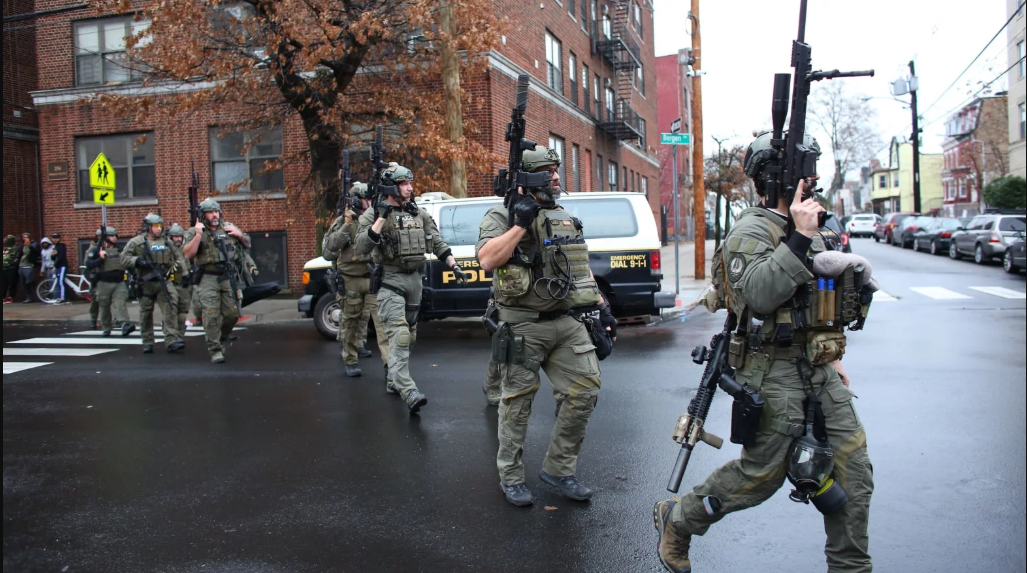
KENA BETANCUR/Afp/AFP via Getty Images Source 

Jersey City, NJ, December 10, 2019


 Husband: "Ya fired the cleaning woman!"

Wife: "She was stealing!"

Husband: "But she's colored!"

Wife: "So?"

Husband: "So the colored have enough trouble!"

Wife: "She was going through my pocketbook!"

Husband: "They're persecuted enough!"

Wife: "Who's persecuting? She stole!"

Husband: "All right! So? We can afford it!"

Wife: "How can we afford it? On your pay? What if she steals more?"

Husband: "She's a colored woman from Harlem! She has no money! She's got a right to steal from us! After all, who is she gonna steal from, if not us?"

Wife: "I married a fool!"

Woody Allen depicted his character, Alvy Singer's, parents having this argument in his 1977, Academy-Award-winning film Annie Hall. The argument echoes in January, 2020, in the wake of numerous, headline-grabbing attacks by African Americans on Jews in the New York City area.

On December 10, 2019, two shooters, influenced by the Black Hebrew Israelite ideology, shot to death four people in Jersey City, NJ. Their target was a Kosher supermarket. On December 28, 2019, a lone man, also influenced by Black Hebrew Israelite ideology, barged into a rabbi's home in Monsey, New York, during a Hanukah celebration. The assailant stabbed five people before guests threw furniture at him and he fled.

These violent attacks received relatively greater attention than other recent assaults, although Seth J. Frantzman pointed out in the Jerusalem Post that the Jersey City shooting did not receive the attention that other comparable shootings receive. Frantzman wrote,

"The murder of three people at a kosher supermarket in Jersey City was mostly ignored in the United States. No rallies or marches against the antisemitism that led to it. No major political upheavals or even much recognition. The usual anger over gun violence after mass shootings was nowhere to be found … America as a whole can’t mourn Orthodox Jews and it can’t confront perpetrators when the perpetrators come from a minority community. This is inconvenient antisemitism and it is a kind of antisemitism privilege. Despite widespread anti-racism programs in the US, there are still those in America for whom being antisemitic is a birthright and not something to be ashamed of."

I live fourteen miles from Jersey City and I am a voracious consumer of news media. Frantzman is correct. It was a long time before concerned residents were informed of what exactly transpired, who the assailants were, and what their motive was. When this information finally was released, it was rapidly buried. If Jewish assailants, armed with an arsenal including a pipe bomb, had attacked a black-owned business and its customers in broad daylight, no doubt at least a week of news stories would have followed.

The Monsey and Jersey City attacks are part of a trend. An incident on December 24, 2019 is fairly typical. A Jewish man is walking on the sidewalk of Albany Avenue and Lincoln Place in Crown Heights, Brooklyn. Seven young black males approach him and throw something at his head. The Jewish man is knocked off center but continues walking, rapidly, away from the youths. Three of the youths, one armed with a long object, chase after him. Two punch him. This is all recorded on video. At first, the victim did not report this attack to anyone. Such attacks had become part of life for Jews in the New York metro area. Further, new "reforms" would make the victim's name known to his attackers. They could come at him again, using means other than street assault. Seth J. Frantzman calls the frequency of these attacks "a slow-moving pogrom."

One might think that after the Monsey and Jersey City atrocities, news accounts, editorial pages, Twitter and other social media would be flooded with demands that African Americans confront the antisemitism percolating in their communities, that schools would be developing curricula to educate those in thrall to irrational hatred and violence, and that elected officials would be fearless in naming and shaming the ideologies and resentments that incite violence and hate.

Those reasonable expectations would be thwarted in any perusal of mainstream and social media in early January, 2020. Rather one finds an almost science-fiction phenomenon at work. Jews condemning police protection. Jews insisting that blacks not be associated with antisemitism. And, of course, a rally in support of an antisemitic schoolboard member.

In the wake of the kosher market shooting, Jersey City schoolboard member Joan Terrell-Paige posted a protest against Jews on Facebook. Terrell-Paige referred to "jews" – lower case – as "brutes" who "wave bags of money" to get their way. Terrell-Paige implied that the shooters were martyrs, trying to protect the black community from evil Jews. "Drugs and guns are planted in the black community" she alleged, perhaps by Jews. Jews are guilty of an "assault on Black communities of America. My people deserve respect and to live in peace."

New Jersey Governor Murphy asked that Terrell-Paige resign. As of this writing, she is still a member of the Jersey City schoolboard.

What's more, Patch.com reported on December 30 that a candlelight vigil was planned to support Terrell-Paige. Al Sharpton's National Action Network defended Terrell-Paige. Gov. Murphy and Jersey City Mayor Steve Fulop "need to shut their mouths" said the National Action Network's Carolyn Oliver Fair. Terrell-Paige "said nothing wrong. Everything she said is the truth. So where is this anti-Semitism coming in? I am not getting it," said Oliver Fair, who also alleged that the Jersey City shooters were Jewish. The shooters were not Jewish; rather, they were influenced by the Black Hebrew Israelites, a hate group that insists that Jews are "imposters" and that the real Jews of the Bible were black.

What is more astounding is the number of Jewish spokespersons who took a similar approach. On December 30, 2019, the Labour-Leftist aligned British daily The Guardian managed to round up enough tweets to publish an article entitled, "Jewish Groups Push Back Against Police Surge in Wake Of Antisemitic Attacks. Liberal Groups Say the New Policing Measures Put Forward by Mayor De Blasio Will Divide Communities." All the words in that headline are spelled correctly. The grammar works. But that's where sanity ends. In the wake of deadly attacks, one inside a private home during a holiday celebration, The Guardian wants Jews to forgo police protection in the name of leftist identity politics.

Where have we encountered this selection of one group's suffering as earning priority over another group's suffering? Oh, yes. After women were raped, sometimes gang-raped, by Muslim migrants in Europe, they were often told to keep quiet, because reports of these rapes would interfere with migration policy. (See here, here, here, here, and here).

It's weird enough that non-Jews would tell Jews to forgo police protection and endure beatings, even death, in the name of political correctness. But Jews are doing it, too.

On December 29, 2019, the Jewish Voice for Peace blamed "rising white nationalist violence" for attacks on "Jews, Muslims, Black people, and all people of color." Police protection for Jews was unwanted. Jews should not "rely on the very forces detaining and locking up and killing our friends, family, & neighbors."

David Klion, editor at Jewish Currents and published in The Nation, The New York Times, and The Guardian, tweeted on December 29 that "I never want out of my mind" that "We should not give one inch to right-wing forces within and outside of our community exploiting these attacks to legitimize racism."

The "racism" at work in these attacks is expressed by black people who despise Jews. And Klion wants never to have "out of his mind" (no pun intended) that right-wing racism is the problem? Well, yes. Because, as Klion tweeted on December 27, "Flooding POC neighborhoods with cops is going to carry real costs, potentially even fatal ones, for tens of thousands of people who have no complicity in these attacks. I'm also deeply uncomfortable with the optics of cops functioning as security for Jews against POC."

Jews shot; Jews stabbed; Klion is worried about "optics" of a police presence. In reply to Klion's tweet, Twitter user "TalkToTheHand" posted a photo of National Guard troops accompanying black children to school in the American South during the Civil Rights Movement. Thank you, TalkToTheHand.

Ariel Gold asked, "If the National Guard are deployed and more police are on the streets to keep Jews safe, what will that mean for Black communities? Is the trade off worth it? Is this the answer? Is this lasting safety for all?" Think about the "tradeoff" Gold mentions. She's talking about keeping Jews safe from street assaults. What is the other object in this trade? "more police … in Black communities." To Gold, that is a bad thing. More police. Less crime. Bad. Think about that.

Sophie Ellman-Golan tweeted, "This sends a pretty stark message to non-Jewish POC living in these neighborhoods that their safety matters less than the safety of their Jewish neighbors. That's really really bad for literally everyone except our common enemies, who benefit when we're divided."

The Forward insisted that "Anti-Semitism Isn't Blacks vs. Jews. Saying So Hurts Us All." The article insisted that no relation be drawn between any aspect of African American culture, no matter how fringe, and attacks on Jews. Apparently the attackers have all been lone wolves with no connection to any aspect of black culture.

Jews for Racial and Economic Justice tweeted that "Our response to antisemitic violence must focus on building solidarity with other groups targeted by white supremacy, not increased policing."

What makes the above-cited material all the more surreal is how much it differs from rhetoric that accompanies accusations of antisemitism when the accused are more clearly identified as Christians, and, in the case of my own research, identified specifically as Polish Catholics. My book Bieganski details rhetoric about Poles and other Eastern European Christians in relation to accusations of antisemitism. As I demonstrate in the book, antisemitic crimes committed by Poles are spoken of as inseparable from Polish identity. This approach can be summed up as, "You did the bad thing you did because you are Polish. Polish people do bad things." When it comes to blacks, the analysis becomes, "You did the bad thing you did because you are a victim of oppression. The people who are oppressing you are responsible for the bad thing you did."

Wladyslaw Bartoszewski was captured by the German Nazis and imprisoned in Auschwitz. He made it out – and immediately co-founded, in Nazi-occupied Poland, Zegota, the only organization in Nazi-occupied Europe whose sole purpose was to rescue Jews. After the war, he protested against antisemitic atrocities committed by his fellow Poles, as co-founder of the All-Poland Anti-Racist league. For this, he was imprisoned by the Soviets.

And yet, the very Polish, devoutly Catholic Bartoszewski faced verbal abuse in both Germany and Israel. Why? His ethnic identity. Polish identity has been conflated with antisemitism for too many people. If you are a Pole, you are an anti-Semite.

That rhetoric is used to conflate Polish identity with antisemitism and to shield African American identity from any association with antisemitism may be of little interest to anyone but Poles. But this dichotomy is in fact pertinent to African Americans.

It's undeniable that antisemitism has played a significant role in Polish culture and that Poland was site of antisemitic atrocities carried about by Poles. Poles are not protected by political correctness. Why? Political correctness is a concern of the left and Poles are not likely recruits  in bringing on world revolution. Poles famously fought the Soviets, significantly in 1920, in the Polish-Soviet War that Poles, miraculously, won. Poles fought the Soviets again after Soviets, along with their allies, the Nazis, invaded Poland in 1939, and then again in 1945, with resistance lasting till the end of communism in 1989. Poles are notoriously Catholic, and Catholics are not likely fodder for world communist revolution. Leftists have no reason to use rhetoric to protect Poles. Rather, leftists are all too happy to insist, inaccurately, that hate is a Christian thing, and that Catholicism is responsible for antisemitism.

The ease with which Poles are identified with antisemitism, and the difficulty of naming African Americans as anti-Semites, is reflected in Deborah Lipstadt's December 29, 2019 piece in The Atlantic Monthly. Lipstadt is the professor of Holocaust history of Emory University. Her essay appeared after the Hanukah stabbing, after the Jersey City shooting. She had plenty of reason to address African American antisemitism. She did not. She chickened out. In fact she never uses the words "black" or "African American."

Whom does Lipstadt accuse? The Poles. And the Slovaks. Eastern European, Christian populations. Her bashing is not warranted. Szczecin, a city in Poland, wanted an explanatory note added to a commemorative plaque, clarifying that the victim the plaque commemorated was murdered by German Nazis. That's a reasonable and necessary request, given how Holocaust history is distorted. Slovaks? Thugs desecrated a Jewish cemetery. A very bad thing, but not representational of Slovaks, and not pertinent to Monsey.

The simple truth is, neither Lipstadt nor The Atlantic Monthly will catch one bit of flak for bashing Poles and Slovaks, who don't matter to Atlantic Monthly readers or Emory University or America's elite. Go after easy targets. With them, be as racist and as essentializing as you want. Poles do bad things because they are Poles. African Americans do bad things because they are oppressed, but that's potentially controversial, so we won't even mention it in this article.

Their lack of politically correct protection has, ultimately, been to Poles' advantage in some ways, though Poles may find that hard to perceive. Poles have been accused before the world of being essential, unchanging and unchangeable anti-Semites. Those accusations have prompted mass examination of conscience in Poland. Those outside of Poland are probably largely unaware of these national mea culpas, confessionals, and resolutions to reform, but they are very real. Nobel-prize winner Czeslaw Milosz produced two of the earliest significant works of art addressing the Holocaust, "Campo de Fiori," and "A Poor Christian Looks at the Ghetto." Pope John Paul II became the first pope to enter a Jewish house of worship "since St Peter," and he was the first pope to visit Auschwitz, where he made it a point to pray at the monument to Jewish victims, defying communist propaganda that downplayed the Jewish identity of most victims. John Paul insisted on the continued validity of God's covenant with the Jews.

I could go on, naming filmmakers, authors, theologians, and average citizens who have taken it upon themselves to address and to work to eliminate Polish and all forms of antisemitism. I pray that in my own small way, I continue this mission.

As quoted above, Seth J. Frantzman wrote that "There are still those in America for whom being antisemitic is a birthright and not something to be ashamed of." The key word here is "shame." Shame drives some Poles to address and defeat antisemitism. Shame, combined with pride in Poland's multicultural heritage, its tradition of "For your freedom and ours."

The publications, organizations, and social media users insisting on not addressing those aspects of African American culture that allow antisemitism to metastasize are not doing African Americans any favors at all. Shame is necessary to human community. Years ago I was on a bus in my majority minority community. Garbage on the street is a major problem here. People throw their garbage on the street, in the river, on playgrounds, without a second thought. A young man got off the bus and was about to throw garbage on the street. I glared at him. For a second he caught my baneful glare. He actually stopped, and carried his garbage to a garbage can. I shamed him. His behavior changed.  

No, not all African Americans are anti-Semites. Only a minority are. No, no decent person wants to return to the bad old days of vicious stereotyping. But the violent attacks are going to continue until someone has the courage to stand up, root out, and analyze the ideologies that give a free pass to the black antisemitism that does exist. We can't do that as long as we are virtue signaling. Servicing one's own reputation as a good, paternalistic liberal infantilizes and betrays black people.


This piece first appeared at Front Page Magazine here

Monday, January 6, 2020

Solidarity Rally against Antisemitism Foley Square, Brooklyn Bridge and Cadman Plaza, January 5, 2020

Homemade sign for the Solidarity Rally against antisemitism NYC 1/5/2020
Jeenah Moon Getty Source
On Sunday, January 5, 2020, thousands of people marched from Foley Square in lower Manhattan, across the Brooklyn Bridge, to Cadman Plaza in Brooklyn, a distance of a mile and a half. 

Our goal was to protest recent antisemitic attacks in the New York City and New Jersey area. Attackers have often been African American and attacks involve street violence including punching, thrown objects, spitting, cursing, and vandalism. The Jersey City attacks involved four fatalities. The Monsey attack involved stabbing; one victim may never recover. 

On Sunday in Manhattan, temperatures were in the 30s and there was a brisk wind. 

Crowd size has been variously estimated. the New York Times estimated "tens of thousands." The Forward estimated 25,000.

The rally was scheduled to begin in Foley Square in lower Manhattan at 11:00. I was at the rally between 10:30 and 2:30. The entire time, I was a dot in a giant crowd, smooshed between thousands of other people. Once we began our walk over the bridge, we moved very, very slowly. That's because of the sheer number of people. 

I left the Cadman Plaza rally at 2:30 and attempted to walk back over the Brooklyn Bridge. I was unable to do so. There were still throngs of people walking back toward the Cadman Plaza point. The police announced that the bridge was closed to Manhattan-bound foot traffic. I had to detour to the Manhattan Bridge. 

New York governor Andrew Cuomo, Mayor Bill Deblasio, both US Senators Chuck Schumer and Kirsten Gillibrand lead the march. 

There is a lesson here for Polonia. Hours of hard work went into making this rally happen. Rally organizers worked, planned, and made it happen. 

When people unite and work toward a goal, they can make things happen. 


Tuesday, December 31, 2019

Attacks on Jews in NY and Media Double Standards. We Need to Talk about Black Anti-Semitism

Photo credit: Mark Lennihan source


Attacks on Jews in NYC and Media Double Standards
We Need to Change the Way We Talk about Black Anti-Semitism

December 26, 2019, the day after Christmas, those Americans who emerged from their holiday celebrations to check world headlines were in for a shock. Police reported several attacks on Jews in New York. Americans don't think of their largest city, a world center of finance and the arts, a cosmopolitan capital where one can enjoy cuisine from any continent at any hour of the day or night, as a place where Jews are unsafe on the streets. New York is the city of Seinfeld, of Woody Allen and three-time mayor Michael Bloomberg. Former Mayor David Dinkins famously called New York a "gorgeous mosaic" of diverse peoples.

But in fact, these Christmas-and-Hanukkah-week attacks were part of a trend. As bad as they were, worse was yet to come. On Saturday, December 28, Rabbi Chaim Rottenberg and his guests celebrated the closing nights of Hanukkah in Monsey, a suburb north of Manhattan. An intruder burst into the home and stabbed five people.

Recent attacks on Jews in New York City typically involve unprovoked punching, cursing, and hurling of objects ranging from soft drinks to large and potentially deadly stones. Victims range from children to the elderly, and include mothers accompanied by their babies. Attackers sometimes yell anti-Semitic comments.

Videos reveal that attackers are frequently black. In one startling video from November 4, 2018, a group of young African Americans congregate outside a Brooklyn synagogue, talk among themselves, hurl a pole through the synagogue window, and then run away. In another attack, a Jewish man is walking down the sidewalk when what appears to be a black youth runs up behind him and punches him hard in the head, nearly knocking him over. In a March, 2019 assault, an apparently healthy, young man kicks a toddler's stroller being pushed by the child's mother. Attacks are not always violent. In one videotaped confrontation, a black woman screamed verbal abuse at a Jewish man on the New York City subway.

On December 10, 2019, David Anderson and Francine Graham killed four people in Jersey City, just across the Hudson River from Manhattan. Deceased victims include Police Detective Joseph Seals, Leah Ferencz, owner of a kosher grocery store, Moshe Deutsch, a rabbinical student and a shopper at that store, and Douglas Rodriguez, a store employee and immigrant from Ecuador. Shooter David Anderson was an anti-Semite who had been influenced by the Black Hebrew Israelites, who claim that Jews are not really Jewish, and that the characters in the Bible were all really black. In this ideology, contemporary Jews are labeled "imposter Jews" and "so-called Jews." This idea is not limited to violent extremists. On December 14, Saturday Night Live comic Kenan Thompson referred to "historically correct black Jesus." Jersey City killer David Anderson used the word "imposter" to refer to modern-day Jews. Anderson and Graham's killings were classified as a terrorist incident and a hate crime. The New Jersey attorney general said that the killers "had a tremendous amount of firepower. They had a pipe bomb in their van."

In the wake of this attack, Jersey City school board member Joan Terrell-Paige appeared to attempt to justify it. Terrell-Paige called "jews," as she spelled the word, in lower-case, "brutes," and said that people should seek a "message" in the killers' actions.

Clearly, black anti-Semitism is a problem. It is found among juvenile delinquents, TV stars, terrorists, and those entrusted with educating the young. Black anti-Semitism has an articulated ideology. Not all black people who don't like Jews adhere to this ideology, but it's available to them. Today's Jews are merely "so-called" Jews, "imposter Jews," "usurper Jews," "interloper Jews," and "Johnny-come-lately Jews." In this ideology, the real descendants of the Jews of the Bible are African Americans.

Mainstream media often declines to identify the race of those who attack Jews. On December 27, 2019, media reported that an attacker hit a Jewish mother in the head as she walked with her son in Brooklyn. The attacker, an account reported, was 42 years old and female. But the account did not identify her race, and no mugshot was provided.   

Mainstream media's hand-wringing around the racial identities of attackers is evident in an October 31, 2018 New York Times article with the disconcerting title, "Is It Safe to Be Jewish in New York?" The "first inkling" of danger for Jews appeared in 2016, the Times reported, when the words "Go Trump" appeared in a playground alongside swastikas. Really? Trump's election was really the "first inkling" of trouble for Jews in New York City?

In fact, New York City hosted a deadly anti-Semitic pogrom in Crown Heights in 1991. According to one account,

"It was the most terrifying four days and nights in American Jewish history … with shouts of 'Kill the Jews' and 'Heil Hitler'; roving mobs in Crown Heights throwing stones at Jews; police standing passively; gangs breaking into homes with mezuzahs while Jews hid in closets. One Jew was murdered; others beaten to a pulp; an Israeli flag was burned."

In 1995, Al Sharpton fomented deadly hatred during his Freddy's Fashion Mart protests. One of the protesters killed eight people, including himself.

In 2002, Amiri Baraka, aka Everett LeRoi Jones, New Jersey's Poet Laureate, published a poem blaming Jews for the 2001 terror attacks.

No, the election of Donald Trump was not the "first inkling" of trouble for Jews in New York City.

The Times must confess that "During the past 22 months, not one person caught or identified as the aggressor in an anti-Semitic hate crime has been associated with a far right-wing group." The Times gingerly acknowledges "it is the varied backgrounds of people who commit hate crimes in the city that make combating and talking about anti-Semitism in New York much harder."

The reader comments section is not so careful to use the phrase "varied backgrounds." The most popular reader comment next to the above-linked Times article blames the "Many members of minority communities" who have participated in attacks. The second most popular comment is even more direct. "for left-leaning New Yorkers, anti-Semitism is an issue worth addressing only when the perpetrators of anti-Semitism fit their narrative. If a Nazi or white supremacist does it -- take note and take action.  If the perpetrator is less convenient to the Narrative (evil can only emanate from straight white males), like if the perpetrator is black or Muslim, then they play it down and ignore it."

National Public Radio surprisingly allowed Bari Weiss to speak bluntly in a September 21, 2019 broadcast. "To judge from the footage of many of these attacks, at least some of the perpetrators seem to be young black men or teenagers. And perhaps that's one of the reasons that so many people want to avert their eyes from what's happening in places like Crown Heights," she said.

What we are seeing here is the economy of truth. If it benefits the speaker to condemn white anti-Semites, the speaker will do so. If it damages the speaker to condemn black anti-Semites, the speaker will avoid doing so. This rhetorical game has nothing to do with respecting or helping black people. It has everything to do with covering one's own posterior, and hoarding one's own political correctness points.

***

My book Bieganski devotes a chapter to black anti-Semitism. The purpose of the chapter is to demonstrate a media double standard. I compare press coverage of two clusters of events that involved accusations of anti-Semitism. One cluster of events involved Polish Catholics; the other involved African Americans.

In November, 1993, Khalid Abdul Muhammad, of the Nation of Islam, made a speech at Kean College in New Jersey. Muhammad said, inter alia, that Jews were not related to the main characters in the Bible, who were black (although, somehow, black Jesus' killers were Jews), that Jews hold economic, cultural, and political control of American and African blacks, which they use to torment and oppress blacks, that Jews were responsible for the Holocaust because of their obnoxious behavior in Germany, that Jews control the press worldwide, and that Jewish involvement in the Civil Rights Movement was a ploy to get blacks killed.

These charges were leveled in non-standard, frequently obscene and contemptuous language. For example, when Muhammad accused Jews of controlling the world gem trade, he said, "That's why you call yourself Mr. Rubenstein, Mr. Goldstein, Mr. Silverstein. Because you been stealing rubies and gold and silver ... we say it real quick and call it jewelry, but it's not jewelry, it's Jew-elry, 'cause you're the rogue that's stealing all over the face of the planet earth." When ridiculing Jewish involvement in the Civil Rights movement, Muhammad imitated a Yiddish accent. Muhammad, in future speeches, called for death to all Jews: "Never will I say I am not an anti-Semite. I pray that God will kill my enemy and take him off the face of the planet Earth."

In response to such research-grade anti-Semitism, mainstream press accounts did not begin with full-throated condemnation. In fact, mainstream press articles about Muhammad's speech and attendant controversies are so formulaic that they appear more like the scripture of some obsessive religious doctrine than the result of a free and vigorous press.

One of the refrains of this formula was reference to black suffering. The following quotes, though all similar, are taken from different articles, authors, and sources. Some listed: "drugs, violence, high rates of teen-age pregnancy, poor schooling and poor discipline," "unemployment, alienation, drugs, violence, health care, education, and lack of economic opportunity," "poverty, hopelessness, and despair," "drugs, poverty, hopelessness and crime," "crime, poverty, and inequality," "drugs, poverty, and bitterness," "misery, drugs, crime, poverty, and dying hope," "bitterness, alienation, and mistrust," "the bank that refuses to lend a dime to the inner city to the boy who lives next door and carries a pistol, a crack vial and a heart turned to stone by disappointment and hopelessness" as being responsible for misbehavior.

Other articles recounted black suffering in more intimate detail, often using vivid anecdotes: "The teen-ager pulled up his shirt to show the bandage on his lean belly and the round hole on his back that had been sealed shut. He had been shot the other week, walking down the street to buy a hamburger." "The year was 1948 and the laws of segregation were in full force. For Muqaddin, who is black, it was a shattering experience that left him seething with rage against white America." A Black Muslim woman was asked to remove her veil while shopping in a mall. The woman reported: "she was 'humiliated' by the encounter with the St. Paul police, who forced her to uncover her face. 'I don't want men lusting after the way I look or sound. It's like someone else being made to pull down their undershorts in public.'"

Many references to black suffering went without amplifying commentary. The reader was invited to use his own devices to weigh black suffering in some ethical scale against anti-Semitism. Other writers offered more guidance, and advanced complex rationalizations as to why black suffering ought either to dilute or erase focus on anti-Semitism.

Notre Dame American Studies chairman Robert Schmuhl spun references to black suffering into support for Ishmael Reed's argument that the real story was the threat to blacks and Jews posed by white Christians. The Times argued that since blacks were suffering so much, they needed to embrace and support each other, regardless of ideology. The Times pointed out that blacks, consumed by their suffering, might be "too politically unsophisticated" to differentiate between ideologies. Writer Thulani Davis repeated this view in Time. One African American woman was quoted as saying that since African Americans faced so many threats from white society, it was necessary to choose a force that could protect them, and that that force was the Nation of Islam, regardless of its anti-Semitism. This need for protection was also stated in The Christian Century.

USA Today argued that black suffering made blacks hate all whites, not just Jews. The Humanist argued that the traumas of slavery created a mythic vacuum that NOI was filling. Benjamin Chavis, in the Times, argued that the suffering of blacks "has created an ... alarming chasm of attitudes and perceptions"; thus, whites could not judge people so different from themselves. He also explicitly stated that black suffering, not the racism of NOI, was the real story, the story the press should be covering. This was repeated in several articles, by several authors, including in Time and Maclean's, and by Rabbi Michael Lerner.

Great care was taken to avoid condemnatory headlines and to provide headlines that strove to represent "both sides," without, somehow, stressing that one side was eliminationist anti-Semitism. With the use of such headlines and such "balance," America's mainstream press changed the story. Muhammad's anti-Semitism was not the issue on which focus needed to be trained; focus needed to be trained, rather, on an effort to hear the "other side." An article in which Farrakhan alluded to blood libel and a Jewish conspiracy to destroy him was headlined, "Farrakhan Softens Tone."

Readers were invited to focus on white haters, not black ones. The Progressive compared Muhammad to David Duke. Shelby Steele, in the Times, compared him to Meir Kahane and the KKK. Bob Herbert in the Times compared him to "[Theodore G.] Bilbo and [George] Wallace in blackface." Henry Louis Gates, also in the Times, summoned memories of those who watched Kitty Genovese die and repeated a vivid quote by a rabbi at Baruch Goldstein's funeral: "One million Arabs are not worth a Jewish fingernail." New York magazine ran one issue with two covers; one featured an anti-Semitic NOI preacher; the other, conservative radio personality Bob Grant. The magazine's editor-in-chief, Kurt Anderson, said, "This idea of parallel covers began to make sense and seemed like a way to demonstrate that they go full circle to illustrate the different strident ends of the spectrum."

These comparisons were not buried towards the end of articles, but appeared up front, to confront the reader head-on. The important event to focus on was not the anti-Semitism of a black man, but racism in general. The New York Times entitled one Muhammad-inspired editorial with a generalized headline: "The Stew of Hate." The lead sentence never mentioned Muhammad: "Religious and racial bigotry never recede entirely, witness the ebb and flow of Klan membership." Yes, condemnation of the Klan is laudable, but the Times was changing the subject to one easier to discuss.

Publications simultaneously engaged in a contrary tactic: anti-Semitism among African Americans was dismissed as unworthy of note. "Less news than soap opera" comparable to the competition between figure skaters Nancy Kerrigan and Tonya Harding, reported a political science professor. "Just a pimple" said Franklyn Jenifer, president of Howard College, in US News and World Report. "I don't get so upset by Farrakhan," yawned Michael Lerner in Time. Jews are never mentioned in the annual Ebony poll of urgent issues, sociology professor Raymond Mack reminded his readers. "Forget Farrakhan" ran a headline in the Times, under which Bob Herbert advised: "It's time to turn to other matters."

The mainstream press used cautious and trivializing vocabulary to report anti-Semitism among African Americans. Maclean's trivialized: "the Jews took a special shellacking, not much of a surprise." Professor Doris Wilkinson asked whether or not it was even possible that there be such a thing as "black anti-Semitism." In the lead sentence of one article, the Times reported that "Black racism" is, for some blacks, "a laughable oxymoron." Some articles began with "balanced" rhetorical questions, as in this profile of the leader who invited Farrakhan to an NAACP summit: "Who is Benjamin Chavis Jr., and what in the world is he trying to do to the venerable NAACP? Is he a brash and brilliant innovator, pumping life into a sclerotic organization whose glory days are past and whose current relevance is questioned? Or is he an unrepentant radical and a peripatetic neophyte?" When Farrakhan made classically anti-Semitic statements, echoing blood libel: "The same people opposed to [Jesus] are opposed to me. It's the Passover season. It's the right time;" the Times said merely that these statements "may register on many ears as patently anti-Semitic." Time said that Farrakhan "appeared" to be putting down other people; that he was "misunderstood."

Statistics and anecdotes were cited to indicate that black anti-Semites were not representational of the black population. This in spite of other statistics that showed that African Americans are more anti-Semitic than the general population, and unlike the general population, become more anti-Semitic as they become more educated

Reports of anti-Semitism among African Americans were, it was posited, part of a hidden, nefarious, anti-black agenda. Charles Rangel suggested that the ADL might have been milking Muhammad's speech for money and publicity. The Amsterdam News accused the ADL of "willful and cynical exploitation of a people for the purpose of raising money from Jews by frightening them." Michael Lerner also suggested that Jews were using accusations of anti-Semitism among African Americans, in this case as "an excuse to deny our own racism toward blacks" and as "justification for some Americans to declare themselves 'disillusioned with the oppressed'" and to cut social programs for the poor. The Times repeated this; charges of African American anti-Semitism were allegedly "an excuse for doing little to reduce inequalities."

Writer Thulani Davis, in Time, wrote that accusations of anti-Semitism among African Americans were "attempts to set the terms of the discussion of racial conflict solely on African American xenophobia. Like all litmus tests, this one is reductive and promotes self-defense rather than thought and disclosure."

Davis also pointed out that in the litmus test atmosphere, "African Americans do not even feel comfortable to debate in public ... in such a delicate public discussion it is dangerous to risk having words taken out of context, ideas abbreviated into unrecognizable and harmful sound bites ... If the issue is used simply to identify enemies, few will step forward." Davis further stated that media reports of anti-Semitism among African-Americans were part of a wider effort to create negative images of black people that fed off of whites' fears of "black hate." "Black hate, though, is only a new wrinkle in the increasingly negative portrayal of blacks as a whole," she wrote. This fear of black hate is taught to "each group of new immigrants settling in the big cities of America."

A letter to the Times denounced as "racist" and "paternalistic" A.M. Rosenthal's request that blacks denounce Muhammad. Rosenthal, implied the writer, was not just to blame for his whiteness, he was also a parvenu who told African-Americans, "in their own country" "what to do and say ... even by those that just arrive on these shores."

Accounts veered into victim blaming. Blaming Jews for the anti-Semitism of blacks goes back at least to Michael Lerner's 1969 manifesto in Judaism, where he wrote: "black anti-Semitism ... is ... a tremendous disgrace to Jews, for this is ... rooted in the concrete fact of oppression by Jews of blacks in the ghetto. In short, this anti-Semitism is in part an earned anti-Semitism." Lerner was ready with similar accusations to explain anti-Semitism among African Americans in 1994: "Jewish neoconservatives at Commentary and neoliberals at the New Republic have led the assault on affirmative action" and Jews have "delighted in the prospect of throwing black women and children off welfare as soon as possible." Others also blamed Jewish opposition to affirmative action for alienating blacks.

***

This is but a brief summary of my comparisons of press accounts of accusations of anti-Semitism among African Americans, versus press accounts of accusations of anti-Semitism leveled against members of other demographics, especially persons or groups most associated with Catholicism. In this brief summary, one can discern a pattern.

For months now, the media has presented alarming reports of random, innocent Jews aggressively attacked on New York City streets. The attackers, video suggests, are often African American. This is a problem, a problem that needs to be addressed with courage, frankness, and dedication. If members of less-protected demographics, Catholic high school boys from the American South, for example, were attacking Jews on the streets, there would be an international outcry, a flood of tweets from average citizens as well as celebrities, television broadcasts, academic conferences and articles, and demands for an immediately available curriculum to educate bigoted persons. A review of the above paragraphs outlining my research on how media reacted to an overtly genocidal African American anti-Semitic speaker suggests a reason why so few have been willing to state the obvious. No, not all African Americans are anti-Semites, but some are, and those that are include some who commit violent crimes, including murder, in the name of anti-Semitism. This hatred, and these assaults, are not random, but are supported by a detailed and deeply rooted ideology that declares that Jews are "imposters," "interlopers," "Johnny-come-lately Jews" and "usurpers" who have co-opted black people's real identity.

Further, apologias for these assaults rely on a competition for victim status created by leftist ideology. The left awards its certified victims with virtue, innocence, authority, and tangible benefits through programs like Affirmative Action. As long as being the biggest victim is valuable, some African Americans will resent Jews, perversely, for the Jews' own victimization.

"The black holocaust is one hundred times worse than the so-called Jew holocaust," said Khalid Abdul Muhammad on the campus of Howard University. This articulated hatred must be described, denounced, and deconstructed. There should be forthright academic articles, conferences, and curricula, now, condemning this murderous anti-Semitism. Those who take on this task face daunting odds. Those odds make this work no less vital and urgent.

Yes, African Americans have suffered grievous harm. Yes, statistics indicate that African Americans today are, as a group, poorer, less educated, less healthy, and more likely to be incarcerated than white Americans as a group. Yes, all Americans must do everything they can to close the gaps between whites and blacks.

But separate systems of ethics for blacks and whites are no more moral than separate water fountains for blacks and whites. Human decency should not be emblazoned with a "whites only" sign. It is not imperialist or racist for people who aren't African American to speak out against black anti-Semitism. It is paternalistic for mainstream media to resort to transparent weasel words when reporting on vile street attacks on Jewish elderly persons, women, children, and toddlers in strollers. If hitting an old man in the head with a ten-pound paving stone is behavior that is beneath contempt for a white person, it is also beneath contempt for a black person. Those who refuse to say so clearly are guilty themselves. Let us not rewrite Martin Niemoller's famous warning to read, "Then they came for the Jews / And I did not speak out / Because I did not want to risk being accused of being politically incorrect."


This piece first appeared in Front Page Magazine here