Saturday, February 5, 2011

Jews' Importance to Poland


 Casimir the Great and Esterka by Wladyslaw Luscczkiewicz


A previous post introduces this series of quotes. Another previous post attests to the Importance of Poland to Jews. Subsequent posts attest to Love as a Factor in Polish-Jewish relations, and Jews' Defense of Poland


Jews, Judaism, and Polish-Jewish relations are and have been central to Poles and Poland. Jews were there at Poland's genesis, and recorded it. The first known written record of Poland is by Abraham ben Jacob. The vivid and unique portrait of Early Poland is seen, not through the eyes of indigenous Poles, but through the eyes of a literate, sophisticated Jewish traveler. He described a fertile land inhabited by a violent, anarchic, lusty but loyal people making their way in a demanding landscape.

"In general, the Slavs are violent, and inclined to aggression. If not for the disharmony amongst them, caused by the multiplication of factions and by their fragmentation into clans, no people could match their strength...Their women, when married, do not commit adultery. But a girl, when she falls in love with some man or other, will go to him and quench her lust. If a husband marries a girl and finds her to be a virgin, he says to her, 'If there were something good in you, men would have desired you, and you would certainly have found someone to take your virginity.' Then he sends her back, and frees himself from her. The lands of the Slavs are the coldest of all. When the nights are moonlit and the days clear, the most severe frosts occur ... The wells and ponds are covered with a hard shell of ice, as if made of stone. When people breathe, icicles form on their beards, as if made of glass" (Davies I 3)

In his function, recording a people who had not yet recorded themselves in an idiom that had penetrated the outside world, and in his perceptions of the people so described, Abraham ben Jacob can be compared to Jewish writers on Poland who lived a thousand years later, for example, Isaac Bashevis Singer.

Legend as well as history places a Jew in a key role in Poland's genesis. In 842, according to one retelling, a Jewish man, Abraham Prochownik, was invited to become the next king of an embryonic Poland. If he turned this invitation down, it was implied, he would be put to death. Prochownik regarded this invitation with hesitance, and made a speech arguing for the coronation of Piast, peasant and wheelwright. Prochwnik's oratory was so persuasive that Piast, indeed, became king, establishing a dynasty (Adler 26).

Again, in this legend, themes appear that had resonance in later Jewish literature on the Jewish experience in Poland. It may be that this legend was developed out of these resonant themes. Poles, it is understood in much Jewish literature, see Jews as superior in many ways, but may threaten Jews with their own superior might. Poles require Jewish wisdom to govern themselves. Jews are most safe when they exercise their superior powers from behind the throne, and do not take on overt trappings of power. Poles have the superior might; Jews, the superior verbal and reasoning skills.

The centrality of Jews and Judaism to Poles and Poland can often be summed up as the importance of an urban, literate, mobile and mercantile population to its rural or sylvan, oral, rooted, and in many ways culturally isolated counterpart. Poland's pre-World-War-II urban populations including large percentages of Jews; the professions were disproportionately Jewish. Until recently, the majority of Catholic Poles were agricultural, non-mercantile, and many, oral, as opposed to literate. "It is impossible to study the history of the Polish town without taking into consideration their Jewish population," attested Polish scholar Maria Bogucka. Prolific Polish author Jozef Ignacy Kraszewski (1812-1887) stated the importance of Jews to Polish urban life more poetically. "And do you know what makes every town Polish? The Jews. When there are no more Jews, we enter an alien country and feel, accustomed as we are to their good sense and services, as if something were not quite right" (Hoffman Shtetl 132).

Jews played a central role in the development of Polish economy (Rosman). "Jews, acting as merchants, traders, arendators of propination, or agents of the szlachta, were almost the only intermediaries between the peasants and the market, and it was through them that the Polish village slowly emerged from its isolation" (Goldberg "Poles and Jews" 262).

Polish novelist Tadeusz Konwicki provided a picture of rural Poles' isolation, and the role that language played in it.

"Imagine a wooded area where human settlements are scattered over several miles, where the nearest train station is forty miles away, where communication is so difficult, where everywhere around is a forest, where mail is always late, where you have no bookstores, theaters, gramophones, then forms of entertainment are restricted. People visit one another during holidays, come for Christmas or a wedding or a name day, and it lasts for a week. Then, what is the most enjoyable way to cheat time, apart from music? A talent to tell stories." (Sobieska)

Jews, who often traveled and had ties to the outside world, played an important role as storehouses and purveyors of Polish cultural products, both material products, like books, and intangible products, like performed music. This role of Polish Jews is epitomized by the Jewish character Jankiel in Adam Mickiewicz's national epic, Pan Tadeusz. "Every Polish child learns about Jankiel," according to Jewish-Polish cultural leader Stanislaw Krajewski (75). Through Jankiel, Adam Mickiewicz, Poland's most revered poet, declared that "Israel constitutes an integral part of the Polish community" (Hertz 29). Jankiel was credited with being the first to bring to his region the tune that would later become Poland's national anthem (Hertz 30). Hertz cited other important Jewish characters in Polish literature. He noted author Wladyslaw Syrokomla's fictional character of a Wilno bookseller.

Jankiel from Pan Tadeusz source

"Syrokomla's bookseller ... is a Jew who brings Polish books to people in thatched cottages and saves important remnants of the past from oblivion ... Polish-Jewish historian Shatzky would write a beautiful piece on the role and activities of those small dealers in old books who made such a great contribution in disseminating Polish values and cultural traditions" (Hertz 30).

The role of a Jewish book merchant as one who knows Poles and Poland was vividly captured by Polish poet Maria Konopnicka in her portrayal of Mendel, a Jewish bookbinder (1842-1910).

"Mendel knows the little secrets of this world by heart. He knows when the cough of the old archivist who brings him thick, dust-laden folios of musty papers for binding is worse or better; he knows the smell of the pomade of the little ward for whom he sews together the records of his benefactor; he knows when Joasia comes from the wife of the counselor with the request that he 'set nicely behind glass' a congratulatory scroll on which a gilded angel uncovers himself and reveals a young man with a bouquet of roses in his hand; he knows when the student living in the attic goes without supper; and he knows from which side will run up the breathless schoolgirl asking him to bind 'in blue and with gold strings' some romantic poetry transcribed on letter paper" (Segel 222).

Not only Jewish dealers in books disseminated Polish culture; other Jewish merchants also played a role. Not only high culture was disseminated by Jews; folk culture was, as well. Hertz cites a certain style of Hucul apron that was introduced and distributed by Jewish merchants (231). Polish wycinanka, paper cut outs, are its most recognized folk art. Jewish merchants played a role in their distribution and acceptance (Hertz 232). Hertz saw Jewish influence as well in Polish folk carving and jewelry.

Not only dealers in cultural products functioned as culture bearers. Jews who worked in other capacities were also expected to be sources of information for rooted and isolated Poles, reported Hertz.

"Polish society to an increasing degree became transformed into a number of local groups that were very isolated from each other. The nobleman was not inclined to travel distances. He was a homebody and proud of it. His interests were concentrated on his farm ... The printed word seldom reached him; a prayer book, an almanac, and a dream book were sufficient

"In his Wspomnienia z Polesia, Wolynia, i Litwy (Memoirs of Polesie, Volhynia, and Lithuania) Jozef Ignacy Kraszewski writes that, in the years of his youth, a landowner who was hiring a Jew as a tavern keeper would mention that, along with various other duties, the Jew was to inform him of any news of the world that he might hear. A variety of sources belonging to the world of the nobility and its mores confirms Kraszewski's statement. In the nobles' tradition the Jew was seen as particularly well informed, an unerring source of quickly spreading information. In Poland there was an expression, "the Jewish mail." And as Sienkiewicz's Pan Zagloba said, when a Jew sneezes by the Warta River, the zydeks in Lithuania answer "God bless you" a minute later ... In his story "Karabela z Meschedu" (The Scimitar from Mesched), Ksawery Pruszynski describes how his hero, a Jewish antiquary, keeps up relations with his fellow Jews throughout the world" (223).

After Jankiel, the most famous Jewish character in Polish literature may be Rachela. Stanislaw Wyspianski's 1901 play "The Wedding" is a centerpiece of the Polish literary canon. One of its central characters, Rachela, is a Jewish girl who, as Hertz puts it, "unleashes the mystery. It is she who introduces the element of poetic vision that leads to the liberation of that 'which is a dream in everyone's soul'" (208). Like Jankiel, Rachela is a frequently invoked figure, according to Czeslaw Milosz. She has become "proverbial." "With her crimson shawl, her dark beauty, her somewhat ethereal refinement, she has been evoked, since then, by many poets of the twentieth century" (Milosz 357).

Karol Frycz "Rachel" in Wyspianski's "The Wedding" 

In one typically Polish worldview, without Jews, reported Czeslaw Milosz, Polish Nobel laureate, life would be impossible.

"From the old Respublica [i.e., the Commonwealth], with its rural and patriarchal customs, there had remained the idea of 'our Jews' without whom life was unimaginable, who comprised an integral part of the human landscape, and whom it would never have entered anyone's head to disturb in the exercise of their age old commercial functions or the ordering of their internal affairs" (Segel 321).

This worldview is summed up in the proverb, "Kazdy Polak ma swoj Zyd," "Every Pole has his Jew."

Indeed, at least one Pole, far from home, in harsh exile, saw home, Poland, in the face of a fellow exile, a Jew. Adam Szymanski, (1852-1916) was a Polish author who had been exiled to Siberia for his political activity. He wrote of a Jewish visitor to his hut.

"I looked up ... a typical Polish Jew from a small town stood before me ... I knew him at once ... I gazed into the well known features with a certain degree of pleasure; the Jew's appearance at that moment seemed quite natural, since it carried me in thought and feeling to my native land, and the few Polish words [spoken by the Jewish visitor] sounded dear to my ear" (Segel 193).

A thousand years of such vitally intertwining lives was certainly ample to situate Jews and Judaism in the center of Polish lives, culture, and consciousness. An event of incalculable magnitude, the strike of an historic meteor at Poland's heart, drove that centrality home forever. The Holocaust, to a great extent, took place on Polish soil. Almost three million of its roughly six million victims were Polish Jews.

Jan Karski (1914-2000) was a Polish underground fighter during World War II. He barely missed his own death, once, at the hands of the Soviets, who murdered his fellow Polish officers in a genocidal action at Katyn, and again, while being held as a prisoner of the Nazis. The latter tortured him so badly he attempted suicide. After the Polish underground rescued him, Karski volunteered to be smuggled into a concentration camp and the Warsaw Ghetto in order that he might bring an eyewitness account of the Holocaust to the West.

His journey West was fraught with danger. The scars on his wrist, from his suicide attempt, marked him. He knocked out his own teeth so that, his mouth swollen shut, no one would expect him to be able to speak German. "One of the Jews who had prompted Mr. Karski to enter the Ghetto, and who escorted him, was Leon Feiner, a lawyer. Mr. Karski recalled that Mr. Feiner kept murmuring, 'Remember this, remember this'" (Kaufman). That command: "Remember this," echoes throughout Poland to this day.

"The most terrible genocide in human history, the massacre of several million Jews in Poland, which was chosen by Hitler as the place of execution, the blood and ashes of those victims which have permeated Polish soil, constitute an essential bond which has fused Poland and the Jewish people, and from which it is not in our power to free ourselves" (Czapska 53).

Not only scholars and elite authors are engaged in this necessary and necessarily never complete or prefect work of struggling with the Holocaust. At least since the nineteen seventies, some average, everyday Poles have been studying Yiddish. When asked why, they often replied that Poland without Yiddish was incomplete.

Isolated and independent Polish folk artists, like wood carver Waclaw Czerwinski, (b. 1911), created Jewish-themed works, long before doing so would be profitable, trendy, or even noticed by anyone outside of Poland. Asked why he created such works as "The Farewell Embrace," depicting "the last steps in the life of these Jewish people into the gas chambers from Auschwitz to Chelmno," Czerwinski replied, "So that the persecuted should not remain mute" (Schauss 128-130).

Wood carver Jan Reczkowski (1909-?) created Jewish figures to commemorate the Jewish presence in Poland. "I can still visualize many of these people who lived in our midst before the war. Then they were exterminated and that is why I decided to take up this subject" (Schauss 80).

Tadeusz Konwicki was a resistance fighter during World War II. About the genocide of Poland's Jews, he wrote,

"A planet died. A globe incinerated by a cosmic disaster. A black hole. Anti-matter. Oh, God, how did it happen? ... during the brief night of the occupation, something was amputated. Some part of the landscape, the flora, the fauna, the architecture, the sound track was forever severed and borne away into the icy darkness of the universe which is our heaven and our hell" (Segel Stranger vi).

One Polish poet's response:

I Did Not Manage to Save

Jerzy Ficowski

Translated by Keith Bosley and Krystyna Wandycz

I did not manage to save

a single life

I did not know how to stop

a single bullet

And I wander round cemeteries

which are not there

I look for words

which are not there

I run

to help where no one called

to rescue after the event

I want to be on time

Even if I am too late

A vital part of Poland was torn away. Poles struggling with the Holocaust are struggling, in part, to deal with this amputation of a part of the self. Harold Segel sees the process thus: "the Poles are attempting to recover a now extinct dimension of their own past ... the importance of literary culture in Poland and the immense presence of the Jew in that culture enhances the value of such an endeavor" (Segel xii).

Jerzy Kosinski experienced this searching firsthand. Returning to Poland after many years away, he reported being eagerly received by young people in Poland born, not only after the Holocaust, but also after the 1968 Communist persecutions that drove many of Poland's post-Holocaust Jews away. "With so much Jewish cultural legacy steaming from the spiritually fertile Polish soil, to these young men and women the Polish-Jewish relations are a mystery – mystery, not stigmata. They are as prompted to know me better as I am eager to know them."

This process was a mutually fruitful exchange, Kosinski reported. He reported that he was so "rejuvenated by what I found within myself during my twelve days in Poland [that] I started a new romance with my thousand year old Polish-Jewish soul" (Kosinski "Restoring"). Andrzej Bryk , Jagiellonian University Lecturer in law and history, and scholar of Polish-Jewish relations, wrote:

"It is said that there are still Moroccan Jews who have kept the keys to their ancestral homes in fifteenth century Spain and Portugal. Perhaps there are still Polish Jews, or those who have inherited their legacy, who keep their keys to Polish culture, not only the keys to the Jewish cemeteries of their murdered brothers and sisters. If this is possible, then we must ask what part of that culture, what part of the Polish heritage, can be part of their heritage, too" (Polonsky Brother 177).

Indeed, the facts of the Jewish - Polish ethnic interface support the poetic pronouncement of Polish-Jewish author Aaron Zeitlin (1899-1974) in his play based on the legend, and perhaps history, of Polish king Kazimierz the Great and his Jewish companion Esterka, his mistress and the mother of his children. Here Kazimierz voices to Esterka the ineluctable bonds between Poles and Jews, bonds that transcend even death. "We shall die. But so long as your race and mine inhabit this earth, it is not ended, Esterke of Opoczno" (Shmeruk 101).

The Importance of Poland to Jews


credit: Albertus. Source


Various Jewish voices have emphatically asserted the centrality of Poland to Jews and Judaism. Professor Jacob Goldberg of the Hebrew University in Jerusalem has been called "the leading scholar" of Polish-Jewish history (Teller 7). In his acceptance speech on being awarded the Doctor Honoris Causa at the University of Warsaw in 1993, Prof. Goldberg stated: "There is no history of Poland without the history of the Jews, and no history of the Jews without the history of Poland" (Goldberg 9).

Poland is central to Jews and Judaism because of the size of the Jewish community in Poland, its power and autonomy, its duration, and its status as an important source of the Jewish communities in America and Israel. One thumbnail account of how this community originated was provided by Ralph Slovenko, scholar of law and psychiatry, and child of Jewish parents who emigrated from Ukraine.

"The history of Jews in the Diaspora needs no retelling, but their life in Poland was of a different order than elsewhere in the Diaspora. Jews came to Poland in large numbers, and lived there for centuries, because in Poland they found a haven. Jews first began coming to Poland over a thousand years ago, with the great influx beginning in the 14th century, when the many-sided pressures on the part of the Christian European states caused a migration to the east. By the year 1500, Poland was regarded as the safest country in Europe for Jews, and for centuries, Poland was known as the "country of heretics." "The kingdom of justice was the kingdom of Poland."

"Poland was the leader among the countries of the continent in the protection of liberty. In the 16th century it was a country without censorship, where anything and everything was published. The Statute of Kalisz (1264) was the first general law to give protection to Jews in Europe, guaranteeing them full religious liberty, freedom of trade and protection against offenders of their rights. For centuries, Jews in Poland found unparalleled protection. Out of a desire to have Jews build up Poland's economy, and as a genuine friend of the Jews, King Casimir [Kazimierz] III in the 14th century granted Jews special privileges. Casimir is known as "Casimir the Great," but the feudalists lambasted and nicknamed him "king of serfs and Jews." He was animated by a determination to transform Poland into a great Western power."

"Jews at the Inn" Apoloniusz Kedzierski source

Novelist Sholem Asch (1880-1957) offered an account of how religious Jews may have understood their life in Poland.

"God took a piece of Eretz Yisroel, which he had hidden away in the heavens at the time when the Temple was destroyed, and sent it down upon the earth and said: 'Be my resting place for my children in exile.' That is why it is called Poland, Polin, from the Hebrew poh lin, which means, 'Here shalt thou lodge' in the exile. That is why Satan has no power over us here, and the Torah is spread broadcast over the whole country. There are synagogues, and schools, and yeshivahs, God be thanked. 'And what will happen in the future when the Messiah will come? ... ' 'How can you ask? In the great future, when the Messiah will come, God will certainly transport Poland with all its settlements, synagogues and Yeshivahs to Eretz Yisroel. How else could it be?'" (Asch xi)

Jewish historian Joseph Adler wrote, "Not since the dispersion from the Holy Land in 70 CE had there been such an ingathering of Jews. By the end of the 18th century the Jewish minority in Poland exceeded one million people and represented 80 per cent of the world's Jewry" (Adler 28).

Celebrated Polish-Jewish novelist Jerzy Kosinski (c. 1933-1991) wrote that in Poland, "the largest Jewish community in the world flourished spiritually for the longest uninterrupted period since Biblical times," from it "originates the majority of the world's Jewry today" (Kosinski, "Second").

Dr. Marek Edelman, cardiologist, at the time of this statement sole surviving leader of the Warsaw Ghetto uprising, and a Solidarity activist in Lodz, Poland, told an interviewer in 1987, "Jewry was the basin between the Vistula and the Dnieper. What existed in America, in France, in England, didn't create Jewish culture" (Across Frontiers).

Author, editor, and university lecturer Rafael Scharf wrote:

"There blossomed on these lands a full, rich, varied and creative Jewish life. There was total freedom of worship, an autonomy in religious matters, rabbis of all types from the ultra orthodox to the so called progressives, (and like today everywhere – in perpetual strife!); there were many Hasidim with their 'courts' of faithful, there were schools where instruction was held in Hebrew and yeshivas for Talmudic studies; there were newspapers printed in Polish, Yiddish, and Hebrew (according to Marian Fuchs of the Jewish Historical Institute in Warsaw, there were thirty Jewish dailies and 130 periodicals in Poland in 1939). There were political parties – Zionist, religious, workers', assimilationist; there were Jewish members of the Sejm and Senate, there were men of science and men of letters. There were theaters, charitable and education associations, sports clubs. In a word a civilization flourished, with its traditions, language, folklore, literature, and music, and with roots deeper than Polish civilization." (Scharf 272)

Polish-Jewish paper cut out source

Jewish culture in Poland enjoyed a great deal of autonomous development, but it did incorporate Polish cultural influences, scholars maintain. For example, the dress adopted by modern day Hasidic Jews in America and Israel, dress that is currently understood to be specifically "Jewish," is in fact based on the dress of "'certain social groups in eighteenth-century Poland'" (Nosowski 161-2). David Buxton, a British scholar of Eastern European architecture, reported that Jewish synagogues in Poland, influenced by local Polish architecture, were "the nearest approach to a national architectural style that the Jews have ever produced" (Buxton). Eva Hoffman described possible Polish influence on Jewish political organization and style, an influence, she suggested, that survives to this day (Hoffman 54). Goldberg summarized the overall impact of Polish culture on Jewish development:

"Polish-Jewish relations were crucial in shaping a number of domains of Jewish life in the Commonwealth, and in determining the social structure of the Jewish community as a whole. The Jews' economic activity and many aspects of their social life followed a course laid down by the developing relations between Poles and Jews. Only a few individual fields of religious and cultural life developed independently, though even they were to some extent determined by Polish-Jewish relations" (Goldberg "Speech"10).

Polish-born Jewish sociologist, editor, and author Aleksander Hertz (1895-1983) described interpenetration of Jewish and Polish cultural influences.

"The Jews who headed the mass Jewish national emancipation movements and formulated their ideologies were of the intelligentsia. In Poland, they had their roots in Polish culture, more precisely, in the culture of Polish nobility ... it requires not great effort to detect echoes of Polish romanticism, Zeromski and Mloda Polska in their work ... How much of the old fashioned Polish tale can be felt in the stories of a Shalom Aleichem or Isaac Leib Peretz. And Chaim Bialik's great poetry preserves something of Polish romanticism" (Hertz, 153-4).

Harold B. Segel, an American scholar of Ashkenazi descent, and professor emeritus of Slavic Languages and Comparative Literature at Columbia University, reported that

"Polish literature is a literature of Jewish experience; indeed, it is the greatest European literature of Jewish experience ... Poland has the richest Jewish history of any country in Europe, and one of the richest in the world" (Segel xi).

Jewish Studies Professor Gershon Hundert affirmed that the Commonwealth created a sense of security that would help to create a large and culturally vibrant Jewish community. That community would, through emigration and cultural export, have an impact on the world. "Even today, their [Polish Jews'] descendants include most of the Jews in the Soviet Union and North America and about half of the Jewish population of Israel ... More than security, there was [in Poland] a sense of rootedness and permanence" (Hundert 32, 34).

Antony Polonsky, author, scholar, editor of Polin, A Journal of Polish-Jewish Studies, and president of the Institute for Polish-Jewish Studies, wrote:

"By the time of Poland's partition at the end of the eighteenth century, perhaps two thirds of the world's Jewish population lived on the lands of the Polish Lithuanian Commonwealth, and the unique civilization they created outlived the extinction of the Polish state. In the nineteenth and twentieth centuries, it became the seedbed from which grew the major movements which have transformed Jewish life – Zionism, socialism, neo-orthodoxy. It was also a reservoir which fed the human flood to Western Europe, North and South America, the Antipodes, and Palestine which has, to a major degree, created the present geography of the Jewish world. The great Jewish historian, Salo Baron, himself of Polish-Jewish origins, has described American Jewry as a 'bridge built by Polish Jews'." (Polonsky, 6)

With immigration, "Polish Jewry, the bedrock of Ashkenazi Jewry, had successfully transmitted its cultural values and way of life ... to most of Jewry the world over" (Adler 29).

Evidence of the international political import of emigrants from Polish Jewry can be found in the biographies of Israeli leaders, many of whom had roots in Poland, including Ehud Barak, Binyamin Netanyahu, Shimon Peres, Menachem Begin, Yitzhak Shamir, and David Ben Gurion.

Not only world leaders came from Polish Jewry. One feature of Jewish life in Commonwealth territories was the shtetl, or small town. The oeuvre of author Adolf Rudnicki (1912-1990) has been called a "testament to the Polish Jews" (Milosz, History). Rudnicki declared that "The shtetl was a Polish phenomenon, a very Polish product. The shtetl. A flower which has grown out of our own soil" (Rudnicki 39, 42, 43). Jewish writer Grigori Kanowicz, speaking of the shtetls of Poland, wrote of them as a wellspring of Jewish life: "'Those little towns are our second Old Testament. All of us came from there'" (Orla-Bukowska 113).

Many American Jews descend from the c. 1880-1929 immigration. They often employ the term "Russian-Jewish" to identify their ancestry. The population described as "Russian Jewish" consists largely of what is understood by the scholars quoted here as Polish Jewry. In the late eighteenth century, the Polish-Lithuanian Commonwealth was partitioned among Russia, Prussia, and Austria. Russia had previously denied Jews entry. After the partitions, Jews were limited to the Pale of Settlement, largely consisting of old Commonwealth territories (Davies II 241), and denied entry to Russia proper. Jewish life in the Pale was originally a product, not of Russian policy or culture, but of the policy and culture of the Polish-Lithuanian Commonwealth.

When immigrants from the Pale of Settlement arrived in destination ports, their passports identified them as Russian, in the same way that Polish peasants, speakers of Polish language and bearers of Polish culture, were identified, on their official identity papers, as "Russian." Segel assessed the Pale negatively. "The least tolerant [occupying power after the partitions] with respect to the Jew was Russia, and it was within the period of the Russian hegemony over Poland ... that the notorious Pale of Settlement and the pogrom became the new facts of Jewish life in Eastern Europe" (Segel, "Introduction" 10).

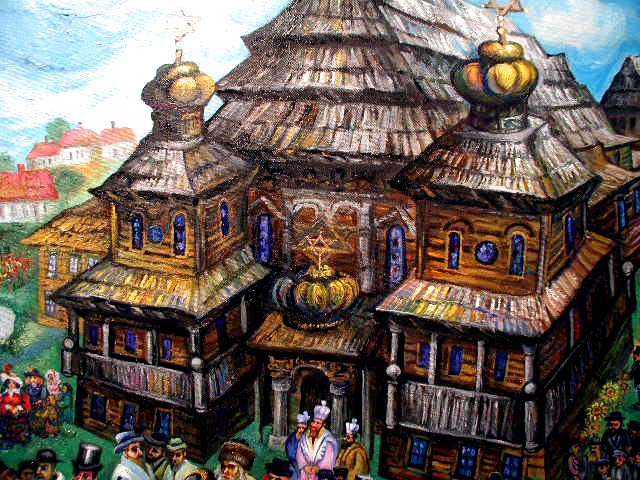
Ari Roussimoff Ancient Wooden Synagogue 

Eastern Commonwealth territories continued to change hands into the twentieth century. In Yale Strom's 1996 documentary film, Carpati, Fifty Miles, Fifty Years, a Carpathian mountain resident reported, "I had my bris in the Austro-Hungarian Empire, my bar mitzvah in Czechoslovakia, my divorce in the Soviet Union, and I'll be buried in the Ukraine, but I've never left my hometown." The borders changed, but this Jewish resident remained. His presence is very much a legacy of the policies of the Polish-Lithuanian Commonwealth that welcomed Jewish settlement, and, unlike other European countries, never expelled Jews, and granted Jews autonomy that they found nowhere else.

The Jewish community in Poland remained central to world Jewry up to the eve of its extinction in the Holocaust. "Interwar Poland was the golden age of modern, autonomous Diaspora Jewish politics. There was nothing like it before, and I will be bold enough to say that there will never be anything like it again in the Jewish Diaspora" wrote Ezra Mendelssohn, an historian of Jewish labor and Zionist history (Mendelssohn 203). Rabbi Michael Schudrich, from New York, now in Poland, affirmed, "'Before the war, we would have to come here to study. This was the heart, the arms, the legs, the kidney, the pinky of Jewish tradition'" (Buruma).

In a September, 1939 photo of German troops invading Poland, the viewer sees troop transport trains besmirched with graffiti reading, "Wir fahren nach Polen um Juden zu versohlen," translated as, "We're going to Poland to beat up the Jews" (Dobroszycki and Kirshenblatt-Gimblett 152). This juvenile graffiti and brutal, bullying language tells a horrible truth. Most of Europe's Jews did not live in Nazi Germany. Germany's pre-war population was about sixty-two million. Depending on criteria used to define who was a Jew, of those sixty-two million Germans, only between five and six hundred thousand, or less than one per cent, were Jews. Most of Europe's Jews lived in pre-war Poland. At about three million, they were ten per cent of Poland's population. Poland is where much of the Holocaust took place. Notorious concentration camps, including Auschwitz-Birkenau, Treblinka, Plaszow and Majdanek, were located in Poland. Auschwitz-Birkenau is often referred to, bitterly, but with some truth, as the world's largest Jewish cemetery.

Given the inestimable agony and injustice that struck Jews in Poland, one might understand why and how many Jews have come to understand "Poland" as a metonym for "evil." One Jewish Holocaust pilgrim reported: "For my people...that land is little more than...a witness to the devices of evil" (Kugelmass 439). Jewish-Polish author Eva Hoffman, daughter of Holocaust survivors, wrote, "In postwar Jewish memory, in the minds of many Holocaust survivors and their descendants, Poland has come to figure as the very heart of darkness, the central symbol of the inferno" (3).

And yet there are Jews today who actively work for dialogue with Poles. Why? George Szabad, co-chair of the National Polish American Jewish American Council and an official of the American Jewish Committee, said, "The only thing that makes the Polish-Jewish bridge so important is the combination of the sense of history and the fact that it is such a love-hate relationship. There is no such thing as Jewish history without Poland, or Polish history without Jews"(Henry). When asked his motivations for working for dialogue with Poles, Byron Sherwin, rabbi, theologian, author, and Spertus College of Judaica vice president, replied,

"the history of the Jews in Poland is absolutely exceptional and cannot be compared with the history, experience and creativity of the Jews in any other country. For instance, the Jews were expelled from almost all the European countries, but not from Poland. Here the Jews created a culture, learning, an educational system and even a language, Yiddish, such as arose nowhere else. Just before the Second World War, eighty-four percent of all the Jews in the world either lived in historically Polish territory, or came from families that had lived there ... I regard it as important to make today's American Jews aware of the special place of Poland in the history of the Jews, and to convince them that, in order to understand themselves, they must come to know the history and development of Judaism in Poland." (Nosowski 157)

Poland's Importance to Jews; Jews' Importance to Poland; Jews' Defense of Poland

White Birches by Cassi Saari source

Following this post, accessible via the links below, is a compilation of quotes attesting to four things:

1.) The importance of Poland to Jews

2.) The importance of Jews to Poland

3.) Love as a factor in Polish-Jewish relations

4.) Jews' Defense of Poland

I compiled these quotes when "Bieganski" was in its early stages. I had to delete them for the final, published book, to keep it from being too long.

I offer these quotes here for anyone who is new to Polish-Jewish relations, and doesn't really know why Poland matters so much to Jews, and why Jews matter so much to Poland.

Friday, February 4, 2011

"The Promised Land" Andrzej Wajda


"The Promised Land" is a visual feast, fast-paced, and every bit as ruthless as the cutthroat characters it depicts. The topic – the Industrial Revolution, and the characters – immoral greedy monsters – are ugly and mean, but Wajda's filmmaking is so virtuosic you watch just for the sheer craft, splendor, and runaway train of a plot. I find it hard to sit through movies where there are no sympathetic main characters and no possibility of a happy ending, but "The Promised Land" is addictively watchable. There's an orgy, a tiger, several mutilated bodies, fires, riots, history, and Wojciech Kilar's driving, award-winning score.

Anyone interested in the Industrial Revolution should see this movie. Fans of Dickens' "Oliver Twist" and Gaskell's "North and South" really must see it. I wish I could require my students to watch it. Wajda was determined to get every detail correct. In the DVD's extra features, an assistant director discusses a scene of indigent paupers receiving charity food. Wajda's team discovered that the indigent were fed from long, metal tables with bowls built right into them. They rebuilt such a table just for this scene, lasting a few minutes. They had special wooden spoons made, and then weathered them by soaking them in oil. The paupers' rags were similarly weathered. There is a lengthy scene where Anna (Anna Nehrebecka), a country aristocrat, travels to the city. The camera follows Anna and lays out Lodz before her in all its gritty, noxious detail: smoking chimneys, workers' funerals, fighting men, the Jewish quarter. The scene looks like documentary footage of a late nineteenth-century industrial city.

"The Promised Land" also takes the viewer into the mansions of Lodz, almost ridiculous in their sumptuousness, plunked down in so much filth, squalor, and despair. Ornate winding staircases, gilt-encrusted columns and ceiling murals lure on industrialists willing to wring every last penny from their desperate employees.

"The Promised Land" depicts Lodz's emergence as a textile manufacturing hub. Three friends, one a Polish aristocrat, one a Jew, and one a German, strive to build their own factory. They have few resources and must do dirty things to make their dreams of unlimited wealth a reality. Blond Karol (Daniel Olbrychski) has the face of a cherub and the soul of a serial killer. His entire being is omnivorous greed. Moryc (Wojciech Pszoniak) cheats another Jew to get his stake. After doing so, he practically collapses from the strain, and then breaks the fourth wall, winking at the audience. He's just an actor playing a part, he reminds us, as they all are, playing any part they want to get their highest ideal: cash.

The film also depicts workers and their plight. A dewy young mill hand is lured into prostitution. Others are consumed by the machines they work. Scenes of mutilated flesh are quite graphic, and yet not sensationalistic. This is the price poor people pay for bread, the film shows us. The camera does not linger. It keeps moving. Just like Lodz, just like men chasing cash, just like history.

There are a few characters who aren't utterly despicable. They appear, make small squeaks of decency, self-respect, and dignity, and are crushed by the inevitable. There is a stunning scene that is quite different from anything else in the film. The film moves quickly and purposefully, but in this scene men meet in a small room to play classical music. The scene is not at all essential to the plot. It moves with atypical languor. The scene seems to say, "Yes, people in Lodz had souls." That reminder makes the surrounding greed-induced frenzy all the more disturbing.

Some viewers protest "The Promised Land" as an anti-Semitic film, because of unpleasant Jewish characters. Indeed, there are unpleasant Jewish characters in the film. Virtually *every* character in the film is unpleasant – even the pretty, innocent child lured into prostitution. The film does not allow you to pity her, but implies that she was complicit in her own downfall. Further, every character is unpleasant in an ethnically- gender-, and socioeconomic-class-coded way. That is, the Polish peasants are unpleasant in a stereotypical way associated with peasants, the one priest is unpleasant in a way associated with priests. The men are bad men, the women are bad women. The priest is onscreen for minutes only, but he leers at a pretty factory hand. Anna has a big heart, but she is ineffectual and not smart enough to see through Karol. Other women are whores or idiots. The Polish aristocrat aggressively sells out every high ideal his ancestors held dear. He desecrates an image of Poland's icon, the Black Madonna of Czestochowa. The Germans are either sadistic and autocratic or lumpen and dull. The Polish peasant who manages to rise above his station is an insufferable, loud-mouthed boor. This film isn't anti-Semitic; it is brutally misanthropic. It depicts people at their worst.

Again, it is Wajda's virtuosic filmmaking that makes all this endurable. At a key moment, a rock flies through a window. That rock means much – the inevitable march of history that has brought industrialists high and might also bring them very, very low. Any other filmmaker would probably have handled the rock through a window as a crashing sound followed by a thud. Wajda films this scene with such skill and poetry that the rock becomes a character in the film. It demands, and gets, the viewer's full attention. Subsequent action is filmed *from the rock's point of view.* Poland is a small, distant, and much contested country. It's filmmaking like that that amply earned Wajda his honorary Academy Award.

Sunday, January 30, 2011

Et Papa tacet: The Genocide of Polish Catholics. By Michael Phayer.

Nazi shooting Father Piotr Sosnowski

'Et Papa tacet': The Genocide of Polish Catholics
Commonweal April 8, 2005
source

Much has been written about Pope Pius XII and the Jews. His unwillingness to speak out explicitly against the murder of Jews in occupied Poland during World War II is well known. Less well known is that before the killing of Jews in death camps began, Pius had to deal with the genocide of Polish Catholics. Until recently, no one understood how the destiny of these two people intersected in the middle of World War II, an intersection that led tragically to the genocide of Jews and to a respite for Catholics.

To Polish Jewish survivors of the Holocaust, it didn't appear that the Germans intended a genocide of ethnic Poles. For one thing, Jews were rounded up by Germans, while the ordinary people of Poland were not. But this fact leads to a mistaken conclusion. The Germans did intend genocide for ethnic Poles. This plan was two-tiered: first, the Nazis would take out the intelligentsia and church leaders; second, after the common people's labor potential had been used up, they'd be eliminated. It is generally known that the Nazis murdered between 5 and 6 million Jews during the war, mostly in gas chambers in occupied Poland. It is less widely understood that if Germany had won, Polish Catholics would have been slowly (or not so slowly) used as slave labor and then murdered.

As far as the Nazis were concerned, Poland itself was to be eliminated. "We shall push the borders of our German race," SS leader Heinrich Himmler said, "five hundred kilometers to the east. All Poles will disappear from the world." In the fall of 1939--soon after the war began--the western, German-occupied half of Poland was divided in two. The northwest area was annexed to Germany, and the rest, called the General Government, was used as a dumping ground for dispossessed Poles from the northwest and as a ghetto for Jews. Hitler then ordered the killing of the Catholic intelligentsia. Later, others, called "primitive Poles," were used as a migrant work force and starved to death.

The Vatican knew of German atrocities against the Poles practically from the war's start. Pope Pius XII reacted swiftly. In December 1939, the Vatican newspaper L'Osservatore Romano decried both the closing of many Polish schools and churches, and the fact that many priests and nuns were being sent to concentration camps or into exile. In January 1940, Vatican Radio reported that Jews and Poles were "being herded into separate ghettos, hermetically sealed, where they face starvation while Polish grain is shipped to Germany." Vatican Radio's accusations were remarkable. Germans were not singled out as the perpetrators, but this was hardly necessary. (Who else could have committed the atrocities in western Poland?) The broadcast went so far as to identify victims by name--Jews and Poles alike. The reference to genocide by starvation was made powerfully clear.

This statement by Vatican Radio turned out to be the strongest, most specific one that the papacy would make about wartime atrocities. Soon after, the Vatican plunged into silence. No more pointed broadcasts. No more damning coverage in L'Osservatore Romano.

Polish Catholics and their church were left to suffer in isolation, and their suffering intensified until 1942. The Germans, knowing Catholicism to be a sacramental and hierarchical religion, attacked the church at these levels. Thirty-nine of western Poland's forty-six bishops were deported, imprisoned, or otherwise put down. Priests were jailed or sent to concentration camps--2,800 to Dachau alone, of whom all but 816 died. In one diocese, 291 of 646 priests were killed. By mid-1942, only 10 priests remained in the diocese of Gnesen to administer the sacraments to 359,000 Catholics. A staggering 20 percent of Poland's clergy failed to survive the war.

Because he believed the war effort required internal unity, Hitler did not allow high-ranking subordinates such as Himmler and Martin Bormann to persecute the church to this extent in Germany. But no such restriction inhibited them in Poland, where the hierarchy were suppressed through deportation and arrest, and where religious communities were suppressed. The Nazis closed innumerable churches and used many as barracks, garages, or warehouses. They shut down seminaries, forbade ordinations, and banned Catholic organizations. Administering the sacraments was strictly limited, especially Sunday Eucharist and confession. Or, if confession was allowed, the penitent was not allowed to receive Communion (at the time, the two sacraments were usually taken together). Thus did the Nazis attempt to disrupt religious life entirely in occupied Poland.

Killing was widespread as well. Gauleiter Arthur Greiser, the Nazi administrator of the Wartheland, killed thousands of Catholics in northwestern Poland. Throughout the war, hundreds of thousands of Poles were shipped to Germany as forced laborers. The bodies of those who died in transit were thrown into roadside ditches. The Germans also sterilized young Polish men and women by using x-rays on their reproductive organs. And as they had done earlier in Germany, they killed patients in Polish mental hospitals. At a facility in Chelm, 428 children were given morphine, then shot. Many patients in medical hospitals were simply thrown out. Initially, most of those imprisoned or murdered by the Nazis were Catholic leaders in the business, political, academic, and religious realms. Until 1942, for example, there were more Catholic prisoners in Auschwitz than Jews.

The persecution of the Polish church during the first years of the war ranks among the bloodiest persecutions in Catholic history. In their despair, church leaders turned to Pope Pius, begging him to condemn the atrocities. He refused. In 1942, Bishop Adam Sapieha of Cracow wrote to the pope saying that the situation was "tragic in the extreme. We are robbed of all human rights. We are exposed to atrocities at the hands of people who lack any notion of human feeling. We live in constant, terrible fear." Sapieha warned the pope that the faithful were losing confidence and respect for Pius because he hadn't condemned the horrors. Another Polish church leader wrote to Pius that some of the faithful were now asking "whether there was a God," and whether the pope "had completely forgotten about the Poles." Hardly a month passed without the pope's receiving an appeal to speak out. Some Poles thought the pope's silence meant he was in league with Hitler. Apostolic Administrator Hilarius Breitinger of Wartheland told the pope that Poles were asking "if the pope could not help and why he keeps silent." Pius responded that he was afraid that if he condemned the atrocities, they would only worsen. Polish church leaders answered that matters could not get any worse. Pius in turn replied that it was Poland's lot to suffer for the greater glory of God.

Pius XII's severest critic was Bishop Karol Radonski (exiled from his diocese of Wloclawek). In September 1942, Radonski wrote two letters to the pope that the editors of the Vatican's World War II documents have described as "violent." After running through a laundry list of atrocities and deprivations, Radonski pointed an accusatory finger at Pope Pius, "et Papa tacet" (and the pope keeps silent). From these documents, we see that the first accusations of Pius's silence during World War II came not from outside the church, or in reference to Jews, but from inside the church, in reference to Catholics.

The highly critical letters of Bishop Radonski were the last criticism the Vatican received from Polish clergy. Beginning in late 1942, the tone of correspondence from Poland to Rome shifted dramatically. Bishop Adamski of Katowice wrote that Catholics were remaining faithful. Apostolic Administrator Breitinger wrote that Poles now understood that the pope's silence had been a "heroic silence." Sensing the mood swing, Pius responded with a letter praising the Poles for their "heroic silence." Of course they had not been silent at all, but the pope's letter was a great success. Bishop Sapieha wrote that his countrymen would never forget the pope's noble and saintly words.

What accounts for this abrupt turnaround in Vatican-Polish relations in early 1943? The answer can be found not in papal dealings with the Polish church, but in the events of the war and Hitler's evil designs. The German army's blitzkrieg into Russia in 1941 foundered with its soldiers in sight of Moscow and Leningrad. Ill prepared for winter, the army was forced to fall back. All efforts then turned to preparing for a second assault in 1942. From the beginning of the war until mid-1942, ghettoized Jews had been forced into labor on starvation diets. The Nazis called it death through attrition, and, it worked. But in contemplating a renewed confrontation with Soviet forces, the army realized that it badly needed the warm clothing and military gear the Jews were producing. At that point, the German military command wanted less attrition and more production.

But that wasn't Hitler's agenda. In July 1942, he gave Himmler the order to kill all ghettoized Jews. By then, there were six death camps in occupied Poland (excluding the later facilities at Auschwitz-Birkenau). In the second half of 1942, nearly a half-million Jews from the Warsaw ghetto were mercilessly liquidated, a process that befell all other ghettos. As eminent Holocaust scholar Christopher Browning has said, death through labor gave way to death of labor. The only work force that could now replace the Jews were Poland's Catholics, and in September 1942, the army high command ordered "that Jewish workers were now to be replaced with Poles." By the end of the year, the substitution of Catholic for Jewish workers had been completed. At the same time, criticism of the pope by Polish churchmen ended.

Carrying out the Holocaust after 1942 meant a temporary suspension of the genocidal agenda intended against Polish Catholics--their labor was too valuable. This is how the destinies of Polish Jews and Polish Catholics crossed paths. When the Germans lost at Stalingrad in the spring of 1943 and Hitler was forced to retreat, the planned genocide of Polish Catholics never resumed in earnest.

Pius XII remained unmoved by the pleas of the Polish hierarchy before 1943 to denounce German atrocities in Poland. But the bishops themselves did no better when it came to the murder of Poland's Jews. It was not until 1995, fifty years after their deafening silence, that the Polish Catholic hierarchy apologized. Pius XII never did.

Michael Phayer is professor of history emeritus at Marquette University.
COPYRIGHT 2005 Commonweal Foundation
COPYRIGHT 2005 Gale Group

Monday, January 24, 2011

An Open Letter to Jan Tomasz Gross


Because I write about Polish-Jewish relations and the brute Polak stereotype, I'm often asked about Jan Tomasz Gross. I respond to those question here. My Amazon review of "Fear" is here.

Long story short: I defend Jan Tomasz Gross.

I've recently received a series of provocative e-mails from a poster I know only as Malgorzata. An excerpt from Malgorzata's most recent e-mail is below. The gracious reader will realize that English is not Malgorzata's first language, and will be tolerant of any minor errors this multilingual poster makes as she expresses herself, quite powerfully.

"It is one thing to make us, Poles, review our knowledge about history, but it's another thing to blame all Poles in front of the world, to others that do not know much about our history. His [Gross'] books give the strong impression that Poland generally supported Holocaust, Poles are Anti-Semites and you cannot expect anything good from Poles.

I do not say we should keep truth hidden in Poland, but let’s think who reads his books in America and Poland. I would estimate that max 10 % of readers are historians, and other highly educated people interested in the topic. These people will resist the hatred towards Polish as their overall knowledge about Polish history is good enough.

Another part of readers will be those that already have a negative opinion about Poles, so they will read the books to support their view. They will follow the overall impressions created in the books; they will never read any articles that disclose some discrepancies or clarify the possible reasons of these acts (but not justify). There are plenty of tensions between Jews and Poles. We have to work it through, not bring new ones.


In my opinion his books enhance the stereotype of Pole as Anti-Semites. When I read or hear statements that Poles have to finally confront their deep Anti-Semitism, I know the author of this comment has never been to Poland and probably does not even know any Poles. I have no idea where they currently see Anti-Semitism in Poland. But I can assume they drew the conclusions from Mr. Gross’s books. This is why I think they bring more harm than good. Especially, when we are trying to work out our relations with the world again."

I think Malgorzata has a valid point. This young lady has inspired me to send the e-mail, below:

jtgross@princeton.edu

Dear Prof. Gross,

Hello, I write about stereotypes of Poles and have a blog devoted to the topic. I receive many e-mails about you. I have responded to these e-mails via a blog post about you, linked below.

In short, I defend you.

Recently, though, I received a series of thoughtful e-mails from a poster known to me only as Malgorzata. As you can see from comments on the blog post, linked below, Malgorzata makes the case that your work, regardless of your intention, is used to slander Poland and exacerbate tensions between Poles and Jews and between Poles and the rest of the world.

Again, I have always defended you. I believe in truth and scholarship.

But there is merit in what Malgorzata writes.

Because of the merit of Malgorzata's posts, I would like to invite you to do something concrete to rectify the damage – no doubt unintentional – that reception of your work has done. Please know that I say that "reception of your work" has done damage. I think you are a responsible scholar and a patriotic Pole-by-birth (though you are American now.) I am confident that you mean well. You can't deny, on the other hand, that your work has been exploited for negative ends.

I want to invite you to read the one book that addresses negative stereotypes of Poles and how those stereotypes are used to distort history, and to do what you can to raise the profile of that book. You are a scholar of world import. "Bieganski: The Brute Polak Stereotype" will never receive much attention; it addresses the concerns of a marginalized group.

You have manifested your courage, your dedication to truth, and your commitment to Poland. I hope that all these will convince you to consider my offer, and to "step up to the plate," to use an American metaphor, and do the right thing. Buy "Bieganski." Read it. Recommend it. Acknowledge that while atrocities committed by Poles are very real and must be confronted, there is another reality at work, stereotyping and distortion. These must also be called out, confronted and defeated.

Respectfully. 


Original blog post that prompted this idea here.
 

Sunday, January 23, 2011

The Way Back: A Masterpiece.


"The Way Back" is a masterpiece, a must-see film for thinking people and for lovers of cinema as a serious art form. I was on the edge of my seat through the entire film, and was stifling tears. I could not resist applauding at the end. I couldn't wait to discuss it with friends. Several hours after I left the theater, I kept seeing everything – a meaty sandwich, clean water flowing from the tap – through the prism of "The Way Back." I'm a long-time fan of director Peter Weir, who gave us classics like "Picnic at Hanging Rock," "Witness" and "The Year of Living Dangerously." Weir has outdone himself.


"The Way Back" depicts a long walk that Gulag escapees took from Siberia to India. I've been lucky enough, under luckier circumstances, to travel some of the world the film references, from Poland to the Himalaya. The film's authenticity in language, costume, even hairstyles, swept me up into its world.

Both Nazi Germany and Soviet Russia attacked Poland in September, 1939, thus beginning World War Two. At first, the Communists killed and deported more people even than the genocidal Nazis. Over a million Poles were deported in cattle cars. Many died; many never returned. No one knows exact numbers. Many struggled to return home, traveling on foot through Eurasia, making shorter treks comparable to that depicted in "The Way Back;" I've met such people.


Janusz (Jim Sturgess) is a young Pole falsely accused by Soviets. His wife is tortured to force a confession. Without ceremony, he is shipped to hellish Siberian concentration camps and mines. Janusz determines to escape, with a ragtag, multilingual crew of followers.

Janusz is not particularly handsome, or muscular, or super intelligent. He doesn't have a commanding voice or swagger. His potentially fatal flaw, in this environment, is kindness. Jim Sturgess' Janusz is one of the best aspects of the film. In real life, true leaders usually are not like Arnold Schwarzenegger. Janusz grew up in the woods, and knows how to jerry-rig a compass to point his group south, and a mask to survive blizzards. In the world of Gulag escapees, that's enough to make him the big man. Indeed, Valka, (Colin Farrell), a very tough gangster, declares, or diagnoses, that Janusz is the leader, the man whom the other escapees must obey, both for their own individual benefit and the benefit of group survival.


Prison escapees traveling thousands of miles of the Eurasian landmass with minimal gear face multiple dangers, from malnutrition-caused blindness to mosquitoes to snakes to dehydration. Some succumb, and die en route. You can't help but bet the same horrible game of chance that Valka proposes: who will die next? And will his meat be tender – that is, will we resort to cannibalism? A crew member falls. Surviving companions, in stunning testimony to their own humanity, take the time, burn the calories, devote the effort, to fashioning makeshift graves, and funerals. And then they march on.

What looks very beautiful on a calendar – an unspoiled mountain forest of snow-dusted evergreens – is actually all but an execution chamber for a hungry fugitive with no tools and only rags for shoes. The last thing a good man sees after making the simple mistake of walking too far with a limited light source will not be a breathtaking natural vista but a comforting, wrenching, hallucination of home.


Weir's best choice as a filmmaker here was simply to get out of the story's way. "The Way Back" does not want to be your best friend. Weir makes no attempt to cozy up to the viewer, to sweeten the story with phony warmth or touching crescendos. Weir makes no attempt to juice the action with cinematic steroids. For much of the film, the viewer is watching one grueling step after another.

Guess what? This is what it's like to suffer for a goal, this is what it's like to be crushed, this is what it's like, purely by chance – not because you are a better person or because God likes you more – to survive. You go on, hour after hour after seemingly pointless hour toward your questionable, impossible objective. This film is an endurance test. It will separate the men from the boys. Folks who think a movie about fantasy, sexy ballerinas is "great" filmmaking, and who think that temporarily losing their cell phone service is a human rights violation, will probably walk right out of "The Way Back."

Characterizations come slowly and are not forced. We discover, in a ruined monastery, that one character had been a priest. We discover that a girl can get taciturn men to talk. Characters speak of food, as hungry people do. "Add more salt!" to a fantasy meal, one begs. Valka makes a decision that caused this viewer to cry. I never thought the film could make me care about this murderous thug, but it did. There is inevitable, and surprising, laughter, also not forced, but integral to the circumstances.

There are moments of high drama. The men must fight wolves. Weir could have lavished lengthy close-ups on those sharp teeth, snarling snouts and prickly pelts. He doesn't. The wolves are onscreen only long enough to establish what they are and what they are up to. And then the next deadly and impossible challenge rolls down the shoot at the viewer, just as it did for those who took this long walk, and the millions of other humans like them, who have survived life and death challenges under impossible conditions. "The Way Back" is, like those poignant grave-markers the marchers make en route, testimony to those who have lived anonymous and agonizing lives in this pitiless world. If you don't think about the big questions while watching this film, and if you're not grateful to the film for that, you don't deserve it.


***

There's been controversy in the press about "The Way Back." Some links, below: