Sunday, July 11, 2010

Population Drifts by Carl Sandburg

Babie Lato Jozef Chelmonski source

Love the Carl Sandburg poem, below, about the deracination of the c. 1880-1929 immigrants and their kids.

POPULATION DRIFTS

Carl Sandburg

New-mown hay smell and wind of the plain made her
a woman whose ribs had the power of the hills in
them and her hands were tough for work and there
was passion for life in her womb.
She and her man crossed the ocean and the years that
marked their faces saw them haggling with landlords
and grocers while six children played on the stones
and prowled in the garbage cans.
One child coughed its lungs away, two more have adenoids
and can neither talk nor run like their mother,
one is in jail, two have jobs in a box factory
And as they fold the pasteboard, they wonder what the
wishing is and the wistful glory in them that flutters
faintly when the glimmer of spring comes on
the air or the green of summer turns brown:
They do not know it is the new-mown hay smell calling
and the wind of the plain praying for them to come
back and take hold of life again with tough hands
and with passion.

High Flying Bird and Coal Mining


Michael Kelemen sent me an interesting email about the Jefferson Airplane song, "High Flying Bird." As Michael pointed out, and as is written about in the website linked below, the song was originally about a coal miner dreaming of escape by death from his coal mining life, into the freedom a bird enjoys.

From Raymond's Folk Song Page:

"This great coal-mining song tells the story of a miner who dreams of escaping the mines by thinking about the freedom of a flying bird, but the only way he can ultimately escape the mines is by dying. It was covered a lot in the early 70s by artists such as Jefferson Airplane, Richie Havens and Gram Parsons, but often with changes to the lyrics that lost the original meaning. I first heard it sung by Judy Henske, who was the first to record the song. It was the title track of her 1963 album (1963) and she sang it with the original words. It was then picked up by Richie Havens and it became his signature song. Wheeler personally did not like the way Havens did the song. He said in a in an interview that "it was too monotonous - although I was thrilled that he did it. I don’t care how you do my songs as long as you do ’em! It is flattering and it helps me to eat."'

High Flying Bird on youtube

Tuesday, June 29, 2010

Betty Friedan, The Feminine Mystique, and the Bieganski Mystique.

Betty Friedan. AP / Anthony Camerano

Stereotypes of Poles as animalistic brutes are so common in American popular culture, academia, and journalism that I had a superabundance of material to choose from. One book I did not cite but could have: Betty Friedan's epoch-making feminist manifesto, "The Feminine Mystique."
I'm rereading the book now for a course. I had reservations about it the first time I read it; this time, at first, I fought with myself. "I must love this tract because I am a feminist" battled it out with "This book is crap."
"This book is crap" won the duel.


Friedan's sources don't hold up.


She cherry picks; if she finds a study whose conclusion she likes she cites it; she ignores research that doesn't support her. What would she make of current studies that suggest that some differences between males and females are hardwired?


She lambastes what she doesn't like about Freud; she cites what she does like about Freud, for example, his thoughts about homosexuals (275). Friedan: "homosexuality is spreading like a murky smog over the American scene" because of "parasitical mother-love." "Homosexuals often lack the maturity to finish school and make sustained professional commitments" (276).


Friedan's childhood was unhappy not because she grew up under the thumb of oppressive patriarch, but because her mother was an "insatiably greedy," unpleasant shrew who relentlessly belittled her father.


She fictionalized her life on many levels, from name changes (Bettye to Betty; Friedman to Friedan) to hiding her Stalinism that was so doctrinaire that she opposed joining the war against Nazi Germany as long as Stalin opposed it.


Friedan's constant belittling of women is grating. Women who fall in love are fluff heads. Women who build their lives around home and children are embarrassments. Women who clean their own homes are worthless fools. Pretty, blue-eyed blondes come in for real trash talk. Friedan never sees the irony in her demand that a real feminist is someone who hires a nanny and a housekeeper to do the lowly work of making a home. A real feminist is doing "important" things like those glorious comrades who marched with Castro (36).


You realize, in reading this book, why history's pendulum had to cough up reactions like Madonna and Martha Stewart.


Of course there are the disturbing allegations that Friedan's husband beat her, and that she beat him.


Friedan insists on the complete plasticity of gender identity. That conceit has had very tragic applications, as in the case of David Reimer. Maybe I need to read this book a third time to come to value its gifts and forgive its flaws.


"The Feminine Mystique" is proof of the need for Godwin's Law. Friedan repeatedly and emphatically compares the status of American housewives to the status of Nazi concentration camp inmates (305-09). Way to trivialize the Holocaust, Betty, and to muddy the waters for those who wish to discuss misogyny with any intelligence or integrity.

I've long wondered at mainstream American feminism's many failures: its inability to appeal to more women, its failure to step up to the plate regarding Islamic gender apartheid and sex trafficking. Friedan's book was foundational. It is replete with ideological cracks.


***
Friedan quotes a study by University of New Hampshire sociologist Arnold W. Green that depicts Poles as animalistic brutes.


Poles. They Don't Know What Love Is.
Just like primitive tribes!

Green's focus is not Poles; Poles exist to serve as contrast to a more important population.

"The Middle Class Male Child and Neurosis" appeared in the American Sociological Review, XI:1 (February 1946) 31-41.


Though Poles beat their children savagely, the children don't become neurotic the way that American middle class children do, Green wrote, because there is no love bond between Polish parent and child.


Green describes a "Polish colony," a mill town in Massachusetts.


"Norms governing courtship and marriage do not apply within this Polish colony. This is also true of parent child relationships … their expectations of their American-born children's conduct reflect an alien peasant system of values. An outstanding feature of peasant family life, in contradistinction to that of modern, middle-class family organization, is the stress placed upon rules and work functions rather than personal sentiment … these rules of conduct and this parental authority are out of place in this American industrial slum."


Parents "are met with the anger and ridicule of their children. These "peasant" parents exercised "vengeful, irrational" parental authority.


"Love is alien to peasant mores"

"Parents apply the fist and the whip rather indiscriminately. The sound of blows, screams, howls, vexations, wails of torment, and hatred are so commonplace along the rows of dilapidated millhouses that the passersby pay them scant attention."

"The open woods and fields are close at hand and the children roam far. The homes are not clean, nor do they contain furniture of any value…children develop openly malicious contempt for their parents as stupid … their training is very similar to that received in many primitive tribes."


Green introduces no Polish informants. He provides no transcripts of interviews. He produces no data to support his assertions of Poles as dirty primitives who don't know what love is. He offers no solution, no suggestions for intervention. He didn't have to. Again, this was published in a scholarly journal.


Friedan liked what Green had to say, so she quoted it unquestioningly and approvingly in "The Feminine Mystique." A woman identified as a liberator and groundbreaker couldn't see the dehumanizing classism and elitism that jumps out at this reader in both Friedan's citation of Green and in Green's original article. Both Friedan, and Green, might as well have been writing about zoo animals.

Sunday, June 27, 2010

Polish. And Gay.

Krakow 2008 Gay Pride Parade. Stan Baranski

Ten years ago I broadcast the following essay via WFIU in Bloomington, Indiana:


***

Have you seen the new Hollywood blockbuster, U-571? A bunch of macho American submarine sailors change the course of World War Two by stealing a Nazi code machine. The filmmakers assured us that this is a true story!


Well, not quite. It was Polish intellectuals, and a gay British mathematician, who did the key work on breaking Enigma, the Nazi code.


Sure, U-571 is only a movie. It's just that unfortunate stereotypes guarantee that "Polish Intellectual" and "gay war hero" are oxymorons, the punchlines of jokes.


Hollywood could have played the hero in the war on stereotypes had it depicted - accurately - the Brilliant Polish scholars, and the heroic British homosexual whose work on Enigma greatly facilitated victory for the right side.


It's not just in Hollywood, unfortunately, that these contributions have been slighted. In real life, after the war, Churchill and Roosevelt delivered Poland, their worthy ally, into the hands of Joseph Stalin, a man responsible for more civilian deaths than Hitler.


And what became of Alan Turing, the gay British mathematician who also worked on Enigma? He was arrested, and offered a chance of prison or forced hormone injections to "cure" his homosexuality. He died an apparent suicide. Unfortunately, U-571 is part of a Hollywood trend that diminishes the role of all the diverse peoples whose combined effort defeated the Nazi menace.


*** End of broadcast essay***

At the time that I broadcast the above essay, I was participating in internet discussion lists devoted to Polish topics. I posted the text of this essay on one such list. I received a poignant private email in reply.


The sender of the e-mail was gay. This person talked about how rough it was to be both Polish and gay. To have to live with negative stereotypes of Poles … and of homosexuals.


The person begged me not to reveal his/her identity. I never have. I haven't forgotten this person, either.


I don't know why Poland, post-1989, allowed homophobia to take a prominent place in its public life. It is always a sorry spectacle when formerly oppressed people, Poles, and African Americans also, adopt prejudice and oppression towards others. When Lech Kaczynski and other prominent Poles were killed recently in a plane crash, many websites, knowing only this of Poland and Kaczynski – that he was a homophobe – carried the headline, "Homophobe Dies."


I'm a Christian. People ask me how I can be gay-friendly. I discuss that here.


Saturday, June 26, 2010

Get Me a Hunky; Comments from Readers

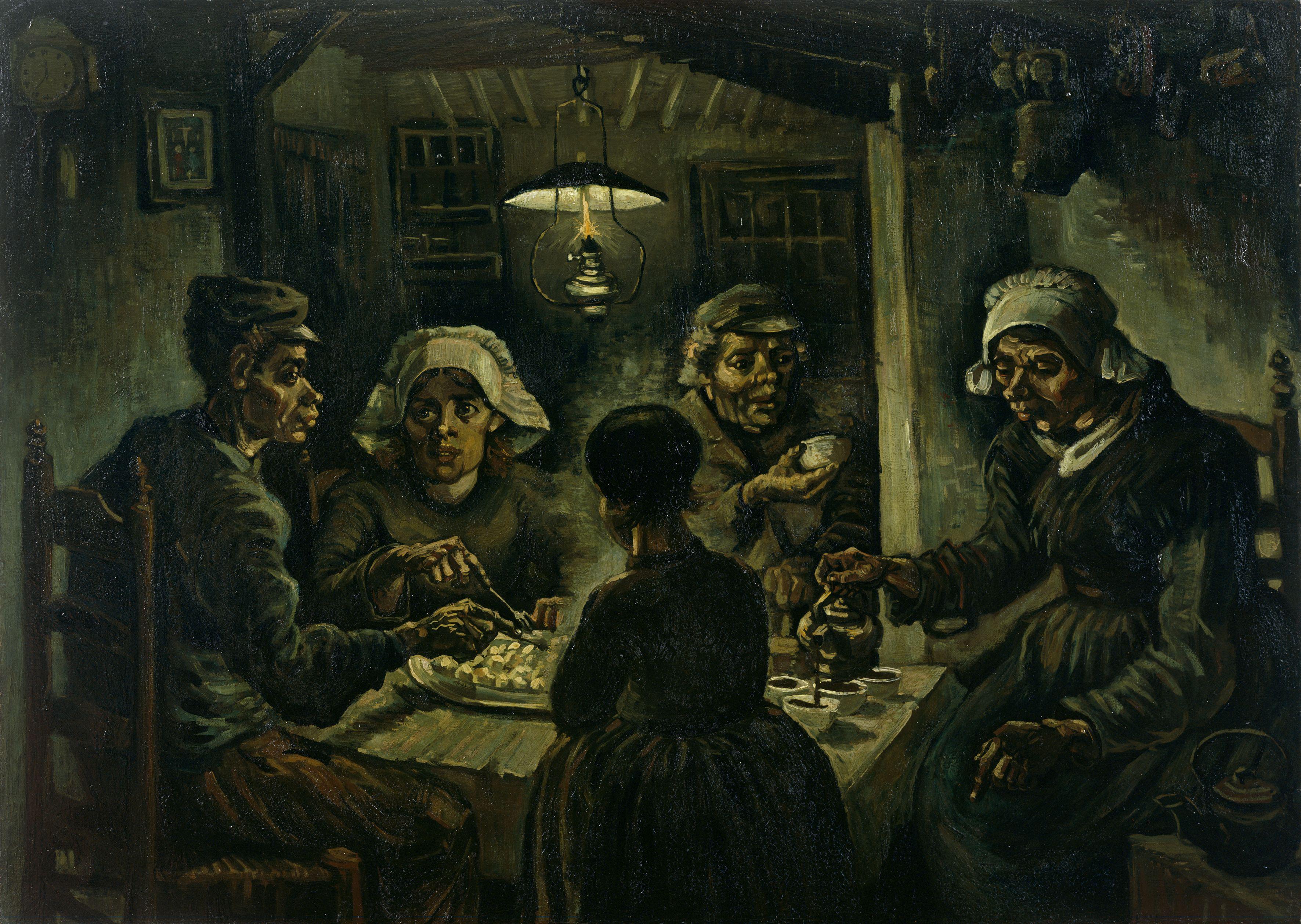
Potato Eaters. Vincent van Gogh. Source: Wikipedia

"Get me a hunky; I need a donkey" provoked interesting feedback from readers. Comments including the following:


* Readers, too, had Polish immigrant parents, both Catholic and Jewish, who maintained silence about their pasts.


* Peasant life was much harder than is commonly acknowledged.


* Immigration was much tougher than is commonly acknowledged.


* Poles, as well as Russians, might oppress their fellow Poles.


Adam Walaszek's article, "'How Could It All Appear so Rosy?': Re-Emigrants from the United States in Poland, 1891 – 1924" addresses all of these points.


Walaszek used peasant and worker memoirs and letters to show that many Polish immigrants wanted and planned, not to stay in America, but to return to Poland. Those who did return were often shocked.


* They had gotten used to American wealth and were horrified by the poverty of Polish villages and the hardship of peasant life.


* They had gotten used to American democracy and were stunned by the power exercised by Polish priests and village politics.


* They had cherished dreams that, once Poland was freed from foreign domination, Poland would become a "democratic, affluent, peasants' Poland." Instead, they returned to discover that Poles had changed "a czarist truncheon for a Polish one."


Snips from Walaszek's not-to-be-missed article:


"I only wished to [return to Poland.] I cried and cried for my mother for a year. I was homesick and I could not find a place for myself. At night I always dreamed that I would die. I was extremely homesick."


Immigration was jarring. Poles "jumped from feudalism to capitalism within the space of one month"


Upon return to Poland, some wrote,


"I was wondering if the twentieth century, with all its miracles, has arrived here, or whether the time had stopped somewhere around the caveman era"


"Even in our family houses the walls have rotted away and warped where the supportive beams sank below the level of the ground and the whole house was slowly bending down."


"I disliked the old customs of our people, I disliked the huge bare feet of our girls, elderly women, children and men ... It seemed to me somehow archaic, slave-like, and simply primitive and unaesthetical. I was surprised and indignant on seeing that people do not bathe in villages, they do not know what a bath is, whereas most country cottages are joined directly to barns and pigsties. I will not believe it if anyone tells me that a peasant wearing coarse trousers, a shirt, a russet coat and a sheepskin hat or a peasant woman with red bare legs wearing a bawdy, pleated Gypsy-like skirt, a shapeless blouse and some head scarf, look nice and human like."


"I was shown a blind beggar with an intelligent face leaning against the wall of the Old Theater [in Krakow's Szczepanski Square.] An old woman dressed in rags was walking along. Rags which Poles in Passaic, New York, or Chicago would throw into the garbage cans would be like royal outfits for this poor woman."


Returning migrants were treated with suspicion and outright hostility. Priests denounced them from pulpits, to the point of demanding of non-immigrant wives that they not allow returning immigrant husbands into the home. Returning immigrants' businesses were sabotaged.


One returning immigrant wrote


"[My own people] pulled me to pieces. It was entirely different in NY. The people here are so dumb and mean. They look upon the Polish Americans as if they were criminals."


A priest preached in church that the returning immigrants should have been shot. The Polish American newspaper, "Ameryka Echo," was burned by a priest.


How this all relates to stereotypes of Poles, and Polish-Jewish relations. Humans – not just Poles, not just Jews, but humans – often judge and feel contempt for workers, peasants, dirty people, the poor. It's an old joke – when people claim to have been reincarnated from some past life, in their past life they often claim to have been Cleopatra, or some other prominent, royal personage. It's less attractive to claim to have been what most humans have been: anonymous, poor, dirty, oppressed, overworked, and short-lived.


Simple hatred of the poor and the unfortunate for their sin of poverty and misfortune is the oldest, most universal, and most crushing hatred.


We could learn to appreciate and honor the strengths and gifts of peasants. We haven't yet done so.


We can't come to terms with the brute Polak stereotype until we come to terms with our own classism, our own conviction that someone with dirt under her nails is a lesser human than we.


So often scholars get away with arguing that Poles expressed hostility to Jews because Poles' essence is anti-Semitic. If they even try to be more intellectually developed than that – and they often don't make even that effort, even in the most elite and academically sanctioned prose, condemning Poles with a racism that would be taboo were it applied to any other ethnic group – they'll claim that it is Poles' Catholicism that makes them anti-Semitic.


This is balderdash. There is ample scholarship on the inescapable political realities of colonized, invaded, deprived, peasant societies. In Walaszek's article, one reads of Polish peasants expressing a hostility to their own kin from America – if and when these Polish peasants feared that those kin would upset a very fragile, post-war, post-colonization status quo of village economics, land ownership, religious belief, and divisions of power.


Those who demonize Poles insist on viewing them from the perspective of 20th and 21st century Americans, with their wealth, democracy, and unlimited opportunities. From that perspective, the behaviors described above appear to be the mere malice and backwardness of one group of essentially debased people, Poles.


George Foster, an American anthropologist, developed the concept of "limited good" as a way of understanding ALL societies, especially peasant societies, where chronic scarcity is a fact of life. Foster wanted to understand such societies on their own terms. He rejected applying American values to peasant society. Application of "limited good" would illuminate the tensions of Polish peasant life that Walaszek details, above.


With the tool of limited good, these behaviors become understandable as an expression of universal human tendencies.


I can't think of a single prominent scholar of Polish-Jewish relations who makes any sustained use of Foster in discussions of Polish-Jewish relations. Perhaps this is so because it serves these scholars' ends to depict Poles, as is acceptable, in the academy, in the mainstream press, and in popular culture, as possessed of a nasty and intractable Polish essence, "Polish anti-Semitism."


George Foster and Limited Good

Adam Walaszek
"How Could It All Appear So Rosy?"

Tuesday, June 22, 2010

GET ME A HUNKY; I NEED A DONKEY


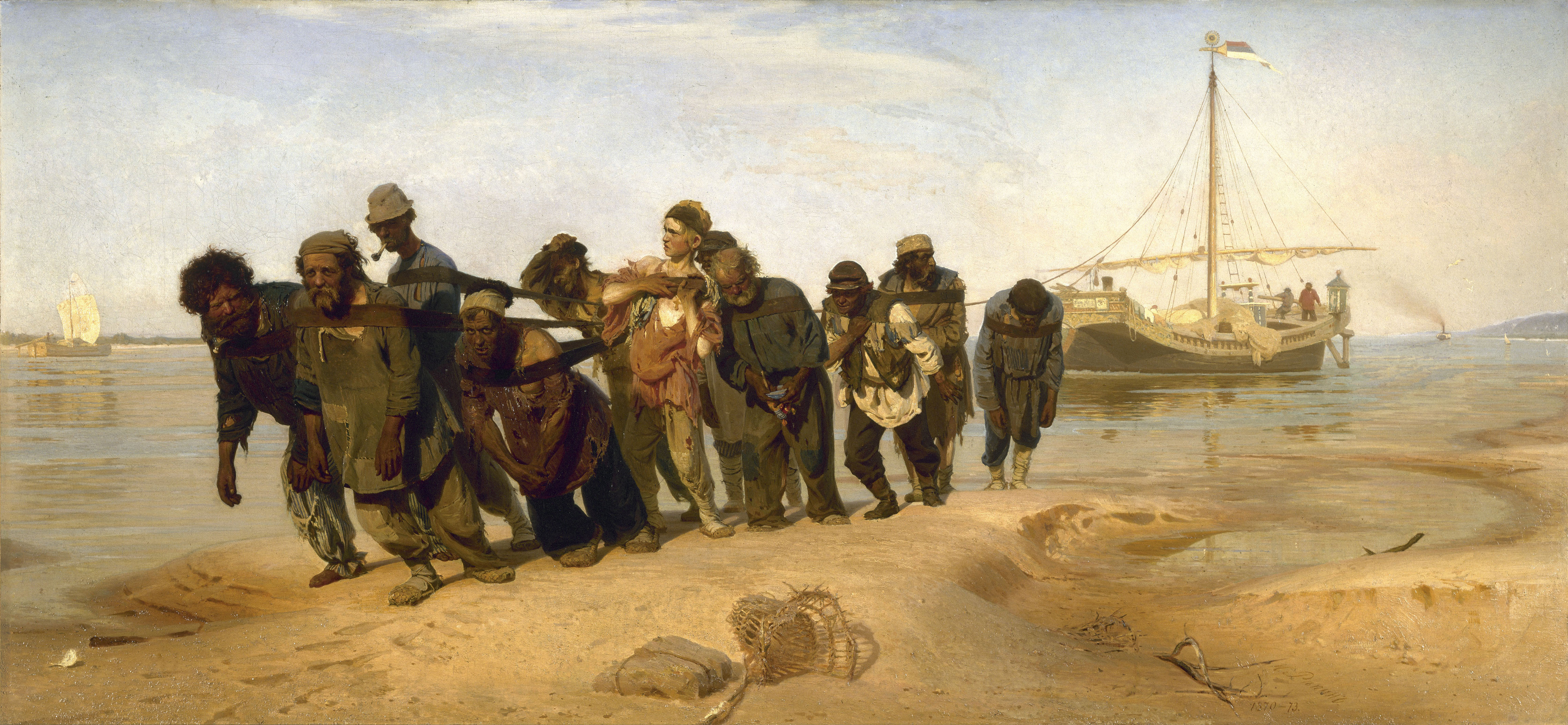
Some of my ancestors enjoying their "white privilege."
Ilya Repin's "Barge Haulers on the Volga"


My dad was not in this photo - but he could have been.
Lewis Hine. "Breaker Boys"


"Get me a Hunky; I need a donkey."


According to my dad, Anthony Goska, that's what the coalmine bosses called out in Throop, Pennsylvania, early in the twentieth century when they needed some work done. They were seeking "strong backs," Bohunks, Poles, Hungarians, and Slovaks.


True story:


I really love one of my students. She's smart and she cares and I'm confident that, if she got the right degree and the right job, she could use her brains and heart to make the world a better place.


There's no guarantee she'll get there. Her parents have bequeathed nothing to her but hard times. She's done pink collar work, just to scrape by.


She came to me one day and told me she was leaving university. In one of her teacher-education classes, the professor was talking about poverty as if it were only experienced by "people of color." My student raised her hand. Said, "There are poor white people in this country, too." Professor said, "Their poverty doesn't count because they are white." Quote unquote.


When my student heard that, she had an epiphany. She realized that the ivory tower world she had hocked so much to be part of was, in its allowance of dominance by unquestioned Politcal Correctness, bullshit.


"Stay," I begged, pleaded, commanded, struggling to find a strategy that would get her to stay. "This academic world needs minds, hearts, like yours, needs a sense of outrage like yours. Stay." I hope and pray that she does.


Polish peasant


I interviewed my dad on tape twenty years ago. Rereading the transcript breaks my heart, and not just cause he's gone. I'm a Jersey girl; lemme let Springsteen do the talking: "The first kick I took was when I hit the ground. You end up like a dog that's been beat too much. Till you spend half your life just covering up."


What was God thinking? What were you thinking, God? A child, didn't even speak English, constantly beat, and beating, and never able to get his head above drowning tides: peasant status, Poland's colonization, mass migrations, racism, The Industrial Revolution, world war, displacement, deracination.


Not just my father. Millions of others like him. Bohunks: Eastern European, Christian, peasant immigrants who came to the US between 1880 and 1929 to mine coal, and forge steel, and get blown up, and their skin stripped off, and chopped to pieces by industrial fans: industrial accidents that killed many young. Then they came of age, and they were shipped off to places like the Western Front and Omaha Beach.


Why isn't their story told in the Ivory Tower?


Poor, enserfed, whites. Can't have that. I could tell so many stories. Ask me sometime. I could go on all day. Just one more: in a class, on a university campus, professor says, "Well, yes, there was racism against the [1880-1929] immigrants, because they were dark-skinned, and this is a white supremacist country."


Believe that? Can I sell you a bridge, or a war, or a hate? Or a lie, disguised as your own history?


But our silencing and erasure is not the fault of academic limousine liberals. It's our fault. That's right. It's OUR fault.


Have we made our voices heard? No. Have we bought copies of "Out of This Furnace" or "Laughing in the Jungle" or "The Poems of Anton Piotrowski"? No. And demanded that they be placed on syllabi? No. We have not.


Have any of you even READ "The Poems of Anton Piotrowski"? Links below. Buy. Read. Learn. Get back to me.


My dad's interview is brutal. Most of it I wouldn't even share. It's all just too harsh. Below are some of the milder excerpts.


DVG: Why did the Poles come to America?


AG: Because the czars burned our books.


DVG: What was everyday life like in Poland?


AG: Well, all it was, was grubbing. Grub. You know what I mean? They was no really, nothing. And it kept getting worse.


DVG: Do you have any idea of what sort of expectations your parents had before they came to America?


AG: Just the work. Better than there. Terrible under the czar. Everybody wanted a piece of Poland. They had no chance whatsoever. My folks were just peasants. That's the situation.


DVG: And what did the people who recruited immigrants say? Did they say you could have a better life here?


AG: Well, it couldn't be any worse.


DVG: So, did your parents ever talk to you about Poland?


AG: Hey – I heard them talking all the time about Poland.


DVG: What did they say?


AG: The reason they got outta there, they were slaves, you know?


DVG: Did they pass on any Polish culture? How about holidays? Did you do any traditional things on holidays?


AG: Ya sat around. Ya didn't work. On Sundays, and on Christmas. And that's when you dressed up.


DVG: Come on, give me some details.


AG: The Russians were really hammering at them. They went to sleep hungry a lotta nights. My mother said to me once, "I don't wanna tell you anything about there, because I never had a good moment there. I came here to make a life. Because there was nothing there. Where we lived, we were under the Russian rule, all the time, and we were starving."


DVG: Did she write to her relatives in Poland?


AG: My mother couldn't write. Couldn't read.


DVG: So, she didn't get letters from Poland. How about when Germany invaded in 1939?


AG: Oh, hey, they were all sick. She had a few sisters there, but she never, ya know – got to talk to them, because they were poor, poor [No phones, no letters]. And the only information they got when Mrs. Sykowski went over there and came back, before the war and told them how bad it was over there. My mother said to me, "There's nothing you can do about it. And it's too late for me now to worry about them." She said, "They wouldn't know me and I wouldn't know them."


DVG: Why did you call Throop [his coal mining town in Pennsylvania] "Skunk Hollow"?


AG: The public sewers emptied out – you know your grandma's house? Remember the cemetery? The Lithuanian cemetery? You remember the coal dump? The slag dump? Well, right there, from the colliery, they pumped the water out, and it became a black stream. Now the city sewers were put in for the affluent people, and they let it come out right by that cemetery. The last house by grandma. [I remember a pervasive sulfur odor from the perpetually glowing slag heap.]


The Brown Road section that they called has the road that was a brown clay. So they called it Brown Road. Then, down in Smoke Town, they called that Smoke Town because it seemed that when [the mist or fog would rise], people would say, "Smoke." And the kids called it Smoke Town.


You'd be surprised to see how many people want to go back to Skunk Hollow. It was the nicest – everybody knew everybody. And nobody squealed on anybody.


[Indeed, he remembered so many names from Throop: Szymankiewicz, Sykowski, Kormas, Sirotnik, Cieciorka, Gedvilas, Wencko, Legemza, Maknowski, Klimuszko, Minczewski.]


DVG: How about Polish culture in Throop? You had all these immigrants from Poland living there.


AG: We really had no culture. The Polish, the Slovak, the Hungarian. Cause all the schools were based around the English, Scotch, and Welsh. And most of them predominantly Protestant. So we had none. The teachers, were all English, Irish, Scotch, and Welsh. They had no use for Polaks. All the teachers like I told you, were Scotch, English, Irish, and Welsh. And they had no use for the Hunkies except that they had a job. But they – they didn't care whether you learned or not. I didn't like school at all. But, when I went down to Jefferson school, Mrs. Legemza, who's Slovak, had more tolerance. Whereas the one's down to Brown-Columbus school were strictly all English, Scotch, and Welsh.


They hated the Hunkies because when they went to some of the taverns in Throop, most of them were run by Polish, Hungarian, and that. Irish, Scotch and English got their stuffings kicked out of them because they used to know the English language they got away with things with the police. If my folks wouldda had money for college I wouldda buckled down. [One teacher, who was Polish, did mistreat Polish children. My father resented this, and guessed that this Polish teacher mistreated Polish children in order to "fit in" with the other teachers.] I know we were good people, the Polaks. Why does he have to do what the Irish teachers were doin' on some of the foreign kids?


DG: Your name used to be GÄ…ska. They changed it in school?


AG: They changed it to make it easier for themselves. There was no things about illegality. The Scotch, English, Irish, Welsh did everything they wanted. They were the teacher and they made it easier for themselves.


DVG: What was it like in the coal mines? [He worked in the minds as a boy.]


AG: The coal companies wanted the donkeys. That's what they called us. "Strong backs." Nobody in the world should work in the coal mines. You had to wear winter underwear down the mines. It was cold, and once you start perspiring, if you didn't have that heavy underwear, you would freeze, you would get sick. At least that way the perspiration was kept warm. You're coming out and you stink. You blow your nose three or four times it would come black like them shoes. What else you want to know? It was hard work. And when I first went down I was working in high coal, then I got a job it was four foot coal, and then would be three foot coal. You know how high three foot is, right? [I've heard that coal shafts could be as low as eighteen inches.]


Then you gotta be on your belly, like this, that's why they used to have them kneepads. Four foot wasn't bad. You could kneel down and really throw it far. And then if you had to throw it too far you could still bend over and really whip it sideways – but that makes it tough, because now your whole body is hanging on your waist. And then with the extra coal … in other words, then, as far as I'm, in my opinion, there should never have been any coal mines, but you had 'em. That God should have never made them.


They had no benefits like you have over here. And if you didn't work, you didn't get paid. No benefits. No nothing. No holidays. When a holiday came, the mines were closed. Cause, ya know, years – today they have some benefits. Ya know. But that's today. Don't forget. Going back then, they had no benefits. You worked or you didn't get paid. You didn't get paid by the hour. You got paid by what you produced. And, then, like, uh, sometime the company, uh, would, uh, not pay 'em. They say, "Wait a minute. We give you twenty-ten cars." "You didn't clean out the rock. You only get paid for the coal." That's the way it goes.


We were three-handed. And we were what they call robbing the coal. You know. You're not robbin it. But that was the expression they used. In other words, you were, remember I told you they did pillars? You know, say, as big as this room – a pillar – to keep the thing from coming down. Now what we did, we went all the way in to where they quit, and we'd start taking the coal up there. From the front. And that's what the call stealing the coal. Till we came to the end of where they had the mines. Eventually we close and then that's why they had a lot of caves. Because there were no pillars there and the props rotted.


They had the expression in the coal mines "Lazy Irish." They're always – the Irish were always lazy. They didn't wanna work. And they were heavy drinkers. And that, more, you should realize, in history, if you study that, they were always bein cheated. So, as a result, they were always drinking, and that became hereditary. But the good workers were the Polish, Slovak, Magyars. They wouldn't shovel as hard as you, or nothing. If you start a fight? There you get fired. They knew, because the Irish could speak English, you didn't stand a chance. Expression was always, "Drunken Irish."


A lot of people got hurt and killed. Well, most of them, if they had a cave-in, that's most of them. But then sometimes, when they were ramming, the dynamite. And someone mighta took a drill and created a spark … right in the face. But most of them … cave-ins. And the company was always tryin a save money, cause to get props cost them a lot of money. That's why people got hurt, killed.


DVG: How about black lung?


AG: Oh, loads of people. And they didn't get any help till, oh, God, way late. Way late. They here like thirty years before they started giving them all kind of respirators. You know? And then, a lot of 'em, wouldn't wear 'em. Because it's tough breathing and doing heavy work. So, that was a sad part, too. You know yourself. If you start running, right? Put a respirator on ya? Wouldn't be good running, would it? That's what happened. In the beginning, there was no benefits. People would pick mushrooms [and forage in the forest for food]. You know something, people would help people. There was no welfare then. People would help people. They were very cooperative with each other.


DVG: There were gangs.


AG: In my time, everybody fought. And the Polaks from Dickson used to fight us Polaks from Skunk Hollow. And then we used to fight the other guys that had some money in Throop. We'd always be fighting. It was a way of life in them days. They'd chase us up; we'd chase them back to the river. A couple guys get their heads split. And a couple of guys lost their eyes.


[If a child got beat by other children, his parents might beat him for losing a fight.]


AG: His dad came over and "What the hell are you crying for? Get up and [kick] get the hell home!" He didn't want to know nothing. That's the way people were then. And, as my father taught me, all of us, the three boys before Bernie came. "Don't you dare come home crying unless you got that guy going home crying!" After the third time that I got a lacing with that barber strap, I made somebody else cry. And, like, uh, Mr. Malcolm. He almost killed his two sons. They got their fannies paddled. It was a way of life. Cause, when the men came over there, they had the same situation, you know? In other words, the Protestants and the Irish, whenever, you know, they seen some Hunky coming home staggering, they'd pick on him. Beat him up. [So Hunky parents taught their kids to be tough, to survive a tough world.]


My mother was a scrapper, too. And she'd stand up. I'm sure you'd do the same. She didn't care how big somebody was. They ain't gonna tell her to shut up. They ain't gonna tell her.


[My dad learned to take beatings, and to beat, in school. He served time. He was about ten years old when this happened. He was trying to protect his little brother.]


AG: A woman worked for the county. Miecz [his little brother] got in some kinda trouble. And, I said to her, "You goddamn bum, get out of here. You leave my brother alone! Who the hell do you think you are? Bitch!" My mother and father didn't know. They never learned anything in English. So, I told her, "You try taking him outta there, and I'll bust your head." Mrs. Rinsler. That was her name.


She said, "Now I got you, and you're going to jail."


I said, "So, what's the big deal?"


He was sent to St. Michael's Industrial School for Boys.


AG: It was beautiful. The nuns took care of us. We called them sisters. There was no such thing as nuns in that day. You know, they were known as sisters. And I stayed there for a year. That's the nicest place I ever been. I enjoyed it there. There was swimming. Sister Cecilia, we called her the cowboy, cause she was bowlegged. She walked like a cowboy. We got what they call bendovers. Bend down, touch your toes, and fwt! [hits hands] A stick about that thickness. Sister Cecilia give me a whop right in the nose.


Bohunks are silenced and invisible in American culture. We do that to ourselves. And some of the others who do that to us are, sad to say, upper class Poles, who wish we did not exist. The most notorious expression of this snobbery occurred in 1987. Nobel Prize winning poet Czeslaw Milosz, in the New York Times, denounced "the incredible cultural crudeness of Polish Americans … It's probable that some civilizations do not shape people so they have enough resilience to be able to stand on their own two feet outside their ghetto." Stanislaus Blejwas, a Polish-American himself, responded, asking, "Why a poet, an individual concerned with human values," resorts to" "intolerant prejudice unique to intellectuals, the contemptuous condemnation of the masses."


I used to run into Milosz regularly when I was getting my MA at UC Berkeley. I always had to resist the temptation to walk up to him, hug him, shout, "How ya doin, Chet? Wanna go polka wid me? And eat some kielbasa?" And then start a rousing rendition of "In heaven there is no beer." And encourage him to sing along. I fantasized this many times.


Really, what I should have said to Chet was this: my grandmother was trod upon by those in power. But they never crushed her. She could not read - but she came to America for books. My father mined coal, and I'm getting a PhD. And I have not met better people in the Ivory Tower than I met working as a nurse's aid or a landscaper or a carpenter to fund my degree.


Milosz' contempt is not unique. Serfs, peasants, in Poland were notoriously ill-treated by upper class Poles. Norman Davies' "God's Playground" quotes one protest against a Poland that was "heaven for the nobility, paradise for Jews, and hell for serfs." Poland suffered, Krzysztof Opalinski surmised, because God was punishing the evil nobility for their mistreatment of serfs:


God does not punish Poland for nothing,
but chiefly for the harsh oppression visited on the serfs,
which is worse than slavery: as if the peasant
were not your neighbor, nor even a person.
My heart sinks, and I shudder to reflect
On that oppression, which outweighs pagan bondage.
For God's sake, have you Poles lost your minds completely?
Your whole welfare, your supply of food, the wealth you amass
All derives from your serfs. It is their hands which feed you,
and still you treat them with such cruelty


In Poland, another commentator wrote, was where "The cattle live like people, and the common people like cattle."


"Out of this Furnace"


"Laughing in the Jungle"


"The Poems of Anton Piotrowski"


"Anthracite Coal Region's Slavic Community"


Robbing Coal

Monday, June 14, 2010

His Grandmother's River


His Grandmother's River


Makow Mazowiecki by Maciek 86


Thomas Merton said, "There is no way of telling people that they are all walking around shining like the sun."


The Judeo-Christian tradition uniquely insists that we are made in the image and likeness of God, precious to God, and loved by God. Before the concept of the hologram was invented, the Bible informed us that we reflect the divine.


I experienced this awestruck encounter with the shimmering magnificence in each individual human being when doing the interviews for "Bieganski."


My informant would arrive, we would exchange conventional courtesies, I'd offer tea and cookies, and, within minutes, this person I'd just met would be sharing cherished family heirlooms: tales of life-and-death struggle, or laugh-out-loud jokes about a cheap aunt, or swashbuckling accounts of how grandpa liberated Grand Duchess Anastasia from the Bolsheviks and escaped to America.


"Bieganski's" initial academic readers often criticized the lengthy transcripts of informant interviews. I had to keep eliminating text I wish I could have kept.


The inclusion of some lengthy transcripts in "Bieganski" is not merely a matter of sentiment or theology. It is one of historiography.


Every time I eliminated an entire informant's transcript, or even just deleted a few words, I was making choices that would fashion which version of Polish-Jewish, or Christian-Jewish, or Jewish history or identity the remaining text supported.


The brilliant orality scholar Walter J. Ong wrote, "All narrative is artificial … Reality never occurs in narrative form … To make a narrative, I have to isolate certain elements out of the unbroken and seamless web of history with a view to fitting them into a particular construct … Not everything in the web will fit a given design"


An example: again and again informants insisted, "I've never experienced anti-Semitism in America."


If I use my scissors to cut off the transcript there, I am telling one story. If I allow the reel to unspool, we get to the part of the interview, occurring perhaps an hour later, where the informant finally told me about the swastika spray-painted on the family home, the cruel joke, the harassment at work.


Cathy, a beautiful, natural blonde and devout Christian, proud of her German heritage, talked about being the daughter of a Jewish Holocaust survivor. She was not the "typical" or "representational" child-of-a-Holocaust survivor, but if we use our scissors to snip her story out, we miss key data required for full understanding.


Roy Martin's story never made it into the final version of my book. I asked for, and received, permission to post Roy's comments here.


I invite the reader to read Roy's story twice: once for its obvious beauty and power, and once with a historian in mind. This historian has a pair of scissors in his hand. He can cut Roy's story wherever he chooses, to produce a sound bite supporting this point of view, or that.


Roy Martin speaks:


My first trip to Poland changed my life. I had never known such generosity existed. A man who gave me $500,000 zlotys (before they were redenominated) because "You have come all this way to see where your grandmother was born; you must continue." People who would ask me to stay in their homes for "a few days or maybe a week" and place their best food before me while they ate bread with butter in the kitchen. People who would insist that I stay in the best bedroom, all by myself, while others slept on the floor in a common room.


Beautiful people with huge hearts. I've seen too the changes, the ways in which Poland has adopted capitalism, drowning out so much of its impulse to be human. Adopted KFC and Pizza Hut, drowning out (and closing down) the milk bars that used to be everywhere.


There are so many generous, beautiful people in the world. We don't know that, living in this paradise [America] where everything has a price and every interaction is a transaction, an exchange. We think we're more advanced than the peoples of places like Poland and Turkey until we get there and find them teaching us lessons we could not have imagined about what it means to be human.


…All of my grandparents were from that region. My maternal grandmother was from Makow Mazowiecki, about 50 miles from Warsaw. My other grandparents were from Poland (or Russia or Austria – depending on where the borders were at any given time). All of my grandparents came to the USA from that region as children, prior to 1924 when immigration was restricted.


My first trip to Poland was in 1994. Was quite a whirlwind, complete with a romance that turned into a very long distance relationship. As a result, I made many return trips to Poland. The last time I went to Poland for the sake of being in Poland was 1999, but I was back again in 2001 (just traveling through). I believe I was there five or six times during those years.


I am Jewish. All of my grandparents were Jews. I was very close with my maternal grandmother. She was born in Makow Mazowiecki. When I was a child, she told many stories. These stories were funny and charming and I believe revealed an underlying love of Poland (although I know she would deny it). She returned to Europe many times but never went back to Poland. Even though she was an open, loving person who believed in people's essential goodness, she could not get past what she had experienced as a child. She protested for civil rights in the 1950s and 1960s, for migrants in the 1970s, for many other causes, but she hated Poles.


As I got older, her stories became less idealized. Toward the end of her life, she would tell stories that were so horrible she would cry as she spoke. But it wasn't until after her death that I found out (from her American-born sister) that she had watched as her mother was raped by a soldier and, at the age of 6, she might have been raped as well. (She was the only one of seven children born in Poland.)

Polish girl mourning her sister, September, 1939


She did her best to convince me to hate Poles and Poland (as so many Jews do). But. As close as I was to her, I couldn't help but feel an underlying love of Poland. I had to see the place where she was born. I set out not knowing if Makow (which my family called Makova) still existed. It had taken me pretty extensive research to figure out that Makova was Makow Mazowiecki and where it had been. But I wasn't able to find it on the maps at the University of Arizona library. A history professor advised me that, the way the Germans and Russians fought, they might have wiped it off the map. But I knew they couldn't destroy the river. The river that was so central to her stories. The center of community. The source of life. So if I figured, if I saw nothing else, I'd at least see the waters she had known.


Getting there was adventure upon adventure, which I could go on about for some time. Crossing the border at Frankfurt Oder, still not knowing if Makow existed, I wondered if my grandmother, if she were alive, would be angry at me for returning or be proud of me for my open heart and adventurousness. As I passed the midpoint in the river and entered Poland, I was shocked to find a single tear running down my cheek. Shocked to discover that, somewhere deep within my soul, I apparently loved Poland too.


I hadn't planned on telling anyone I was Jewish because I had always heard that Poles hated us. I thought, if they knew, I would be skinned alive. The image that came to me, again and again as I ventured in, was Conrad's "Heart of Darkness." I was venturing into this place where my people had been tortured and killed, where they were hated and reviled. I would see where my grandmother was born, get out and never go back.


What I discovered came as revelation. Poland is filled with the most generous, open-hearted people I'd ever known. Since I didn't feel comfortable accepting generosity from anti-Semites, I began telling people I was Jewish. With a few exceptions, a few moments when I recognized a negative reaction, for the most part nothing changed. One man warned me to be careful who I told this to, but he didn't care one bit. His hospitality merely shifted from wanting to show me the sights of Makow Mazowietski to wanting to show me the Jewish sights (and of course my near-mythical river).


A little further into my trip, I was exploring Poland with a young woman – an open-hearted person with whom I soon fell in love. In time, we experienced the longest of long-distance relationships. Eventually we married, then later divorced. Truthfully, I wasn't ready for someone so wonderful. But I still look back on that relationship as the best I've ever known. The only one that might have lasted. The one that deviated from my karmic path for a short, beautiful time, the one that made all the bad things in my life worthwhile – because this path had lead me to her.


Going back for a moment to a few days after she and I had met, there we were, walking through the entrance to Auschwitz together, under the sign "Arbeit Mach Frei." It seemed so odd to be there, of all places, with the beautiful, idealistic young woman who knew nothing of anti-Semitism, who thought of Jews and Poles as brothers and sisters, who believed we had suffered and died together at the hands of the Nazis, who wanted nothing more than to show me what had happened to my people.
by Jochen Zimmermann


In Poland, I discovered something few Jews know, and even fewer acknowledge. There were heroic Poles who risked their lives to save Jews during the holocaust. There are Poles who willingly gave their lives as well.


None of that takes away the very real history of anti-Semitism in Poland. The two live side by side in the history of this complex nation. Nor is anti-Semitism entirely a relic of the past. Allegations of Jewish blood arose in political campaigns when I was there. Every now and again, I saw the face of anti-Semitism. Nevertheless, it's also true that Poles taught me more about generosity and kindness than I had ever learned in the United States.


The world is complex. Few things are black and white. In 1994, I entered a Poland that was nothing if not shades of grey. Over the next five years, I watched as Poland became ever more complex, evolving into every shade of the colors of the rainbow.


End of Roy's comments.


I wrote to Roy, "You are definitely Polish! You have that ability to write prose that makes you cry and makes you have goose bumps, which I have right now."


Roy responded, "Thank you Danusha. Now I'm feeling a bit choked up. To read the words 'You are definitely Polish!' Would my grandmother be proud or horrified? Now that she's on the other side of the veil that hides us from who we were, I'm sure the former."

Art of Arthur Szyk


Listen to Henryk Gorecki's moving choral piece, "Szeroka Woda," "Broad Water."