Tuesday, March 15, 2011

Bieganski Is Everywhere: The Poetry Foundation on Czeslaw Milosz and Maximilian Kolbe


Nobel-Prize-Winning Poet Czeslaw Milosz. Source: Wikipedia

Saint Maximilian Kolbel. Source: Saints.SQPN.com

The Poetry Foundation's Logo. Their Site.

"Bieganski" demonstrates that the Brute Polak image is everywhere in Western culture, that it is an essential part of the cultural baggage of Westerners, and that the image does hard work – it provides a scapegoat for Holocaust guilt, and, indeed, guilt for all human hate. Because of the pervasiveness and essential nature of the Brute Polak image, limited efforts like the Kosciuszko Foundation's recent petition to urge media to stop using the phrase "Polish concentration camps," while well-intentioned, are ultimately a dead-end. If the Brute Polak image is to be taken on, it must be named, it must be analyzed, and it must be rejected in whole, not in part.

A reader of this blog emailed me a link to The Poetry Foundation's audio essay on two of the most prominent and celebrated Poles of the twentieth century. Czeslaw Milosz was a Nobel Prize-winning poet. Maximilian Kolbe was a Polish priest who sacrificed his life at Auschwitz in order that another might live. Kolbe was canonized by Pope John Paul II in 1982.

Whatever the stated goal of The Poetry Foundation's audio essay on Milosz and Kolbe, the essay serves this goal with brisk efficiency: it communicates the Brute Polak image. Polish culture, this audio essay informs its listeners, is anti-Semitic. This audio essay identifies Polish identity with anti-Semitism.

The Poetry Foundation is, according to its website,

"an independent literary organization committed to a vigorous presence for poetry in our culture. It exists to discover and celebrate the best poetry and to place it before the largest possible audience.

Upon receipt of a major gift from philanthropist Ruth Lilly, the Poetry Foundation was established in 2003, evolving from the Modern Poetry Association, which was founded in 1941. The Poetry Foundation is one of the largest literary foundations in the world."

Admittedly, though The Poetry Foundation is "one of the largest literary foundations in the world," vanishingly few people will ever listen to its audio essay on Czeslaw Milosz and Maximilian Kolbe identifying Polish culture inextricably with anti-Semitism. Given that few will ever hear this essay, why should anyone care?

One might care because this essay demonstrates the truth of the argument of "Bieganski." The Brute Polak stereotype is everywhere, and it serves a purpose: Bieganski is the West's scapegoat for the horrors of anti-Semitism, indeed, for all hate.

In 2004, Willard Gaylon, a professor of clinical psychiatry, published a "wise and very disturbing book" (New York Times book review),"Hatred: The Psychological Descent Into Violence." How to explain hate and violence to good, wholesome, American readers? Gaylon opens his book with a chapter entitled "Confronting Evil Head On." What evil does Gaylon courageously confront for his American audience? The Jihadists who attacked the World Trade Center a few years before publication of his book? The killers at Columbine High School? The Klan? No, Gaylon confronts the ultimate evil: Poles and Poland. Gaylon opens his book with the world's prototypical bigots, haters, and thugs: Poles. Poles hate. Poles torture. Poles kill. If we can understand Poles, we can understand hatred. In this book that purports to go to the source of hatred, there is no place that can stand in for Poland. Poles hate like nobody else.

The Poetry Foundation's audio essay on Czeslaw Milosz and Maximilian Kolbe is very brief – eleven minutes – and restrained. The Poetry Foundation's presenter, Curtis Fox, knows nothing about Poles or Poland. That's clear from the start – he mispronounces both "Czeslaw" and "Milosz" several times throughout the brief essay, making it painful listening. Czeslaw Milosz was the subject of the essay, and a world-renowned, Nobel-Prize-winning poet. When you can't pronounce the name of your subject in an audio internet essay, your lack of concern for any accuracy could not be more obvious. Fox need have no concern for accuracy. He's talking about Poles, and there will be no consequence when he smears them.

Curtis Fox identifies Polish culture with anti-Semitism in a brief phrase, "anti-Semitism is embedded in Polish culture." The essay then participates in Christophobes' necessary slander of Maximilian Kolbe.

Maximilian Kolbe was very Catholic, very Polish, and a very good man. Once Kolbe's canonization made his goodness more widely known, those invested in the Bieganski stereotype needed to get to work to drag him down. Get to work they did. The nadir of their efforts was Christopher Hitchens' declaration that Kolbe was responsible for the Holocaust.

The Poetry Foundation is not so flamboyant in its smear. It merely says, "It is unclear whether or not Kolbe was an anti-Semite."

It is not unclear. After the haters got to work pumping out anti-Kolbe propaganda, two men, St. Louis University history professor Daniel L. Schlafly, Jr., and Warren P. Green, director of the St. Louis Center for Holocaust Studies, closely examined Kolbe and cleared him of the charges against him. Further, Sigmund Gorson, an Auschwitz survivor, testified:

"He knew I was a Jewish boy. That made no difference. His heart was bigger than persons – that is, whether they were Jewish, Catholic or whatever. He loved everyone. He dispensed love and nothing but love. For one thing, he gave away so much of his meager rations that to me it was a miracle he could live.

Now it is easy to be nice, to be charitable, to be humble, when times are good and peace prevails. For someone to be as Father Kolbe was in that time and place – I can only say the way he was is beyond words.

I am a Jew by my heritage as the son of a Jewish mother, and I am of the Jewish faith and very proud of it. And not only did I love Maximilian Kolbe very, very much at Auschwitz, where he befriended me, but I will love him until the last moments of my life."

The Poetry Foundation claims that Kolbe offered help to Nazism's victims "without reference to who they were." This is not true. Kolbe knew that Jews were targeted, and he defied Nazism by helping Jews, with reference to who they were. Kolbe was very aware that approximately two thousand of the refugees from Nazism whom he helped were Jews. In fact, after celebrating winter holidays in a Christian manner, Kolbe arranged for a party that was not specifically Christian, for his Jewish guests. A spokesperson said to Kolbe,

"tomorrow we leave. We've been treated here with much loving concern. We've always felt someone closest to us was sympathetic with us. For the blessing of his all around kindness, in the name of all the Jews present here, we want to express our warm and sincere thanks to you, Father Maximilian, and to all the Brothers. But words are inadequate for what our hearts desire to say."

Another said,

"If God permits us to live through this war, we will repay Niepokalanow a hundredfold. And, as for the benevolence shown her to the Jewish refugees from Poznan, we shall never forget it." ("A Man for Others" 120).

Kolbe knew what he was risking. He had previously been arrested by Nazis, who declared him a "Polish swine" "destined for extermination." Many priests had been arrested and murdered by Nazis. Kolbe knew he would be martyred. And he did what he did anyway. Why? Kolbe himself explained,

"No one in the world can change Truth. What we can do and should do is to seek truth and to serve it when we have found it. The real conflict is the inner conflict. Beyond armies of occupation and the hecatombs of extermination camps, there are two irreconcilable enemies in the depth of every soul: good and evil, sin and love. And what use are the victories on the battlefield if we ourselves are defeated in our innermost personal selves?"

Listeners will not meet this extraordinary hero in The Poetry Foundation's audio essay. They will meet, merely, a man who was perhaps an anti-Semite who didn't notice that he was helping Jews.

One might argue that this blog makes too much of the very brief phrase in The Poetry Foundation's audio essay that anti-Semitism is "embedded in Polish culture."

It is undeniable that anti-Semitism was very strong in Polish cultural and political life in the interwar period. "Bieganski" discusses this thoroughly in Chapter Six. That chapter makes clear why it is a very bad move to scapegoat Poles and Poland for anti-Semitism, and, indeed, for all hate. Those same economic and societal mechanisms that prompted powerful anti-Semitism in interwar Poland have not disappeared. They are at work, in full force, in a variety of cultures, involving various populations and religions. By scapegoating Poles, scholars, religious leaders, sociologists and journalists decline to understand powerful, negative forces that continue to foment violence.

The Poetry Foundation's Curtis Fox had no real reason for invoking anti-Semitism in a discussion of Czeslaw Milosz or Maximilian Kolbe. His invoking it did nothing to illuminate his topic. Why did he even bring it up? He had to. Poles / Poland = anti-Semitism in Western consciousness. "Bieganski" establishes that that is the case.

One of the most important, well-endowed, literary foundations in the world could not mention a Polish Nobel Prize Laureate – or a Polish saint – without smearing them with the Bieganski-Brute-Polak brush.

In any case, the very phrase is not one that would have been applied to any other culture. Fox would never talk of the "anti-gentile attitudes embedded in Jewish culture" had he been discussing I. B. Singer. Fox would never talk of the "anti-Semitism embedded in Muslim culture" had been discussing Naguib Mahfouz. He would never mention the "anti-Semitism embedded in African American culture" had he been discussing Toni Morrison.

Fox would do none of the above because, were he to do so, he would be stepping on the toes of people who would hit back.

Poles have yet to organize and hit back against the Bieganski Brute Polak stereotype. So Curtis Fox, and The Poetry Foundation, can slander Poles however they like.

Sunday, March 13, 2011

Edward Herzbaum's "Lost Between Worlds": A Must-Read Book


Edward Herzbaum's "Lost Between Worlds" is stunning, fresh, immediate, and beautiful. Herzbaum's subject matter is World War Two, but it would be an disservice to call "Lost Between Worlds" a World War Two book. "Lost Between Worlds" is a human book, a book about how one human mind and heart responded to world-shattering cataclysm, a book I'd recommend to women as well as to men. World War Two buffs must read this book, of course. But anyone who wants to better understand the human heart and mind, and who values beautiful writing, will benefit. "Lost Between Worlds" offered this reader one of the most intimate literary encounters I've ever had with another human being. I kept turning the pages till I'd read the book in two days. My reward was not a highly orchestrated plot, but my encounter with Edward.

"Lost Between Worlds" offers an in-your-face experience of World War Two, Nazis, Soviets, the Holocaust, the mass deportation of Poles to Siberian Gulags, Polish-Jewish relations, combat, torture, and simple human misery. The book's great strength is this: it is an unedited diary, kept on site – in Poland, Russia, Iran, Israel, Monte Cassino – and in real time. It's as if you are reading the blog entries of an average guy whose life keeps thrusting him to the forefront of historical events. You won't learn Churchill's inner thoughts. You'll learn how it feels to be a teenager who is suddenly hunted by Nazis. Nothing comes between the reader and Edward Herzbaum's pain as he is tortured, his contentment when he finally finds enough to eat, his melancholy as he confronts how completely his previously normal life has been ripped from under his feet.

The original journals of "Lost Between Worlds" source

I've read many Holocaust memoirs; this book is unlike others. It took historians, journalists, professors and memoirists a long time to hammer Holocaust and World War Two history into a canon. Herzbaum's eyewitness accounts are not massaged or mediated. There is a passage, pages 41-55, that teachers should use to teach the truth of the Soviet camps. Herzbaum makes no attempt to hide that he is overwhelmed at being slowly snuffed out. Soviet camp life is designed to wring labor from prisoners while working them to death. Even the boards used as beds are a menace; bedbugs sift down from them, and they sometimes crash, crushing prisoners underneath.

A prisoner manages to hoard enough food to overeat, defecates on himself, is kicked out into the snow, and, whimpering, dies from the food his starving body can't digest. Snow sifts down on his corpse. Flowers, a local reports, used to sport lively colors, but have turned pale from fear of the Soviet secret police. Herzbaum describes the camp in architectural detail, as if he were a town planner, while also conveying how unbearably hungry, hurt, and ready for death he is. Had Herzbaum edited this passage decades after writing it, in order to prepare it for publication, I'm sure he would have combed out his own wrenching sense of helpless victimization. But these words were written as the events described were experienced, or not long after, and this raw writing creates the sensation that you are hearing the terrified voice of a tiny insect with a giant human heel coming down on it.

War is nothing if not absurd, and "Lost Between Worlds" conveys war's absurdity with crystalline brilliance. Herzbaum's twisting fate is too Byzantine, and always too close to headline news, to make a believable fictional plot. He was a prisoner of the Nazis, and escaped. We know, in hindsight, what he escaped – Herzbaum was Jewish. Herzbaum didn't know what we now know, though. He was a teenager who made a lucky break, and went off to flirt with Wanda, a Polish girl who loved him, and to go swimming, before being captured by the Soviets. Between the Gulag and the epic and bloody battle of Monte Cassino, Herzbaum has time to watch and review Disney's "Fantasia."

Herzbaum is a natural writer. He sees with clarity and passion and feels that need that real writers feel to communicate with an audience. He has his readers by the lapels and won't let us go till he has told his tale. He describes Soviets torturing him with a lit cigarette (pages 26-7) with the same immediacy that he describes the beauty of a Central Asian evening (119):

"There is a bright moon and some wind. As we stop for a few moments, the exotic landscape is striking, like an intoxicating scent. The tall poplars wave and rustle; the clay walls of the hovels are lit up brilliantly by the moon and the small windows look completely black. Under some trees somebody is laughing or talking in a gentle voice and then there is silence again, but it is full of life. Everything which is dead in the heat of the day is now awake, a life so lush and vibrant that it is difficult to describe. There is also the wind, hungry and restless like a young animal, coming down from the mountains and blowing above the fertile, fragrant valley. It runs amok and then it's silent again."

Herzbaum reports what it is like to be shelled, to be shot, to come across a corpse with no face. He reports what it is like, as a Gulag prisoner, to watch a female prisoner, unaware of his presence, strip and bathe on the opposite bank. He expresses disdain for Italian prostitutes, and their pimps, their own little brothers. He mentions Wanda three times in the book, enough to get a sense of Wanda's love for him.

Edward "Edek" Herzbaum, author of "Lost Between Worlds" source

"Lost Between Worlds" is as remarkable for what it doesn't say or do as for what it does. Herzbaum does discuss his Jewishness, once, briefly, with a Nazi captain (17). This Nazi is friendly and helpful to Herzbaum. The only time Herzbaum's Jewishness comes up in conversations with his fellow Polish exiles and soldiers it is to deny him a pass on Christmas, because Catholic soldiers have priority for passes on that day (133). Herzbaum eventually does get the pass. He describes his emotional response to hearing a pianist play Chopin (124), but, otherwise, Herzbaum barely mentions being Jewish or Polish. Identity politics appear to matter little to Herzbaum. It's unfortunate that they mattered so much to the monsters who gave us World War Two. What matters to Herzbaum is his identity as a 19-year-old (in 1939, when war breaks out) and, when the war ends, a man in his mid-20s. His youth has been stolen. Herzbaum cares about beauty. He cares about the color of the mountain ranges that are arrayed from his sentry post, one after another, far into the distance, into China.

I came away not only loving this book, but loving its author.

Wednesday, March 9, 2011

"Bieganski" as Scapegoat for the Power Elite


QUIZ: From the two photos, below, select the photo of an alleged anti-Semite:


Ron Schiller, NPR Executive source


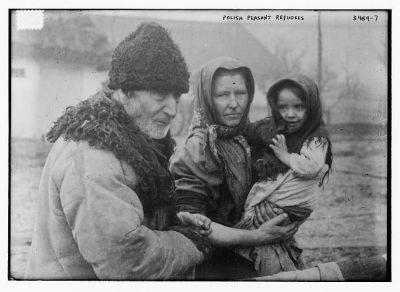
 Polish peasants source

One of the arguments of "Bieganski": power elites exploit the Brute Polak stereotype as a scapegoat. "We," the power elites insist "are not and could never be so debased, so low, so animal, as to be racist, white supremacist, or anti-Semitic. We are modern atheists, not old-fashioned religious kooks; we are well-educated, not ignorant peasants; we are evolved, not animalistic. Look to low, poor, dirty, poor, manual laborers, peasants, 'bitter clingers,' for racism, white supremacy, and anti-Semitism. We have solved all that, and we are beyond it."

Ironically, the power elites' exploitation of the Bieganski stereotype to scapegoat Poles and other poor, relatively powerless, underclasses is parallel to arguments advanced by the very people who gave us Scientific Racism, which reached its demonic nadir in Nazism, as chapters three and chapter seven of "Bieganski" show.

One tragic expression of this perverted, but very popular, worldview was the number of people who insisted that Germany could never harm the Jews because "Germany is clean, modern, secular, scientific, advanced! Such people could never do anything really bad! Surely the Germans are nothing like the ignorant, backward, Catholic, medieval peasants who are really responsible for all the trouble in the world!" One reads sentences like this again and again, from memoirs of the rich and powerful who made the decisions that allowed Hitler to get and keep power, to the memoirs of Jews who were certain than modern, educated, Germans would never hurt them.

There is a parallel in America. When Americans speak of white supremacy, they, even in the word choices they make, blame poor whites, rather than power elites. When Americans, even in jest, voice white supremacist world views, they often unconsciously adopt a Southern accent. They condemn white supremacists as "rednecks," "trailer trash," and "white trash." All these terms specifically target the poor. "Redneck" refers to the back of the neck burned by the sun on those farm laborers who worked hours out in the field. "Trailer trash" refers to people too poor to afford conventional housing. "White trash" refers to those whites in the South, often sharecroppers, just a step above blacks in the social hierarchy, who were too poor to be part of the ruling class. When we use these words, we unquestioningly accept, we invest in, the elite's self-serving lies about the poor.

Recently a member of the American power elite was caught on hidden camera expressing views that sound to many like anti-Semitism. The stereotype of an anti-Semite is a Polish peasant. Ron Schiller, an NPR executive, is no peasant, no Pole, and no friend of Christianity. He makes, and accepts without protest, some questionable statements about Jews, all the same. Video

Friday, March 4, 2011

Peasants Desecrate Graves For Gold

Gold earrings found in a grave. Source - New York Times. Full Description, below.


Grave Robbing and Other Stories of Poles’ Complicity is the headline of a Jewish Daily Forward article about Jan Tomasz Gross' new book, "Golden Harvest." Gross is quoted as saying, "The Poles participated in the murder of Jews, and this was done all over the country." The problem with the quote is, of course, the use of "The Poles" rather than "Poles." The quote, as written, implies that Poles, as a group – rather than criminal individuals – are guilty. That Polish identity, not human nature, is the problem.

Not just Poles qua Poles are guilty. Peasants qua peasants are guilty, too – thus the National-Geographic-style photo, above, so often linked with the book. Babushka-wearing, hand-implement-wielding, dirt-encrusted farm laborers may soon be the sartorial and ethnographic other we can blame for the Holocaust. Forget those SS officers, forget their squeaky leather boots, artfully carved daggers, and Hugo-Boss-designed epaulets. Well-educated, modern, Nazis – people just like us – were just innocent bystanders who let the primitive peasants have their way. Certainly, as chapter seven of "Bieganski" describes, that's what the SS officers themselves said, to escape any sense of guilt for the Final Solution.

Since when is dressing well a crime against humanity? Source

Gross hammers the point home: "the crops in front of [the peasants] are not beets or potatoes but skulls and bones." There you have it: Eastern European peasants' staple foods. Beets and potatoes. That's what the orchestrators of the most notorious crime of the Twentieth Century ate. Not steak, not champagne, or even soda pop. Those who carried out the Holocaust were nothing like us. They were primitive, backward, religious. We are modern, clean, educated, secular. People like us could never do anything like this.

As chapter two of "
Bieganski" demonstrates, after two of Gross' previous books, "Neighbors" and "Fear" were published, the American mainstream press identified Polish identity as the problem. Poles as Poles were guilty for the Holocaust in a way that no other ethnic group – including Germans – was. The same may happen with "Golden Harvest." Because, after all, no one but Poles could commit crimes so heinous as those Gross describes. It's all about being Polish, being a Polish peasant. It's all about the babushkas, and the potatoes, and the beets.

Is there any other way of looking at Polish peasants who desecrated Jewish graves? A way that helps us to better understand humanity – not just the Poles', but the whole human condition, including our own?

A New York Times article may provide clues. "
Ghosts Wail as Cambodians Plunder Killing Field Graves."


Here the peasants are Buddhist, not Catholic. They are consoled by monks in saffron robes, not priests in earth-toned cassocks. They work, harvest, and eat rice, not potatoes. Interestingly, the article never attributes the desecration of graves in Cambodia to an ethnic or religious Cambodian essence. They didn't desecrate these graves because they are Cambodian Buddhists. They desecrated these graves because their country had endured a devastating war, a war that was the result of complex international forces over which they, peasants, had zero control. They were hungry and desperate and left out of world prosperity. They did what any human being would have done in similar circumstances. We look at them; we see ourselves, had our lives and our country's history gone differently.

Funny how that is all clear when the grave robbers are Cambodians, not Poles, Buddhists, not Catholics, eaters of rice, not eaters of beets and potatoes, wearers of sarongs, not babushkas. We feel compassion for these Cambodians – the article's author speaks of trauma and healing – not of superiority and condemnation. We wish them recovery; we wish them well. We do not damn them and condemn them in perpetuity, as we condemn Polish, Catholic, peasants. Simply, it makes us feel good to feel superior to Polish, Catholic, peasants. Cambodian, Buddhist peasants make nice folk art. We can't demonize Cambodians. That would be Politically Incorrect.
Cambodian weaving. Source

Perhaps most importantly, the New York Times is willing to acknowledge that Cambodia and Cambodians underwent severe trauma. No such allowance is given to Poles. Poles merely "imagine" that they suffered during World War II. In fact, they "profited." That's the new narrative. 

There is a picture, above, of a hand holding two gold earrings found in a grave. That photo is not from Poland. It is from Cambodia. How do you feel about the hand, the human hand, holding those earrings now, knowing that it was not a Polish peasant who holds the earrings?

Excerpts from the New York Times article:

***

By the time the researchers arrived in early May, some 200 graves had been dug up and the bones scattered through the woods by hundreds of people hunting for jewelry.

''Everyone was running up there to dig for gold, so I went too,'' said Srey Net, 50, describing what seems to have been a communal frenzy that seized this poor and isolated village. ''If they can dig for gold, why can't I?''

It was the first such raid the researchers had recorded in the thousands of burial grounds they have documented around the country. Altogether 1.7 million people died from 1975 to 1979 from starvation, overwork and disease as well as torture and execution.

''People said, 'This goose has no owner,' '' said Ouk Souk, 60, a farmer. Few valuables were in the graves, but villagers took whatever they could find.

''I think it has become a memory, rather than a physical thing any longer,'' he said, speaking of the pain of the past. ''There will be no more tears. There are no more feelings to express. Only a flash of memory when you see a piece of bone.''

For younger Cambodians, who know remarkably little about the Khmer Rouge period, he said, ''It's just a dead person.''

Srey Noeun, 47, a farmer with four small children, said she could not sleep for three nights after digging two small gold earrings out of a grave.

''I'm afraid that the owner will take revenge on me because she died with nothing but her earrings and now I have taken them,'' Srey Noeun said. ''She'll say, 'Please give them back. They are all I had.'''

Ms. Srey Noeun said she sold the earrings as quickly as she could and bought things that she really needed: four pounds of pork, a sack of rice, oil for cooking and for oil lamps, salt, pepper, seasoning and milk powder for her youngest child.

''We never have enough rice,'' she said. ''Normally we can't afford to buy pork.''

The buried treasure seemed paltry after nearly a week of digging: one gold necklace and 27 small gold earrings. But it was dazzling to people who live without electricity or running water, far from the nearest clinic, school or paved road.

Sunday, February 27, 2011

Polish Scum Responds

A photo of Poles and Polish Americans.
Do we look like scum to you?
If so, why? 


On July 28, 2007, the Boston Globe published "Silence Lifts on Poland's Jews," an essay by Rabbi Joseph Polak, Director of the Florence and Chafetz Hillel House at Boston University.

Rabbi Polak's essay is now on the homepage of the Museum of the History of Polish Jews.

That is unfortunate.

Quickly after its 2007 appearance in the Boston Globe, a fan cut and pasted Rabbi Polak's essay to another website, with a new title. The new title was "Polish Scum."

Rabbi Polak, in "Silence Lifts on Poland's Jews," exploits the brute Polak stereotype that "Bieganski" exposes and critiques.

Rabbi Polak's essay begins with his equation of Poland with the murder of Jews. Poland has no other identity in Rabbi Polak's essay.

Jews, Rabbi Polak reports, "were brought there to be murdered." Note Rabbi Polak's use of the passive voice. Had Rabbi Polak used the active voice, he would have had to identify who brought Jews to Poland to be murdered. Rewrite Rabbi Polak's opening sentence in the active voice: "German Nazis brought Jews to occupied Poland to murder them."

That is a very different sentence.

Provide a key detail: "German Nazis brought Jews to occupied Poland to murder them in concentration camps that included Polish prisoners and Polish victims."

With the inclusion of that key detail in the opening sentence, the entire essay becomes a different essay.

In Rabbi Polak's lengthy essay, Germans are mentioned, once, in passing, in the third paragraph. What did these Germans do? They offered "a little help" to Poles in murdering Jews.

In Rabbi Polak's worldview, now sanctioned by the Museum of the History of Polish Jews, Germans didn't build Auschwitz to incarcerate, torture and murder Poles, eighteen months before its dedication to Jewish victims – although, in historical fact, they did. Germans didn't kill Poles for helping Jews – again, they actually did. Germans didn't commit what historian Michael Phayer called a genocide of Polish Catholics, before they got down to the genocide of the Jews. But they did. In Rabbi Polak's essay, none of that happened. Rabbi Polak's selective focus contributes to his depiction of Poles as scum.

Rabbi Polak allows that, in 2007, after his visit, "Poles are finally beginning to deal with these ghosts in their midst."

Rabbi Polak's word choices locate essentially anti-Semitic Poland, languishing in the past, and contrast that Poland with the future, and modern, evolved persons like himself and other non-Poles, who visit Poland and teach Poles about their debased state.

Thanks to visits like his, Rabbi Polak reports, Poles are learning to be "thoughtful." They are learning to be "truthful." Poland is "turning a corner," an American expression meaning to begin a new direction. Before the arrival of Rabbi Polak and others like him, not thought and truth, but stupidity and lies, had constituted the Polish character.

Poland, foolishly, saw itself as a "victim among victims" of Nazi aggression.

In fact, Rabbi Polak and other disseminators of the brute Polak stereotype are the ones who falsify history. Poland very much was a "victim among victims." To deny Nazism's, and communism's goals and crimes against Poland is tantamount to Holocaust denial.

Warsaw, 1945 source

Poland, Rabbi Polak reports, never referred to its Jews; Poland was silent. Again, this is false. Poles very much did address the Holocaust before the arrival of Rabbi Polak; this is recorded in English-language books that Rabbi Polak could and should have cited, including several volumes of "Polin: Studies in Polish Jewry" and "Bondage to the Dead."

It is true that public discourse about anything and everything was deeply distorted and truncated under the Communists. This distortion of public discourse was proverbial and all-pervasive. Public discourse was corrupted around everything from Soviet economics – "We pretend to work and they pretend to pay us" – to the chronic shortage of feminine hygiene products. A government that penalizes citizens for mentioning consumer-goods shortages is not going to allow vigorous discussion of the Holocaust.

Though not hampered by Soviet oppression, American and Israeli Jews also long-delayed their own response to the Holocaust. As Peter Novick, Jerzy Kosinski and Tom Segev have pointed out, there was measurably more attention paid to the Holocaust in America and Israel generations after WW II ended than during the war itself.

Even so, even under impossible conditions, Poles managed to publish essays, poetry, and broadsides, and to make films. Poles like Czeslaw Milosz, Jerzy Ficowski, Jan Blonski, Marcel Lozinski and Wladyslaw Bartoszewski, and institutions like the Jagiellonian University, took up the issue of the Holocaust and Polish culpability when it was risky to do so. Even simple Polish wood carvers chose to commemorate Poland's lost Jews in their carvings, and announced that they did so to rescue the memory of their lost Jewish neighbors.

Jerzy Kosinski visited Poland, his birthplace, long before Rabbi Polak got there. In 1988, he published an essay about his experience. He wrote that returning to Poland after many years away, he was eagerly received by young people. "With so much Jewish cultural legacy steaming from the spiritually fertile Polish soil, to these young men and women Polish-Jewish relations are a mystery – mystery, not stigmata. They are as prompted to know me better as I am eager to know them." This process was a mutually fruitful exchange, Kosinski reported. He reported that he was so "rejuvenated by what I found within myself during my twelve days in Poland [that] I started a new romance with my thousand-year-old, Polish-Jewish soul."

Rabbi Polak says that Poland's treatment of Jews was a "mixed bag," that Poland made an effort, "centuries long, of preserving the Jews' otherness." This statement is bizarre. Jews enjoyed a great deal of autonomy in Poland. Leaders of the Jewish community used that autonomy to preserve Jews' otherness. Every historian working on Polish-Jewish relations agrees on this point. The average Boston Globe reader would not know that. Thus, Rabbi Polak gets away with saying something that is utterly contrary to the historical record – something that serves a racist stereotype.

Because Poles are themselves so unevolved, outsiders, modern, superior, non-Poles, must, as Rabbi Polak puts it, "make Poland itself cry for its murdered Jews."

No Pole, before Rabbi Polak and other superior, modern people arrived, has ever felt any sadness over the Holocaust. As Rabbi Polak puts it, visitors will ask, "Does anybody here miss them?" It will take outsiders to bring to Poles' attention that they haven't the emotional depth to miss or to mourn Poland's murdered Jews. Again, these non-Polish visitors will force upon debased Poles a key question: "Why Poland did so little to save" its Jews.

Why did Poland do so little to save Jews? Rabbi Polak leaves the question a rhetorical one. He never attempts to answer it. Answers are complicated, of course. One quick and easy answer is the conditions of Nazi occupation in Poland. This catastrophic, genocidal occupation is a bagatelle to Rabbi Polak. Poland murdered its Jews, Rabbi Polak says, "with a little help from Germans," mentioning the Germans only once, in passing, in his lengthy essay. Poland and the Poles' debased essence are fully responsible for the Holocaust. As Rabbi Polak puts it, "death oozes everywhere from its [Poland's] pores."

After I read Rabbi Polak's piece in 2007, I was troubled. How to describe, in a short essay that the Boston Globe might consider publishing, in fewer than one thousand words, all that was misleading, racist, and harmful in Rabbi Polak's piece? How to present deeply complicated truths?

I wrote the piece, below, and sent it to the Boston Globe and the rabbi himself. Weeks went by. I received no reply from the Boston Globe. I resubmitted and received a form rejection.

***
Below, please find my response to "Silence Lifts on Poland's Jews" submitted to, and rejected by the Boston Globe:

***

In 1941, Oswald Rufeisen was walking along a street. A peasant passed on a horse cart. The stranger gestured for Rufeisen to join him. "The Nazis are murdering Jews. I will hide you." Rufeisen was incredulous; Germans were civilized. Who was this Pole? Was this a trap? The Pole persisted. Rufeisen gave in. The Pole saved Rufeisen's life.

In 1987, I was attending a Polish-Jewish conference. Our meetings roiled, like a summer thunderstorm. I had been debating all night with the son of a concentration camp survivor. We took a break around dawn, silently strolling Krakow's cobblestones. Viewing glistening dewdrops on a spider web, this young Canadian Jew, who had never before been to Poland, began to recite, in Polish, the poetry of national bard Adam Mickiewicz.

I study Polish-Jewish relations. In hell, one discovers diamonds unavailable in any other mine. One example: Stefania Podgorska, a Polish teenager who saved 13 Jews thanks to a disembodied voice that directed her to shelter.

I've read thousands of books, articles, and internet posts. I've met key historical figures. I've traveled to Poland and Israel. I've conducted hundreds of interviews. You think I'm about to say, "This qualifies me." Think again. The more I read, the more I am agog, the more I want to say, "I have no right to speak." Because, in the Polish-Jewish narrative, whipsawing plot twists never let up. One example: after the war, Podgorska was dismissed, by a Jew she saved, as an inferior and superfluous "goyka." So, I do speak, because mainstream media simplifies this narrative beyond recognition.

What I think I've learned is this: hate, all hate, is wrong; and human beings, including those we least suspect, shelter reservoirs of goodness and strength.

The years before World War Two were a perfect storm. A toxic cloud circled the globe. Scientific Racism, a perversion of Darwinism, pitted "races" in a struggle for survival of the fittest. American racists cited "evidence" that Poles and Jews, inter alia, were essentially unfit; their entry was barred in 1924. In England, Nazism's sympathizers included the Duke and Duchess of Windsor. In Poland, some nationalists, the Endeks, struggling against three occupying empires, rejected Poland's traditional tolerance, and adopted a Poland-for-Poles stance. World War I, the Russian Revolution, the Versailles Treaty, and the Depression set the stage for racism's most diabolical manifestation: Nazism.

Massive, bulky narratives – a thousand years of Polish-Jewish relations and the black hole of World War Two – are simplified by sound bite culture: Poles become essential anti-Semites; everyone else, including the British Royal Family and followers of Oswald Mosley and Churchill and Roosevelt who heard Jan Karski's report and did not act, the Ivy League universities, the New York Times, the Atlantic Monthly, that all supported Scientific Racism – everyone – is exculpated. The essential, brute Polak takes on everyone's guilt. Important voices like Adam Michnik and Ewa Hoffman have refuted this charge; some of their fellow Jews have criticized them for mending fences with Poles.

Not Poland's good name – neither vanity nor even honor – is the treasure at stake here. Read the primary documents of Scientific Racism. Gathering only enough "evidence" to explain our fellow human beings as essentially different is exactly racism's error.

We may convince ourselves that this or that anecdote proves that Poles are essentially anti-Semitic … that African Americans are essentially lazy … that Jews are … fill-in-the-blank.

That method of thought, that is so easy, that is slickly seductive, that rewards our synapses with the conviction that we've got it all figured out, is what we must resist. Not for the sake of the Poles. Not for the sake of the African Americans, the Muslims or the Jews. We must resist that form of thought for ourselves. We must retain our intellectual and spiritual integrity, in a world that tempts us to believe that human beings and entire nations can be divided between the good and the bad, with us, and our nation, always firmly in the former category.

If you asked me where I am, in my twenty years of study of Polish-Jewish relations, I would tell you that every time I crack a new book, every time I interview a new source, I take that proverbial journey-inaugurating first step; I see a new horizon. I can't enumerate here the facts that counter the sound bite of Poles as essential anti-Semites. I can, though, say that when you find some evidence that convinces you that your neighbor is something essentially other than yourself, that is exactly when you must begin to question.

***

When his "Polish Scum" essay first appeared, I emailed Rabbi Polak and informed him of my concerns. Other concerned Polonians did, as well. Rabbi Polak was intransigent; he reported no movement in this thoughts about Poles.

I have sent Rabbi Polak an e-mail informing him of this blog post, and invited him to respond. If Rabbi Polak does respond, I will post his entire response, unedited.

Friday, February 18, 2011

Krysia Jopek's "Maps and Shadows": Poetic, Moving, Important


Krysia Jopek's "Maps and Shadows" is an intimate, spare, elegantly written and deeply moving memoir of the impact that the Soviet Union's slow-motion genocide against Poles had on one Polish farm family. "Maps and Shadows" is not just a tearjerker; it is not just a family saga; it is not just an incredible and inspirational true story of survival in the face of impossible odds. "Maps and Shadows" is also an important book. It offers key insight into a forgotten atrocity.

Adolf Hitler was not World War Two's only genocidal monster. Joseph Stalin, America's ally, the man FDR called "Uncle Joe," and "a Christian gentleman" was also a mass murderer. Poles were not alone in their victimization at the hands of Stalin; there were also Lithuanians, Ukrainians, and others. I ask, why is it okay for a student to wear a t-shirt with a Soviet red star or other Soviet paraphernalia to class, while a Hitler t-shirt or SS paraphernalia is taboo? One reason is that elites, predominantly leftist, have underplayed Stalin's crimes. "Maps and Shadows" will help to bring a buried story to light, and deepen understanding of World War Two. Jopek's delicate poetry and prose will do the work that professional historians have failed to do.

Hitler and Stalin both invaded Poland in September, 1939, thus igniting World War Two. Both vowed to destroy Poland and eliminate Poles. Stalin packed over a million Poles into cattle cars and deported them to Siberian labor camps, with the goal of working them to death. Forced to fell trees in freezing conditions, given inadequate calories, many died. In August, 1941, tens of thousands of Poles were released to fight in Anders Army, alongside the British. They fought with distinction, especially at Monte Cassino. Pawns in a vicious game, Poles survived on their own wits, in the cattle cars, in Siberia, in Iran, Italy, Africa, and England. Many died and were buried in unmarked graves, their fate known only by the carrion feeders who turned them to dust.

The opening chapter of "Maps and Shadows" is told in the words of Helen, or Helcia, the only girl in the family. The following chapter is told by Henry, or Henryk, Helen's younger brother. Other chapters are written in the voice of Andrzej, the father, and Zofia, the mother. Jopek's own poems are interspersed throughout the chapters. This style of storytelling works well. The family is split up, and mother and son, husband and wife, have no contact with each other, or even certain knowledge of each other's existence, for long stretches. Each family member gives voice to his or her own unique experience of exile. Henry focuses on the process of growing into manhood while in the Gulag and then as a young soldier, so starved he cannot hold up the uniform the Brits issue to him. Helen grows from a girl and an older sister to a teacher of other refugees.

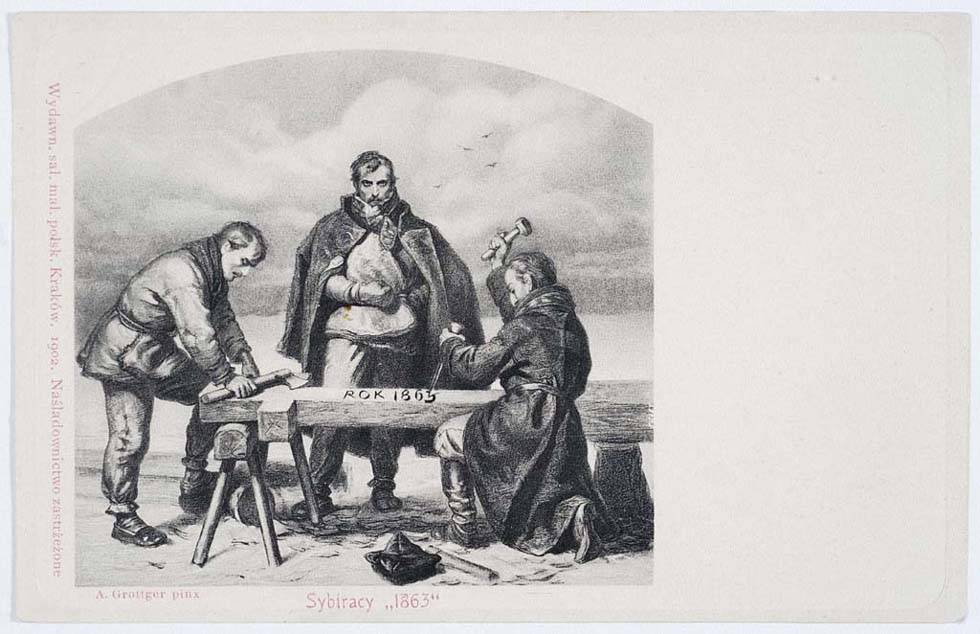
Polish Sybiracy, or Exiles to Siberia, from the Nineteenth Century source


The discontinuous storytelling style works for another reason, as well. People crave narrative structure: a beginning, a complication, action, resolution, and a happy ending. Atrocity does not respect human expectations. Atrocity violates humanity in every way. One way is this: it violates our order. This humble family, probably like the reader's own family, is rousted out of bed in the middle of the night by Soviet soldiers with guns, terrorized, humiliated, and dispossessed. The fleeting glimpse they have of their beloved home as they are packed off to a white hell is the last glimpse of home they will ever have.

There is no triumphant battle – only endless days in a cattle car with no toilet and scores of other deportees. Meaning is shattered. Normal time is meaningless. Father Andrzej and mother Zofia age decades in this one deportation, as they see on each other's faces. Destinations mean nothing – Helen is so ill in India she has no memory of India. People struggle to create meaning, routine, in chaos and injustice: Gulag internees gather mushrooms they don't immediately consume, in spite of hunger, but save for winter. Polish refugees in Africa name their little encampment and go to school, never knowing when or if they will be able to apply what they learn. Siberian refugees, inured to temperatures of forty below, are suddenly plunked down in Iran's unbearable heat; they go for a swim; one drowns in an utterly unfamiliar menace: a sandstorm. Other refugees die from the blessing of food. They had been in Siberia so long they could not digest British rations. Humiliations never stop: after the Poles connect with their British commanders, they are stripped naked and their possessions are burned. Their body hair is shaved off. Martyrdom is not always an apt study for an oil painting; martyrdom sometimes means traveling on a boat up to your ankles in others' vomit, watching your fellow passengers' corpses dumped overboard. Yet humanity remains, "Out of respect we didn't stare at the bodies." Those who manage to survive often don't know why. Helen was unconscious for weeks, the skin of her back worn away, and her vertebrae exposed. Yet she lived, while the healthy man who swam before a sandstorm did not. You stop asking why.

Jopek's writing is always stoic. The book is quick and can be read in one sitting. Readers should not be afraid to read this book. There are no lingering, detailed accounts of cruelty or torture. Jopek's tone is businesslike. This is what happened. Now, on to the next impossibility.

Poles and Poland are often misrepresented in popular, journalistic, and scholarly discourse. There are complicated reasons for that covered in my own book, Bieganski. Books like "Maps and Shadows" will deepen and broaden the reader's understanding of one of the most cataclysmic events in world history, World War Two.


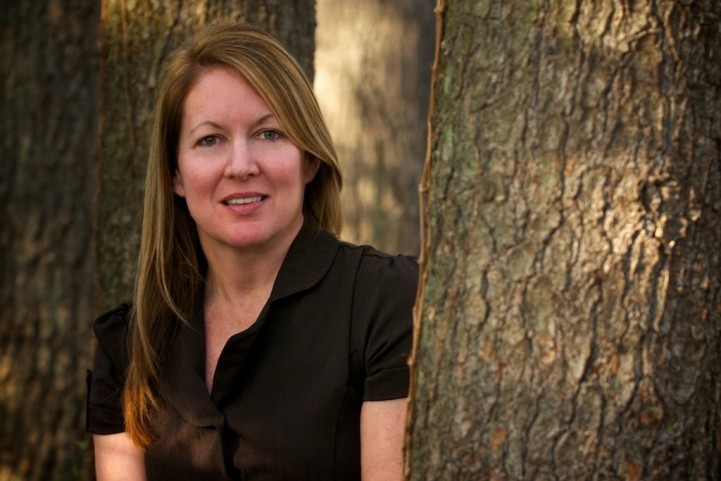
Krysia Jopek photo by Shana Sureck

Monday, February 14, 2011

Happy Saint Valentine's Day. Three Love Poems.


"Hagar's Last Night in Abraham's House"
By Itzik Manger 

The story of Abraham, Sarah, her servant Hagar, and Abraham and Hagar's son, Ishmael, told as if Hagar were a Polish servant girl in Abraham's house in Poland.


Hagar, the servant, sits in the kitchen,
a smoking oil lamp spills
the shapes of shadowy cats and dogs
to flicker on the walls.

She weeps because her master
fired her today.
"Beat it, you bitch," he told her;
"Can't you let me be?"

It was Sarah who egged him on –
that proper deaconess.
Saying, "Either get rid of the girl
or give me a divorce."

Hagar takes out her trunk
a summer hat of straw;
she takes her green silk apron
and her blood-red beads of coral.

These were the gifts he gave her
once upon a day
when they strolled the meadow
by the railroad right-of-way.

"How like the smoke of a chimney,
how like the smoke of a train
is the love of a man, dear mother,
the love of any man."

God knows where we shall run to,
myself and his bastard child,
unless in some alien kitchen
we are allowed to hide.

She takes the kitchen broom,
she sweeps the kitchen floor,
under her blouse something still says
she loves him – and sweeps some more.

Again, she does the dishes,
and scours the copper pan.
"How like the smoke from a chimney
Is the love of any man." 

From David Roskies' A Bridge of Longing: The Lost Art of Yiddish Storytelling. Harvard University Press

***   ***   ***

When Nothing Remains

By Stanislaw Grochowiak

From An Introduction to Polish Literature
Jerzy Stzetelski, ed. UJ Press

One day I shall seat you naked in splendor.
There will be dresses heavy as water.
There will be stockings with the scent of apples.
There will be head coverings, broad,
and there will be metal.

I want to see you naked in a dark landscape
dense with bronzes, chandeliers, bowls
from which let a vanilla punch steam
into the sniffing nostrils of great Danes.

Rembrandt felt this urge when he painted Saskia
departing further and further into her death
as if he wanted to hold her with the weight of grapes
to clamp her down with the light of precious chandeliers.

***   ***   ***

A great love poem by John Guzlowski.