Sunday, April 24, 2011

"Water for Elephants" and "Hanna": Two New Films with Polish Characters

"Water for Elephants" and "Hanna" reviews below, followed by commentary on their Polish characters. One is quite the surprise. 

Even in the poster, Christoph Waltz, and the elephant, are the most interesting characters. 


"Water for Elephants" is a flat soap opera lacking flair or heart or even coherence. It's a love story set in a Depression-era circus; how could it be so boring? Direction and miscasting. Director Francis Lawrence never milks the Depression or the circus setting. He directs as if in the suburban living and bedrooms of television's Pine Valley. You never get the sense of how a Depression-era, small-town kid would be thrilled, terrified, and curious seeing a lion or an elephant for the first time. There are a couple of what appear to be CGI shots of a train chugging across moonlit landscapes; even these lack magic.

Robert Pattinson, star of the teen-vampire sensation "Twilight," is miscast as Jacob, the lead character, a circus vet. Pattinson displays the skills necessary to make teenage girls swoon: he pouts, he broods, he is self-absorbed, he makes zero intellectual or psychological demands on his audience. He has heavy brows and lots of hair. These skills deserve respect. They cause teen girl fans to post reviews of his work that end in multiple exclamation points!!!!!!! But Pattinson is in so far over his head in "Water for Elephants" all you see of him, in some scenes, are bubbles on the surface as he sinks into invisibility.

Reese Witherspoon is a crisp and perky professional with shiny hair and perfect teeth. Problem is, she's playing Marlena, an orphan trick horse rider who marries an abusive circus boss, August (Christoph Waltz.) Marlena should exude desperate vulnerability combined with manipulative power, the kinky raw sex appeal of a woman who, scantily clad in skin-tight, revealing costumes, performs suggestive tricks with muscly animals in front of applauding throngs. Witherspoon doesn't even try to bring that Marlena to life. She just plays Reese Witherspoon, professional movie star with flawless hair and teeth, a little bit bored as Oprah interviews her. There's nothing of the abusive orphanage, the poor street, the skanky Big Top about her at all.

Robert Pattinson's Jacob and Reese Witherspoon's Marlena have zero chemistry. They are the least sexy screen couple I've ever seen. Al Gore and Bill Clinton had more chemistry. When they do kiss, it's not that long-awaited, thrilling moment of release. It's "Huh?"

Christoph Waltz as August, the circus owner, is from a completely different, much better, movie. People are going to walk out of this film wishing that they could have seen the movie centered around Christoph Waltz's August. Waltz demands the audience's attention in a way that no one else in the film does, except Tai as the elephant, Rosie. Waltz's nuanced performance brings to life an August who is very complex and worth caring about, despite his being a monster.

It's clear that Sara Gruen, the book's author, and the filmmaker wanted to tell a story that featured lots of animals. The plot is a cobbled-together, soulless bit of scaffolding on which to hang shots of circus animals and shallow depictions of circus rituals. Why is Jacob a Polish speaker? Why is the elephant a speaker of Polish? Most Polish immigrants to the US at this time were descendents of recently liberated serfs, and did very harsh manual labor in the US: coal mining, steel, cleaning. It's very unlikely that a Polish speaker would be an Ivy League veterinary school graduate. In any case, the film makes no use of Jacob's ethnicity. He could as easily be Spanish or Italian or Greek. Why would a man who had the focus and self-discipline to complete an Ivy League veterinary school education toss aside, literally, everything he has worked for, and everything he owns, to jump on a passing train? The moment utterly lacks verisimilitude and psychological depth. It's obvious that the film just wants to get to its circus setting and animals. Jacob is just a pawn. Why is the film told as an old man's flashback? That approach, and the voiceover narration, add nothing to the film.


***
"Hanna": Come to think of it, she DOES look a bit Polish.

"Hanna" is a ruthless, relentless, chase featuring a teen girl assassin. It's violent and suspenseful, fast and cruel. The chase sprawls over travelogue settings in the Arctic Circle, North Africa, and Berlin. It's like the Bourne movies, like Daniel Craig's Bond movies. The difference is, of course, that the hero is not a muscle-bound adult male, but a barely muscled teenage girl, Saorise Ronan. And the focus never waivers from the chase. Hanna gets no love interest.

I generally don't go to movies I know are going to be violent and I have walked out of violent films, but I loved "Hanna" and kept my eyes open throughout almost all of it. It's not just that Hanna, the assassin, is a girl, and I'm female, too, although that was part of it. "Hanna" depicts Hanna as having an admirable work ethic, and as being an underdog. The one thing that separates her from the people she so determinedly wounds, beats, stabs, and kills is that she is just following the pedagogical training of her admirably dedicated, old-school patriarch, Erik (Eric Bana.) Erik raised his girl to know how to read, write, and kill. He did this for a righteous reason. The people Erik trained Hanna to kill are very, very bad people, and the audience wants them dead, as well. The morality and worldview of "Hanna" is very much that of the setting of its opening scene: the harsh north. This is Nordic morality, where even if you do the right thing, you may end up dead, anyway. There is no reward. If you don't end up dead, and live on, you live on only to keep fighting in a harsh, unforgiving landscape.

Saorise Ronan gives an Oscar-worthy performance as Hanna. She truly inhabits a character whose sole focus is on struggle. She enters every new landscape, from a treeless desert to a hotel room, with the focus of a wild animal: where is the food? Where is something to drink? From what direction will danger come? How will I meet it? Ronan never once slips up, never once behaves as a comfortable teenage girl would behave. She has a killer's eyes throughout the entire film. I have to wonder if this wasn't a tough film for her to make. Playing Hanna would have given me nightmares.

The film's ruthlessness becomes a bit of a failing. The film is so ready to wound and kill characters the audience wants to like, so ready to turn sweet moments into deadly poison, so ready to let any landscape become a death trap, that I did get a bit jaded about 75% into the film. I was no longer surprised when a character showed some humanity only to be dispatched in the most hateful of ways. But the film threw some new plot developments in at that point, and it kept my interest.

Cate Blanchett is terrific as Hanna's foil. Eric Bana is solid as her dedicated teacher and father. The supporting cast, including Tom Hollander and Olivia Williams, is all very good.

The Chemical Brothers' soundtrack is perfect. I often don't even hear soundtracks the first time I watch a movie, and when I do notice them, it is, all too often, because they are intrusive and trying to do the work of wrenching emotions that poor filmmaking could not do. During one breathless scene in "Hanna," I realized that the post-Apocalyptic soundtrack geared me up and made me tense and brought me into the scene in a very enjoyable way.


***

Comments on the Polish characters in these new films:

"Water for Elephants"'s Jacob Jankowski is Polish in name only. It's highly unlikely that a Polish speaker would be an Ivy League vet school grad in the Depression. Most Polish immigrants to the US at that time were descendants of serfs who had been liberated only in the 1860s. They did very demanding, deadly, manual labor and Ivy League universities, at that time, were cranking out "scholarship" proving their racial inferiority. I'm not saying that no Polish American got an Ivy League vet degree in the Depression; I'm saying that such a person would not be representational.

In any case, there is nothing Polish about Robert Pattinson's Jacob. He could be the exact same character and be Greek, Eskimo, or Urdu.

The whole film struck me as random in that way. Events and characters existed only as an excuse to produce a movie pretty animals and exotic circus costumes and the Depression. And none of these features came to have any verisimilitude or heart, except Rosie, the very adorable elephant, and Christoph Waltz.

"Water for Elephants" is the first movie that made me lose respect for a book I had not read. I came to wonder if the book is as random and pointless as the movie, as much just an excuse for pretty horses on the page. I read reviews at Amazon that suggested to me that that may be true.

"Hanna," on the other hand, is fascinating. One learns -- I'm about to type a spoiler! -- that Hanna is a genetically modified human being. She was genetically modified to have less pity, and more of an urge to kill. Where did the CIA go to get embryos to manipulate in this way? You got it, reader, Poland!

Friday, April 22, 2011

The Shroud of Turin


Sometimes it seems to me that everything is related to Polish-Jewish relations.

Of course to a mathematician everything revolves around equations, and to a politician, everything is political.

In April of 2000 my friend Don Freidkin (Polish-Jewish ancestry, now married to a Polish Catholic) was kind enough to give me a documentary about the Shroud of Turin. I was so fascinated I watched the documentary several times, back to back.

The many extraordinary features of the Shroud defy easy explanation. Swiss criminologist Max Frei identified pollen grains from Israel on the shroud.

German master textile restorer, Mechthild Flury-Lemberg, reports shroud features that date it to first century Israel.

Secondo Pia's 1898 photographs confounded the world – these photographs discovered a shroud feature that had previously been invisible. The shroud is a photographic negative. These images were so shocking, Pia was accused of fraud.

Artist Ray Downing claims that the shroud contains three dimensional information.

The man on the shroud shows what appear to be marks left by a Roman whip. (Discussion here. Photo here.)

One could go on, and on, and on. Science has been over the shroud with numerous technologies and instruments and yet no universally accepted explanation for it has emerged.

What I saw on that documentary that Don sent me, though, was that the humanities had been all but ignored. The hard sciences were offering their questions, and answers, but the humanities should be heard from, too.

I drew up a list of questions that a humanities scholar might ask about the shroud. I sent my questions to Barrie M. Schwortz, one of the talking heads on the documentary. I was astounded when Mr. Schwortz wrote back to me, and offered to place my post to him on his award-winning, essential website, www.shroud.com. I include my comments, in full, below. You can also see them on this page, almost halfway down.

I still have these questions. As far as I know, no shroud debunker has even tried to answer them.

***

Barrie M. Schwortz is the go-to expert on the shroud. He maintains an award-winning website that archives the full-text of countless, detailed, published, peer-reviewed scholarly articles. This library is a priceless gift to humanity. We all owe Barrie Schwortz our gratitude.

In August of 2009, I emailed Barrie and asked him a question. You identify yourself as an Orthodox Jew, but as someone who believes that the Shroud of Turin is the burial cloth of Jesus Christ. How do those two features fit into your one life?

Barrie told me to phone him with this question, and I did. We talked for an hour and a half.

It was a private conversation, and I never received permission to repeat what we said to each other, so I won't repeat anything Barrie said here. I will say, though, that I discovered that Barrie is of Polish-Jewish descent. Needless to say, as soon as our phone call was over, I sent Barrie the chapter of "Bieganski" that appeared here.

Since today is Good Friday, I post, below, the questions that someone in the humanities, rather than the hard science questions that have been focused on so far, might ask about the Shroud of Turin.

***

Date: Thu, 27 Apr 2000 18:02:40 -0500 (EST)
From: danusha veronica goska

Dear Barrie Schwortz:

The shroud has been subjected to imaging analysis by NASA scientists, to carbon dating, and to analysis, performed by criminologists and botanists, of the pollen particles found on its surface. Forensic pathologists have analyzed the death depicted on the shroud. At least since Descartes, the West has come to regard religion and hard science as polar opposite disciplines. It is this very intersection of religion and hard science that intrigues, delights, and perhaps even threatens many, and attracts many to the Shroud story.

In truth, though, and perhaps counterintuitively, the hard sciences are limited in their ability to crack the mystery of the shroud. This sounds contrary – science has come to be understood as *the* source of definitive truth. In this case, though, hard science has failed to provide an answer that satisfies the demands of Ockham's razor.

William of Ockham (1285-1347/49), positied that, "Pluralitas non est ponenda sine necessitate;" that is, "Plurality should not be posited without necessity." In other words, Ockham's razor demands that, of two competing theories, the simplest explanation is preferred.

The shroud compels exactly because there *is* no simple or easy explanation. None of science's tests, including carbon dating, has changed that. None have produced a simple explanation that meets the demands of Ockham's razor.

One might argue, based on carbon dating, that the shroud is a simple forgery, dating from the middle ages. That theory is not best tested exclusively by hard science. Rather, insights from the social sciences and the humanities are necessary in cracking this mystery.

I am not a hard scientist. I am a Ph.D. candidate in the Folklore Institute at Indiana University. Folklore, like its fellow social sciences, has demonstrated that human expressive culture follows rules, just as surely as carbon decay follows rules. One does not need to be a social scientist to understand this.

Suppose an archaeologist were to discover, in an Egyptian tomb, a work of art that followed the aesthetic prescriptions of Andy Warhol's 20th century American portrait of Marilyn Monroe. Certainly, hard science would argue that ancient Egyptians possessed all the technology necessary to produce such items of expressive culture. Ancient Egyptians had pigments; they had surfaces on which to draw. Hard scientists might see no mystery in a pharaonic Warhol Marilyn.

A non-scientist would have every reason to find such a blasé attitude bizarre. Of course the ancient Egyptians could produce Warhol-like art. The fact is, though, that they simply never did. Ancient Egyptians, like all artists everywhere, followed the artistic mandates of their time and place.

True, art does change, but it changes organically, slowly, and after leaving vast bodies of evidence of change in intermediary forms. For example, as different as it is, art from Greece's Golden Age can be seen to have grown from Egyptian art, in intermediary forms like Kouroi figures. The shroud is as much an object of wonder and worthy investigation, in spite of carbon dating, as would be an isolated pharaonic Warhol, or a rock song that had been composed during the period of Gregorian Chant, or a Hopi vase that someone somehow came to make during the high point of peasant embroidery in Czechoslovakia. Yes, in each case, technology was available to create these anomalous forms; however, as any layman might well point out, humans did *not* choose to use available technology in order to create anomalous forms.

There are two consistently unaddressed flaws in the arguments of those who contend that the shroud must be of medieval origin, created by contemporaneously available technology. The first flaw is that even if technology had been available to create an image with all the remarkable features of the shroud, there is no way to explain *why* an artist would have done so.

This question must be explored not via carbon dating, NASA imaging, or pollen tests, but, rather, by comparison with other relics from the medieval era. I have not seen research by experts in medieval relics that attempts to compare and contrast the shroud with comparable artifacts from the medieval era. Does the shroud look like other relics, or does it not? If, as I suspect is true, it does not look like other relics from that era, then it behooves anyone who argues for a medieval date to explain exactly why. Those who argue this position must tell us why the equivalent of a Warhol portrait has been found among Egyptian artwork where the laws of human expressive culture dictate that it plainly does not belong.

In the writings of church reformers like Erasmus and Martin Luther, one can read descriptions of medieval relics. In fact, many relics once popular in the medieval era can be visited even today. Reformers like Erasmus and Luther expressed open contempt at the gullibility of the Christian masses. Bones that were obviously animal in origin were treated as if the bones of some dead saint. Random chips of wood were marketed as pieces of the true cross; random swatches of fabric were saints' attire.

Why, in such a lucrative and undemanding marketplace, would any forger resort to anything as detailed and complex as the shroud? Why would a forger resort to an image that would so weirdly mimic photography, a technology that did not exist in the Middle Ages?

Well, one might argue, the forger created the highly detailed, anomalous shroud in order to thoroughly trick his audience. This argument does not withstand analysis. The relic market is profoundly undemanding. It was profoundly undemanding in the Middle Ages; it is barely more demanding today.

The Ka'bah of Islam, the millions of Shiva lingams found throughout the Hindu world, the venerated sites of Buddha's footfall or Buddha's tooth, the packages of "Mary's Milk" on sale to Christian pilgrims in Bethlehem, are all contemporary relics that attest to the willingness of believers to believe in items that might look, to others, like simple rocks or standard, store bought powdered milk.

The faith in relics is not limited to the large, world religions; New Age is similarly flush with relics of a provenance, that, to non-believers, may seem comical at best. For example, a speech well beloved by New Agers, titled "Chief Seattle's speech," has long been known to have been written by a white Christian man living in Texas. This knowledge has not stopped many New Agers from believing that the speech issued, miraculously, from Chief Seattle.

The shroud does more than not follow the simple rules of relic hawkers. The shroud not only does not follow the laws of the expressive culture of medieval relics, it defies them. For example, blood is shown flowing from the man's *wrist,* not his hands. It is standard in Christian iconography to depict Jesus' hands as having been pierced by nails. This was true not only of the medieval era, but also today. What reason would a forging artist have for defying the hegemonic iconography of the crucified Jesus? Anyone who wishes to prove a medieval origin for the shroud must answer that question, and others, for example:

Items of expressive culture are not found in isolation. They are not found without evidence of practice. If one excavates an ancient site and finds one pot, one finds other pots like it, and the remains of failed or broken pots in middens.

If the shroud is a forgery, where are its precedents? Where are the other forged shrouds like it? Where is there evidence of practice shrouds of this type? If the technology to create the shroud was available in medieval Europe, where are other products of this technology? Humankind is an exhaustively exploitative species. We make full use of any technology we discover, and leave ample evidence of that use. Given the lucrative nature of the forgery market, why didn't the forger create a similar Shroud of Mary, Shroud of St. Peter, Shroud of St. Paul, etc.? And why didn't followers do the same?

I'm not attempting here to prove the shroud to be genuine. I am insisting that hard science alone cannot tell us the full truth about the shroud, and that ignoring the obvious questions posed by the humanities and the social sciences leaves us as much in the dark about the shroud as ever.

Friday, April 15, 2011

Solidarity Poster: A Vote for Solidarity is a Step Toward Freedom

"twoj glos dla Solidarnosci krokiem ku wolnosci."
"Your vote for Solidarity is a step toward freedom."
Poster from Krakow, Poland, 1989. 

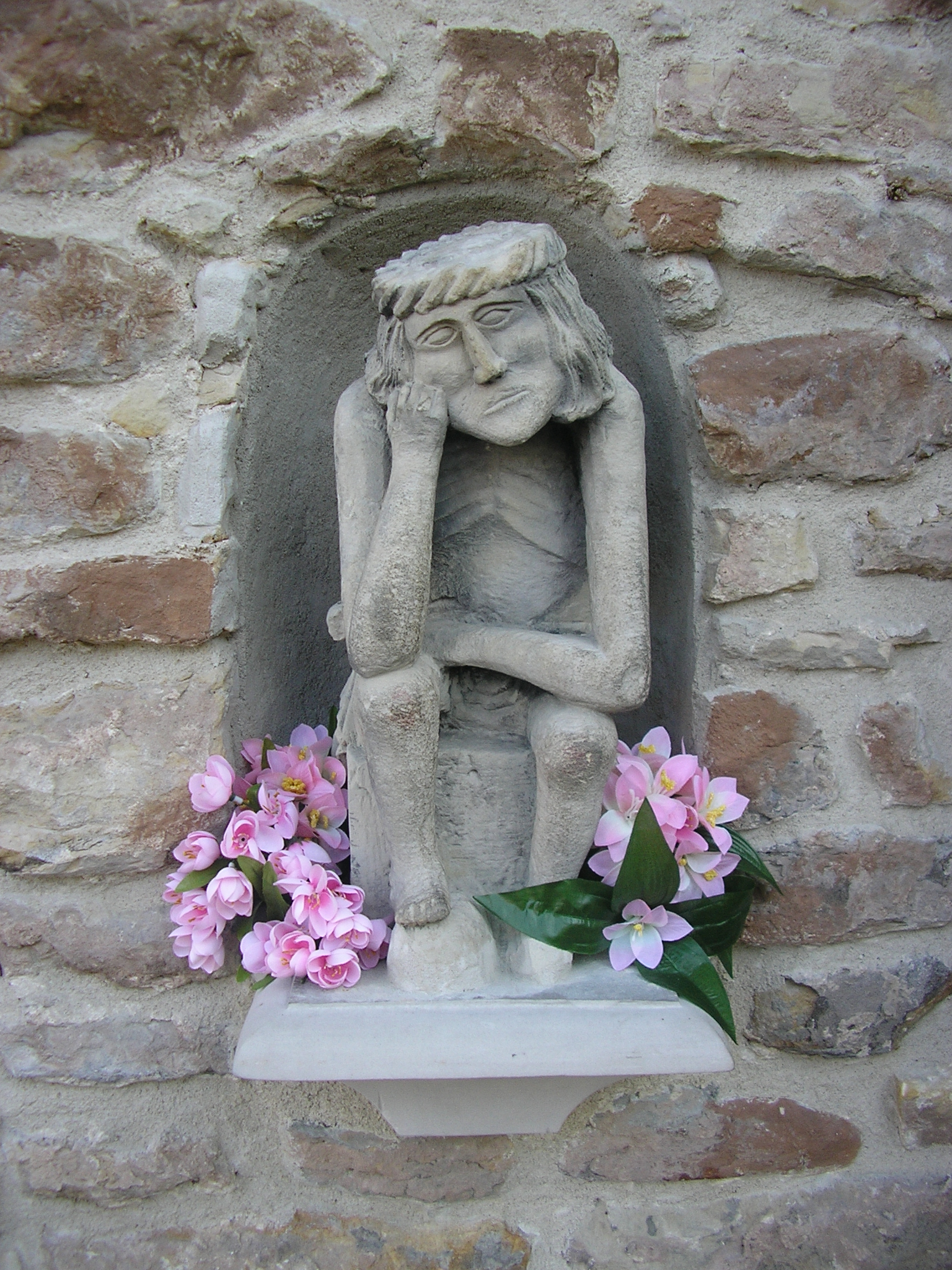
An article by me is scheduled to appear in a scholarly journal sometime soon featuring the above poster, and discussing it in relation to the following works of art:

Wood carving by Jozef Lurka. Source.

Chrystus Frasobliwy or Worried Christ. Source.

"Spadajaca Gwiazda" "Falling Star" by Witold Masznicz at the Nicolaus Copernicus Museum in Frombork. Source.

I'm grateful to Hans Joachim Schauss for his book "Contemporary Polish Folk Artists," Available at Amazon. 

Saturday, April 9, 2011

Daiva Markelis' "White Field, Black Sheep" & Bohunk Identity

White Field, Black Sheep available at Amazon


"White Field, Black Sheep" is a crystalline memoir capturing the experience of a Baby Boomer Lithuanian-American girl growing up in Chicago. It's the kind of book that must be read by anyone who wants to understand America. Some memoirs gain popularity because the author is a very calculating fabulator and crafty self-mythologizer. It's now looking like Malcolm X may have fallen into this category. Some memoirs are worth reading because their authors have ice in their veins and can speak truths in public that would turn the rest of us to Jell-O. Markelis amply displays this literary gift of "just the facts, ma'am." Again and again I found myself saying, "Wow, I can't believe she's actually saying this in a published book." I'm not talking about sensational celebrity confessions that might titillate a cheap read. I'm talking about the kind of detail we don't normally mention, but that makes up the substance of our days: a neighbor kid who is a very particular kind of pill but who grows up into a close friend. An undertaker who was once a drunken one-night-stand.

Markelis exhibits a critical mass of the kind of honesty that, when well applied, rewrites history. She does not tell of world-historical events in an expected, approved way. Markelis' ancestors were persecuted by the Soviets (142); her father was a forced laborer for the Nazis (177). Markelis does not wring persecution for all its worth, or induct herself into the category of Person Deserving of Special Rights. Markelis treats her rivalry with her little sister with more weight and attention. Would that all descendents of victimized peoples had such a sense of proportion.

Markelis lived through the epic desegregation battles that rocked white ethnic neighborhoods in Chicago. Markelis tells this tale through the eyes of the child she was. She quotes a letter that a black prisoner sent her (123). The letter is weird, pathetic, manipulative, and very telling about race relations.

Markelis really won me over when she asked, "What is it that I like most about Lithuanians?" And she frankly responded, "I decided that I didn't like Lithuanians very much. They were cliquish and provincial; many were racist and anti-Semitic. Their cuisine was nothing to write home about, and their national costumes made women look fat. I waited for the thunderbolt to strike, the Lithuanian angel of death to pay a visit" (150). I wish I could bottle and sell the sharpness in that paragraph.
Do I look fat in this? source

Markelis isn't just a courageous voice who honors everyday realities. She commands the art necessary to bring tough facts home in a luxury vehicle. On her deathbed, Markelis' mother requests that her daughter recite a poem from memory. "The words began to leave my mouth like doves released, one by one, into thick summer air and when I finished … I had nothing else to say to my mother" (196).

I'm not Lithuanian, but I'm mindful of the shared experiences of the various Christian, peasant-descent populations of Eastern Europe, from the Baltics in the north to Yugoslavia in the south. I sometimes use the word "Bohunk" exactly because I don't want to use the word "Slav" that excludes the non-Slavs, the Lithuanians, Hungarians, and Romanians. Lithuania and Poland were once one country, and we share folk art like the worried Christ figure, as well as histories of exile and persecution under Soviets and Nazis and manual, immigrant labor in America. I wanted to add Markelis to my list of "writers I could not breathe without" because they honor my own experience. I remember picking up Anzia Yezierska's "Bread Givers" and feeling as if I were learning to read for the first time. When I read about America's most famous Lithuanian fictional hero, Jurgis Rudkus, I shuddered for what we shared: the infinite frustrations of someone born poor and without connections.

Lithuanians and Poles share the Worried Christ figure. Source

I was at first alienated by the gaps in experience and common language between Markelis and myself. Her parents were not, like mine, peasants in the old country and manual laborers here, but white collar intellectuals. I grew up in a small house, jammed with kids and animals; Markelis' parents were landlords and had only two children. Markelis was taught to recite poetry and didn't learn to cook. I was taught to grind poppy seeds and knead kolache before I could read the recipe – in any case, there wasn't any recipe outside of my mother's memory. No great Polish poet was ever mentioned in my childhood home, and any such mention would, every bit as would the worst obscenity, render the poetry fan a social outcast.

Markelis is mindful of her status among her fellow Lithuanians. She records meeting lower class Lithuanian kids who swore and might beat her up (80-81). I could have been one of those girls.

As I kept reading, though, I came to value not just the similarities between Markelis' story and my own (my mother, like Markelis', was also a stickler for proper language use, both in her native Slovak and her adopted English) but I also came to value our differences. That Markelis can speak in detail about what it's like to be a member of the Bohunk intelligentsia – words she probably wouldn't use – about what it's like to have a mother who wrote college papers about poets, and to have ancestors who starved to death and were buried in unmarked graves, helps me to better understand what Bohunk identity means. It doesn't, necessarily, mean that your father or grandfather earned his bread behind a plow.

"White Field, Black Sheep" throws a monkey wrench into current American understandings of ethnicity that lump all "whites" into one big, undifferentiated mass. It threw a monkey wrench into my understanding of Bohunk ethnicity. After reading this book, I feel I know less, rather than more – it prompts me to question what had seemed obvious before. That's the sign of a memorable read. What I do recognize, and share, is Markelis' palpable if problematic affection for her family and her people – the ones she once decided she didn't like very much, but whom she obviously loves.

Daiva Markelis' blog.

Friday, April 8, 2011

Jan Sobieski = Hero -- No, Wait, Sobieski = The Brute Polak

How this:
Jan Sobieski by Jan Matejko
Becomes this:
Result of a Google image search of the word "Yokel." Source.

Imagine this internet conversation:

An author, Bill Levinson, is writing on a widely-read blog. He praises Jan Sobieski, a Polish king of world historical importance. Sobieski commanded the victorious troops at the Battle of Vienna. His troops defeated the Turks, thus halting jihad's millennium-long advance. As prominent Middle East historian Bernard Lewis puts it, "The Ottoman jihad against Christendom finally foundered under the walls of Vienna in 1683, and since then, despite some occasional attempts, no Muslim state has posed a comparable challenge to Christendom" (Lewis, "The Middle East, a Brief History of the Past 2000 Years.")

Rephrasing Cesar's famous quote, "Vini, vidi, vici," "I came, I saw, I conquered," Sobieski said, "Vini, vidi, deus vicit." "I came, I saw, God conquered."

Levinson cannot say enough good things about the Polish warriors in this decisive battle, the winged hussars:

"The unusual wings had two possible purposes. The first was to make a hissing or rattling noise that terrified horses that were not accustomed to it, and the second was to defeat the lariats that were sometimes used by the Tartars. The leopard or tiger fur also was probably quite menacing to horses that were unaccustomed to their appearance or odor. The highly innovative Poles doubtlessly realized that, once they frightened the horse, the man on its back became irrelevant to any subsequent proceedings."

Levinson cites another famous Pole:

"Henryk Sienkiewicz won a Nobel Prize in literature, and his Trilogy are among the best epics that have ever been written."

Levinson reminds his reader: Sobieski's 1683 victory is very much alive. Islam has been planning its revenge for centuries, and jihad is again advancing. The Battle of Vienna took place on September 11 and 12. These dates are not insignificant to the modern person.

In short, this widely-read blog has

Brought an historical Polish hero to its readers' attention

Praised this hero

Related this hero to the average citizen's concerns today: terror attacks.

Now imagine this development in the conversation: the blog's reader responds:

"Q. what is the shortest book ever written?

A. The book of polish War Heroes !

Question: How do you stop a Polish army on horseback?

Answer: Turn off the carousel."

How does this blog reader justify his grotesque Polak jokes?

It's okay to tell disgusting, racist jokes about Poles, because: "I had Polish relatives killed by poles in one of their thousands of pogroms against Jews. Why do you think most of the concentration camps were built in Poland? My ex in laws, viewed the Poles far worse than the Nazis. They came from Poland The worlds largest Jewish graveyard … you are a real mongrel. How about Poland returning the billions of dollars of Jewish communal property back to the Jewish community or compensation?"

"What about all of the private Jewish property stolen from the Jews by the Poles, Government and the Church? Jewish unclaimed art, Bank accounts, unclaimed insurance policies etc. Restitution , admitting their part in history of murdering Jews, would be a good start in normalizing relations."

"after a thousand years of taking crap from poles why should I shed a tear or a kind thought for what they might have suffered under the commies. Yesh din veh yesh dayan!! there is judgment and there is a judge!!! "

Anyone who challenges this racist smear of any and all Poles as essential haters is a monster who disrespects Holocaust victims, and a liar who has a personal "agenda.": "I have no idea why you choose to be an apologist for the poles then and now? I think you have an agenda here somewhere maybe even a polish personal interest."

The poster of the above racist jokes, exaggerated historical rewrites, and hijacking of a blog post about Jan Sobieski to smear all Poles cites scholarship to support his hatred of Poles.

He quotes a review of Jan Tomasz Gross' work. "Gross describes how Warsaw's onlookers watched young Jewish fighters throw themselves from burning windows during the pathetic yet glorious ghetto uprising in 1943, then applauded when German soldiers set upon them below … Gross's reader is suddenly thrust into the Middle Ages. In Krakow and in Kielce, those thirsting for Jewish blood didn't hesitate to maim or murder. "

You don't have to imagine this conversation. It happens everyday.

Someone mentions Poland, maybe even a Polish hero like Jan Sobieski. Or it could just be the word "Poland." That's enough.

Someone else tells a Polak joke.

The Polak joke is defended because Poles are essential haters and any rejection of racist hatred of Poles is the result of a "personal agenda" and a monstrous disrespect toward Holocaust victims.

As this previous entries in this blog have demonstrated, this conversation occurs everyday in university classrooms, university press books, films shown at museums, bestselling novels, when considering applicants to graduate schools, popular films, and in the mainstream press.

The above-described redaction of the conversation is from the Israpundit blog. Link below.

In response, Poles and those concerned by stereotyping and historical revisionism have used this strategy.

1.) Say that Poles are heroic and noble.

2.) Say that Poles have suffered.

3.) Say that Poles are heroic and that Poles have suffered.

That strategy has not worked. That's because it is the wrong strategy.

Yes, many Poles are heroic and noble and have suffered, and all the books and films linked above are good books and films.

They are not, though, the answer to the Brute Polak stereotype. It's as if someone had asked, "What time is it?" and someone else answered, "Toyota Prius." Good car. But not the answer to the question at hand.

Poles and others who reject the Brute Polak stereotype do not have the microphone.

People who disseminate the Brute Polak stereotype have the microphone, and they are winning. Even Jan Sobieski becomes a character in the Brute Polak scenario.

Those who reject the Brute Polak stereotype need to change their strategy. They need to do what Saul Alinsky recommended in "Rules for Radicals." They need to "Pick the target, freeze it, personalize it, and polarize it."

"Bieganski" does exactly that. People interested in defeating the brute Polak stereotype will benefit from this book.

Israpundt redaction of the endless Bieganski-Brute-Polak conversation.


Wednesday, April 6, 2011

Suzanne Moore in The Guardian UK and Bieganski The Brute Polak Stereotype


"Bieganski" argues that the Brute Polak stereotype is not an innocuous feature of ethnic jokes; it is not an innocent mistake. The Brute Polak stereotype, rather, is, inter alia, a culture-wide rewrite of the Holocaust, a recasting of Polish, Catholic peasants in the role properly occupied by German Nazis.

In response to a previous post, "Why Stereotype Poles? Why Distort World War Two History?" a blog reader alerted us to a Suzanne Moore article appearing in The Guardian UK entitled "Dirt Is Everywhere – In Sex, In Class, In Art, and Yes, Readers, In My Home."

In this article focused on dirt, Moore equates Poles with Nazis. Moore's exploitation of the Bieganski stereotype is in no way central to her main point. After blithely equating Poles with Nazis, Moore goes on her merry way. So do most of her readers. There are many reader comments, and most of them ignore Moore's rewrite of Holocaust history. Bieganski is so much a part of Western culture today, no one need pay any attention to it at all, even after some readers point out Moore's falsehood.

Moore wrote: "Racism nearly always depends on defining others as somehow dirty … A look at some of the antisemitic posters … should be on the national curriculum, as far as I am concerned. In pre-war Poland, antisemitism became medicialised. Jews were associated with disease. One shocking image reads: 'Jews are lice, they cause typhus.' Ethnic cleansing depends precisely on defining a whole swath of people as 'matter out of place', as a dirty disease that needs to be eradicated."

Racism is a bad thing. Poles are essentially bad people. Let's pin racism on Poles. Let's take a German, Nazi, wartime poster and re-identify it as a prewar, Polish poster.

Comments under the article talk about the benefits to be gained from various cleaning products. Some, though, are not so easily lead.

One poster wrote:

"Poles in that case are reduced into collective mass murderers of Jews, while Holocaust into singular crime that had nothing in common with German Nazis … S. Moore try to whitewash German nazis and blame Poles"

Subsequent posters don't care about this reader's outraged correction, and go back to thanking Moore for her "thoughtful article" and reporting on home dispensers of hand sanitizer.

One poster refuses to follow the herd:

"Suzanne Moore just managed to pull a very clever propaganda stunt. She took a German poster created during WW II, for Poles, in Polish, in Poland that was brutally occupied by Germany, and wrote that it was from prewar Poland. She did this in an innocuous article on cleanliness where this historical Faux Pas would enter the unsuspecting reader's consciousness without question. She should be severely punished, and the Guardian should be shamed into a public apology. The question is not whether she and the Guardian did this deliberately, but why?"

After this, reader comments return to vacuuming the house. And to Eastern European domestic servants: "Still, I imagine the Lithuanian domestic does her best."


Saturday, April 2, 2011

Light Shines in Darkness: Laurie Skopitz

Under a photo of his family. Source.

This used to be a blog post saluting my friend Rabbi Laurence Skopitz. I later took the blog post, edited it, lengthened it, and submitted it to a new anthology about love on the road. "Love on the Road 2013" edited by Sam Tranum and Lois Kapila is now available at Amazon here. I hope you will have a look. Thank you. And thank you. Rabbi Laurence Skopitz.